

The Fredericksburg City Council approved the FY 2027 budget on May 12, 2026, including approximately 8% increases in water and sewer rates effective July 1, 2026, along with a new two-tier consumption structure designed to ensure high-volume users help fund major infrastructure upgrades.
The changes support more than $110 million in projects while keeping impacts manageable for most typical households.
The budget maintains a focus on preparing the city for growth over the next decade or more. It includes a $1 million transfer from the Fredericksburg City Public Schools operating fund balance to the city’s operating fund. Council also addressed the real estate tax rate and other fees during the second readings.
Base fees for water and sewer are rising about 8% across meter sizes. For a typical 5/8-inch residential meter, the water base fee increases from $21.11 to $22.80, while the sewer base fee rises from $31.60 to $33.49. The new two-tier system applies Tier 1 rates — reflecting the base 8% adjustment — to standard usage volumes, with Tier 2 imposing higher rates on high-volume consumption above a threshold (around 25,000 gallons in the presented scenarios).
Staff presented real-dollar impact scenarios during the May budget work session to provide transparency beyond percentages. A typical single-family home using about 12,000 gallons per month on a 5/8-inch meter would see roughly an $8 monthly increase.
In contrast, an apartment unit in a 150-unit complex averaging 12,000 gallons per unit (billed through a shared larger meter) faces about a $12.67 monthly increase, with the base fee spread thinly across units (often negligible per unit) and Tier 2 contributing roughly $6.49 in the example.
Most typical households consuming 4,000–5,000 gallons per month — aligning with local and industry averages — would remain in Tier 1 only and experience lower increases. Without the Tier 2 structure, the apartment scenario impact would drop to around $6.18 monthly, though exact figures depend on shared-meter math and landlord practices.
Rate Comparison (Approximate Monthly Increases at ~12,000 gallons usage)
– Single-Family Home (5/8-inch meter): ~$8 (full base fee impact + consumption)
– Apartment Unit (shared large meter, 150-unit complex): ~$12.67 (minimal base per unit + Tier 1/Tier 2)
Landlord pass-through to renters “depends” on individual lease terms and Virginia landlord-tenant law — costs are often built into rent, calculated by formula (e.g., per bedroom), or billed separately. City officials noted they do not dictate billing practices but hope landlords follow code guidelines.
Deputy City Manager Mark Whitley emphasized the policy rationale: “Ten percent of the biggest users use fifty percent of our capacity,” and the tiered structure ensures those users carry a fairer share of “capacity upgrades for the system, water and sewer, the massive projects,” including the wastewater treatment plant and Motts Run Water Treatment Plant expansion.
“Building for the future… preparing this community for the next decade, two or three,” Whitley said, noting the investments support residential and business growth while protecting the tax base.
Council members, including Vice Mayor Charlie L. Frye, Jr. (Ward 4), Jannan W. Holmes (At-Large), and Dr. Will B. Mackintosh (At-Large), asked questions on equity, renter impacts, apartment usage realism (noting 12,000 gallons per unit is high compared to typical family-of-four usage around 4,000 gallons), and lower-income complex considerations. Disclosures were read regarding council members’ ties to the school system.
The city is rolling out the new Eye on Water app, which provides daily and projected weekly usage tracking, usage percentages, and leak-detection alerts to help residents monitor and manage consumption.
The rate adjustments and new tiered structure will help fund critical upgrades, including the city’s share of the ongoing Motts Run Water Treatment Plant expansion and the recently advanced wastewater treatment plant project.
Construction is underway on the joint City-Spotylvania Motts Run facility — Fredericksburg’s sole source of drinking water — which will nearly double capacity from 12 million gallons per day (MGD) to 24 MGD. Upon completion in 2027, it will add 2 MGD of potable water to the city’s supply, bringing the total available supply to 7 MGD to support future residential, commercial, and industrial growth.
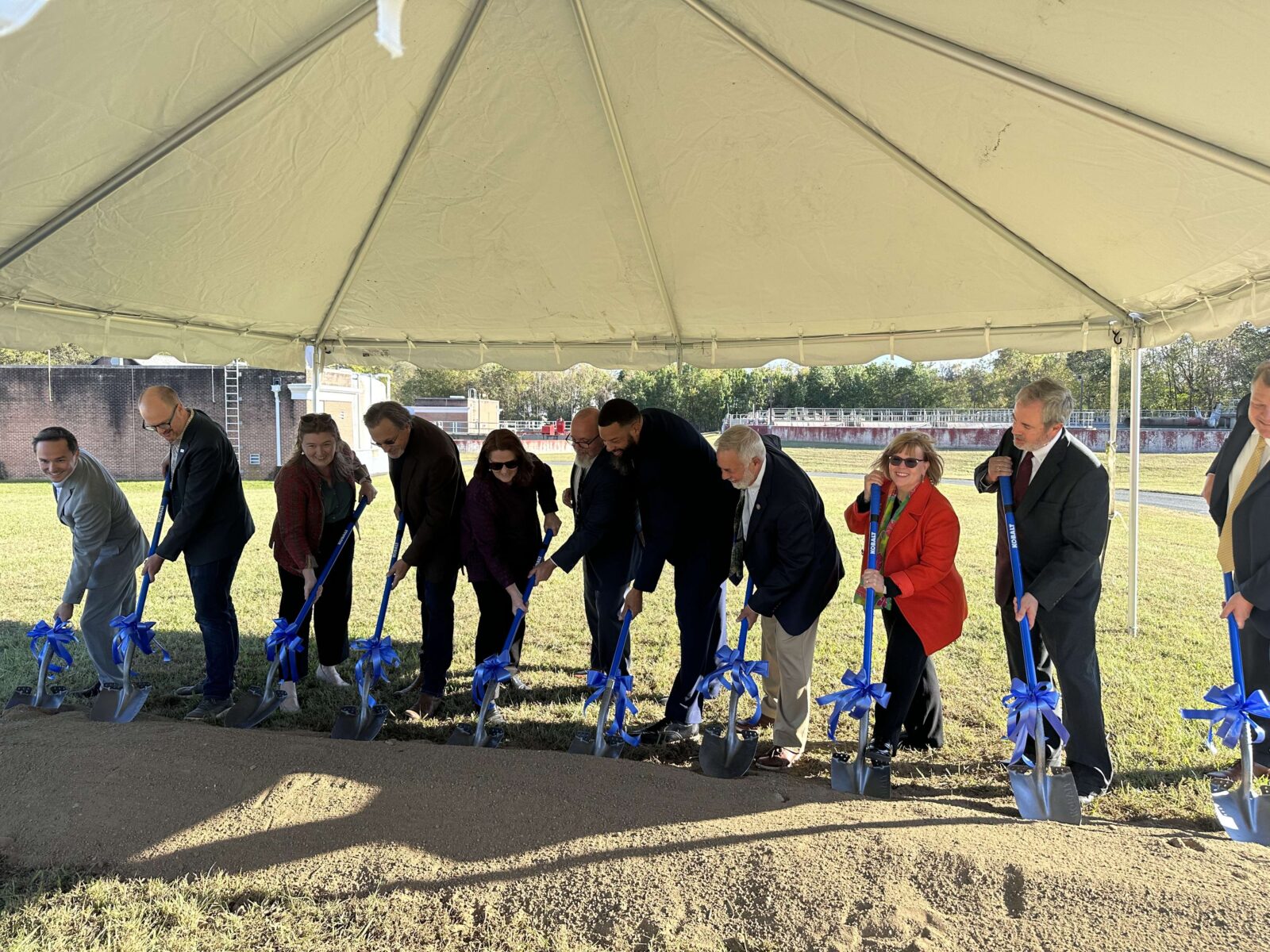
In October 2025, the city held a ceremonial groundbreaking for its largest public works project in history: a roughly $180 million upgrade and expansion of the wastewater treatment plant. That project will increase treatment capacity from 4.5 MGD to 6 MGD while adding advanced nutrient removal technology.
Officials have noted the expanded infrastructure is designed to accommodate planned growth, including data centers in the city’s Technology Overlay District, which can demand millions of gallons of water daily.
