

This update on both the public campaign and outreach into the community follows more than a year of discussion at the Board level. In February 2024, a team was developed to find strategies to reduce panhandling in the county; the team determined public safety and the need for social services were a top priority.
Panhandling, according to county staff, is “someone that is out on the corner and on the median, and they are asking for money.” County staff does not consider those selling items on the side of the road as panhandlers.
In October 2024, the Board deferred a proposal to pay panhandlers after it received significant pushback from the community and the supervisors. Instead, the county created a community engagement plan to address the growing concerns from the public that kicked off in November 2024.
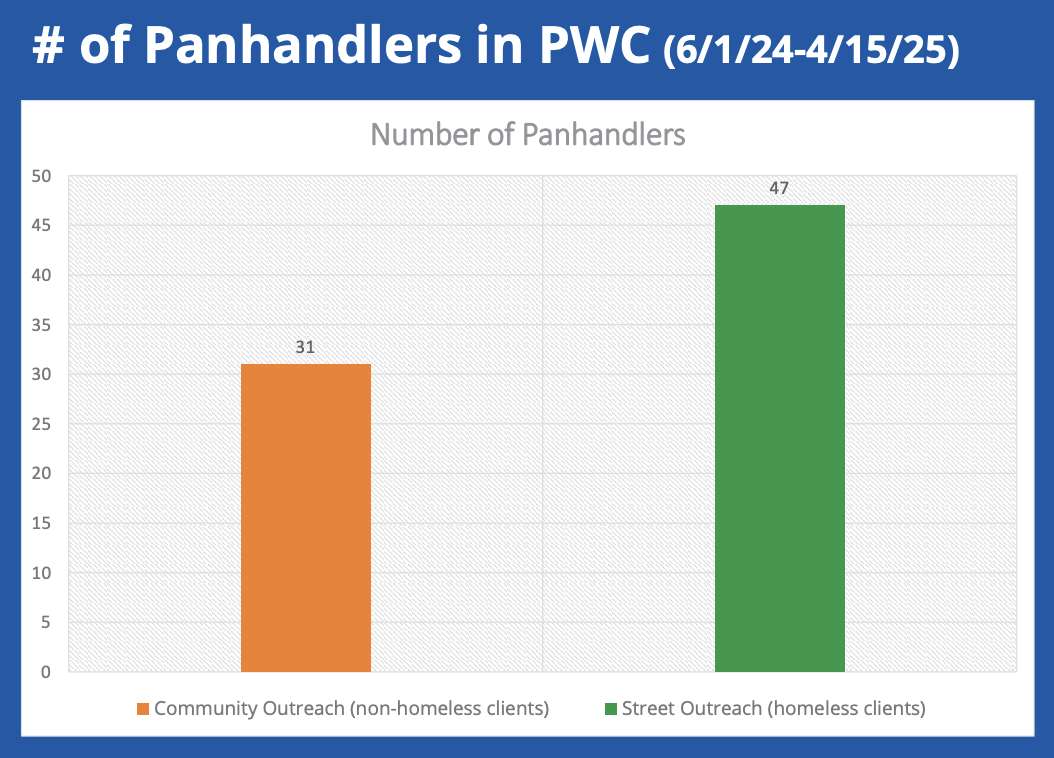
County staff had 78 individul panhandlers participate in the program, according to the data provided in the presentation. Some individuals discontinued the program by finding emergency or permanent housing. 47 of these individuals in the program were found via the street outreach — meaning they are homeless — branch of the campaign, while 31 were found via community outreach, meaning they are not homeless.
Of the 47 total individuals experiencing homelessness, 40% reported having a disability. 4% of the homeless population are veterans, and 8.5% reported being a domestic violence survivor.
A majority of the individuals, 56 or 72% were male, while 22 were female. Most of the individuals were between the ages of 35 and 64, totaling 49 or 63%. 46 individuals identified as white and 33 of them are homeless.
The Occoquan District reported the highest number of panhandlers at 20 total, while Gainesville came in at a close second with 17 people. The lowest number was found in the Coles District with three total and in the Brentsville District with four total people.
Phyllis Jennings-Holt, the Department of Social Services director, said the primary reasons for each individual panhandling were different.
“Among the non-homeless clients, the reasons [for panhandling] varied, most tied to economic instability and gaps in the safety net, such as unstable employment, employment in general, disability, medical needs, hotels and motel costs and housing insecurity,” Jennings-Holt said. “For the 38 folks that were in the street outreach or homeless, the primary reason was essentially not having somewhere to live and needing money to pay for a hotel or motel, lack of affordable housing, unemployment and having some type of financial hardship and housing challenges.”
Jennings-Holt said recruiting panhandlers into the program has proven to be quite difficult.
“The street outreach team, when they get a call and they go out and they engage with an individual, that individual not necessarily wants to do services the first time. Sometimes it takes four, five, six times for them to be ready to engage in services with the department,” she said. “There are some folks who will say they just want a hotel, or there are some folks who will just say, ‘I just want to get enough money to buy food, or I just want to get enough money to pay for my own hotel.'”
Coles District Supervisor Yesli Vega, who has been pushing for changes to how the county approaches panhandling, said it’s a safety and health risk for people to be in the medians of busy roads.
“I’ve stopped and I’ve spoken to two women. They’re just having a hard time and they need extra money. They’re selling mangoes, cucumbers. I mean, you name it,” Vega said. “We have to be proactive. We have to do better. We have to find a place to put these folks, which why this ordinance is extremely important.”
Nikki Brown, the communications and engagement director for the county, said the public campaign has been successful from website engagement, streaming services, movie ads, digital advertisements and social media.
According to the presentation, the Spanish campaign outperformed the English campaign in terms of video views. The Spanish video received more than 104,000 views, while the English video only received 94,000 views.
“The really big piece of this … is the total video completion rate is 89%, which is unheard of. Most folks … don’t have the attention span to watch a one-minute video, which I know is shocking, but it is true,” Brown said. “… That is really exciting for us, because it means that people are actually watching almost the whole video.”
Brown said the campaign will continue this summer in movie theaters, over social media, in newspapers and gas stations, and will continue to be highlighted in the community newsletter and various message boards.
