

Candland wants to abolish schools revenue-share agreementThe Republican on the Prince William County Board of Supervisors wants to abolish the revenue sharing agreement — a funding mechanism in place since 1986 between the taxing authority Prince William County Board of Supervisors and the county’s School Board. Under the agreement, the schools automatically receive just over 57% of the total county government budget.
Candland did not say what would replace the revenue-share agreement.
The revenue sharing agreement was put in place, in part, to stop politicians on both Boards from arguing over how much funding the school should receive annually. Candland’s call to abolish it comes after he called to increase it from the current 57.23% of the total county government budget going to fund local schools.
About half of the Prince William County school division $1.4 billion budget comes from the revenue share.
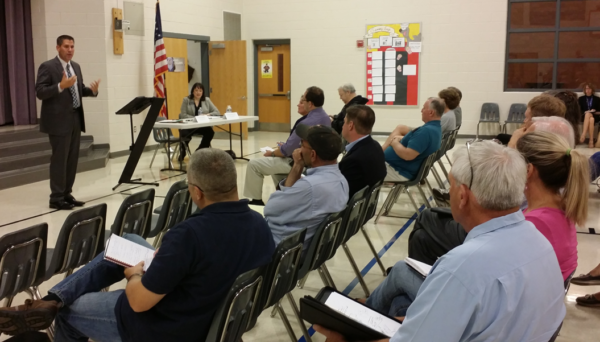
“Since we are the ones taking the tax money from you, the taxpayer, we said [the Board of Supervisors] should get involved [in the school funding process],” Candland told a group of about 20 people who came to his town hall meeting on education funding on Sept. 1 at Gravely Elementary School near Haymarket. “The reaction is always ‘we need more money for schools, so we thought we would increase the revenue-sharing agreement from 56.75% to 57.23%.”
But the increase hasn’t helped, said Candland, as Prince William County still boasts the largest number of students per classroom than any other local school system in the Washington, D.C. region, leading to unsolved overcrowding issues that require some students to eat lunches at 10:30 a.m. and some as late as 1:15 p.m.
He’s also criticized the School Board for opting to build an $11 million indoor swimming facility at Colgan High School, which opened Saturday.
“Some of the decisions that get made on the School Board are infuriating,” said Candland, adding the cash could have been better spent on lowering class sizes.
The school pool had so much community support when the School Board approved its construction in December 2013, however, his own Board of Supervisors would have approved the pool had the decision been up to its members, Candland admitted.
Alyson Satterwhite, the elected School Board member in Gainesville, also spoke at the town hall meeting. She called the revenue sharing agreement a “cop-out” for politicians who would rather give a set percentage of cash to the School Board rather than address school funding needs on an annual basis.
Both politicians said that if the revenue-sharing model is dumped for something else, safeguards are needed to ensure the School Board doesn’t receive less money from the Board of Supervisors that it does today.
The Board of Supervisors automatically transfers about 57% of its annual budget to the School Board, which may spend it however it wants. This year, the county sent more than $456 million to the school division, making up at least 46% of the school division’s $1.4 billion operating budget.
The county increased the amount of its funding by $21 million. Coupled with a state funding increase of about $17 million, the school’s overall operating budget this year saw about a $34 million increase.
The meeting was the first in planned series of town hall meeting Candland plans to hold to discuss education funding.
