

By CINDY BROOKSHIRE
For Potomac Local News
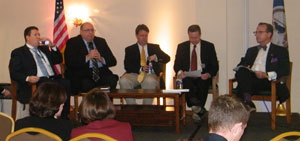
MANASSAS, Va. — Leaders from Prince William, Manassas, and Manassas Park wrangled with pressing issues like sequestration’s impact on the area, and how to fund transportation, at Wednesday “State of Prince William.”
Put on by the Prince William Chamber of Commerce, more than 200 local business leaders gathered at the Continental Event Center in Manassas for the annual luncheon.
On the panel: Corey Stewart, Chairman-at-Large, Prince William Board of County Supervisors; Andrew Harrover, Vice Mayor, City of Manassas; Frank Jones, Mayor, City of Manassas Park; and Milt Johns, Chairman-at-Large, Prince William County School Board. The panel answered questions posed by moderator Bernie Niemeier, President & Publisher of Virginia Business magazine.
The top challenges for all three jurisdictions? Funding for transportation and uncertainty over sequestration (mandatory cuts to federal programs).
While urging business leaders to keep “pressure on our delegation in Richmond to stay on focus” about transportation funding, Stewart praised the work of Virginia Senator Charles Colgan, D – Manassas, Prince William, and Virginia Secretary of Transportation Sean Connaughton for steering $300 million toward Prince William roads – but estimated one-half billion more is needed. He shared his vision for “complete renewal and renovations to the Route 1 Corridor,” and promoted the Tri-County Parkway that would make a “better connection to Dulles of prime importance” and replace the “19th century road system” that strings together Prince William with Loudoun, two of the wealthiest counties in the Commonwealth.
Chairman Johns praised STEM (Science, Technology, Engineering and Math), which is now offered in all county public schools, as well as the nationally recognized robotics program, as training the workforce “for their tomorrow.” But he acknowledged to Chamber members that “we can’t build schools fast enough” to meet the uncapped growth in student population. “We are cautiously exploring online virtual options that would allow us to educate more without the brick and mortar,” he said, with the caveat that “to save $50 million in the long run, you have to find $5 million to start.” Mayor Jones suggested that’s where Northern Virginia Community College and other higher education members of the Chamber could seize “a tremendous opportunity locally to help out in a non-traditional way.”
In response to a question about strategies to increase economic development, Vice Mayor Harrover showcased the city of Manassas’ Technology Zone and Downtown Arts & Tourism District designations as well as a comprehensive incentives package, all on the city’s newly redesigned and more accessible website. Jones also outlined Manassas Park’s incentives and suggested VRE offer reverse commutes to drive the workforce toward Prince William’s town centers, which already offer abundant office space in close proximity to their stations in Woodbridge, Manassas, Manassas Park and Broad Run.
On the question of economic development, Stewart’s response was, “Our major competitors are not our surrounding jurisdictions. A lot of money is leaving the U.S. We have the opportunity to bring billions of foreign investment, especially from East Asia to the U.S. and that’s what we should be focusing on.” Stewart represented the county on a trip to China in August 2012.
In response to a technology question, Stewart commended George Mason University’s biomedical research as a major economic driver; Jones touted Manassas Park’s new technology committee and Harrover shared that Manassas is investing $1 million in information technology upgrades. Stewart added that “the county is moving toward the cloud,” referring cloud computing, where service and resources are delivered via network.
Other questions and responses centered on taxes (BPOL, machines & tools tax), unfunded mandates and state shortfalls, the new baseball stadium (“which cost us nothing,” according to Stewart) and Mayor Jones’ plea for businesses to offer an aggressive intern program to harness the skills of young job seekers. Chamber CEO Rob Clapper closed out the two-hour event with a call to action for the business community: “Remember the challenge to get engaged and find something you can do to make Prince William the premier location to live, work, play and do business.”
The opportunity to hear elected officials from three jurisdictions attracted attendees such as Erwin Stierle, the new Community Executive for the American Red Cross’s Prince William Office; Irene Cromer, Supervisor, Community Relations for Prince William County Schools; Al Alborn, Principal and Founder of the Alborn Foundation; exhibitor Debbie Sanders, Guest Services Manager for Potomac Mills and Jeremy McPike (D), who recently announced he is running for state delegate, representing the 31st District, in November 2013.
