
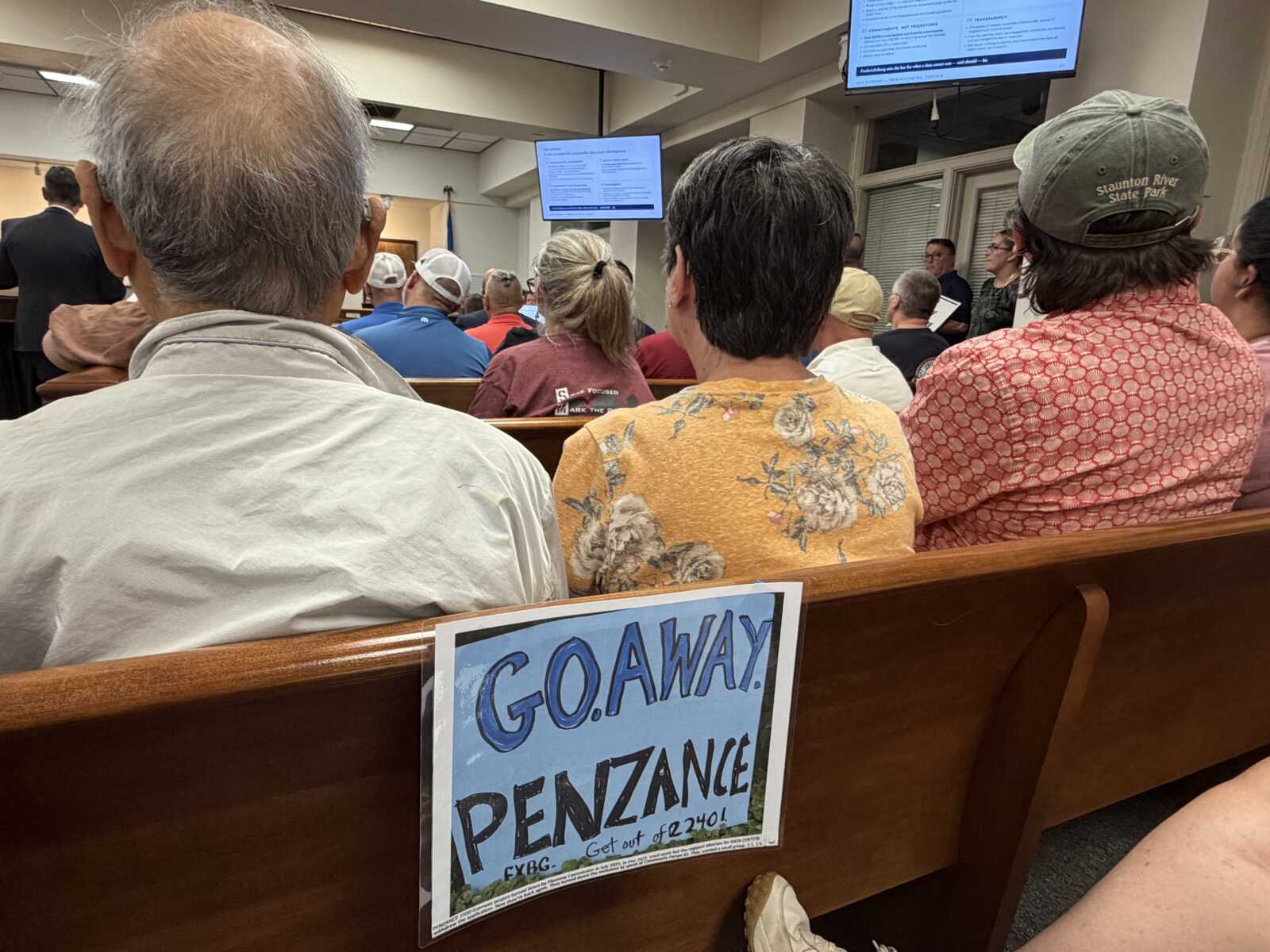
After a hearing that ran past midnight, members kept data centers inside the Technology Overlay District — and left a $23.4 million tax projection on the table.
City Council voted 7–0 early Wednesday to deny a rezoning that would have put two data center buildings on the Hylton tract along Interstate 95, then voted 7–0 again to deny a special use permit that would have raised those buildings from 50 feet to 75 feet.
The votes came after a public hearing that started Tuesday night, Aug. 25, in Council Chambers at 715 Princess Anne Street and ran past midnight. Council suspended its rules 6–1 to continue after 11 p.m. The meeting adjourned about 12:46 a.m.
The case was ZMA 24-10-005, covering parcels listed in city application files as 2401 Plank Road, 2303 Plank Road, 1109 Mahone Street, and 1500 Gateway Boulevard, just off Route 3.
1500 Gateway LLC, a Penzance affiliate also listed in city files as 1500 Gateway Venture, LLC, wanted about 1 million square feet across two buildings on roughly 83 to 84 acres between Plank Road/Route 3 and Cowan Boulevard. The Planning Commission had already recommended denial 7–0 twice — first in July 2025, then again in December — and found the proposed substation not in substantial accord with the Comprehensive Plan.
Council members praised a scaled-back plan and a large proffer package. They then said the site sits outside the Technology Overlay District the city mapped in 2025 for the north end of Small Area 1, generally known as Celebrate Virginia South. Denying the rezoning and the height permit ended the package. Council did not take a separate yes-or-no vote on reconsidering the Planning Commission’s Virginia Code § 15.2-2232 substation finding.
What Changed Since December
Zoning Administrator Kelly Machen told Council the current plan is not the four-building campus that failed at the Planning Commission last winter.
Staff and the applicant described these revisions:
- Four buildings totaling about 2 million square feet were consolidated into two totaling about 1 million square feet, shifted toward Interstate 95.
- The height request dropped from 90 feet to 75 feet. I-2 zoning allows 50 feet by right.
- Potable and reuse cooling came out. The applicant said the campus would be air-cooled only, with water limited to domestic use and fire suppression at 2,700 gallons a day.
- Open space rose to about 44 percent of the site. Land bays A, B, and H were offered to the city.
- Generator yards moved to the Interstate 95 side of the buildings.
- Cash proffers rose from just over $1 million in December to just over $40 million in staff’s tally.
Faison Qureshi, speaking for 1500 Gateway LLC, called the project the first Virginia data center to use zero water for cooling and the first built entirely under a project labor agreement — claims the company. He also cited a hyperscaler letter of intent and said Dominion Energy upgrades nearby were already underway.
Land-use counsel Charlie Payne said the 650-foot setback to the nearest Great Oaks home “far exceeds” the overlay’s 200-foot residential separation. “I’ve never seen proffers of this nature in any data center industrial project, period,” he said after public comment.
Why the Vote Was Unanimous
No member spoke in favor of approval before the motions.
Mackintosh said he felt bound by the 2024–25 Technology Overlay District process. About 3.8 percent of the city is in the overlay, he said, compared with closer to 1.75 percent currently zoned for data centers in some neighboring jurisdictions. He said he wants data-center revenue and other uses on the city’s 10 square miles.
Councilor Crump and Councilor Holmes said the overlay created public trust that was still recent. Both said Penzance had adapted more than a typical applicant.
Councilor Rowe said he was not on Council when the overlay passed. As a constituent, he said, he heard a promise that centers go in the overlay, “though the TOD doesn’t necessarily say that.” He named the corridor neighborhoods along Cowan Boulevard that would see power lines: the Preserves, Hills of Snowden, Madonna House, Evergreens, Belmont, Commons, and Monticello.
“The people of Fredericksburg have made their voice heard,” Rowe said.
Councilor Finn said the cooling and generator changes were serious. She then said every Cowan-area transmission route remains “highly problematic,” whether it runs by Hugh Mercer Elementary School at 2100 Cowan Boulevard, the Smith Run trail, or senior apartments. That made the project “nonviable,” she said. Finn moved both denials.
Vice Mayor Frye said that support for the project was lacking. He asked colleagues to take the project labor agreement lesson to other city jobs, including a middle-school project where he said the city had missed the chance.
Mayor Devine cited a seven-month overlay process. She said the city should pursue the mapped campus near Celebrate Virginia South and the FredNats ballpark — the path Council approved in 2025 along Gordon W. Shelton Boulevard and Carl D. Silver Parkway. Development pressure on the Hylton tract, she said, is “still on the table.”
Inside the Hearing
Speakers had five minutes. Applause was ruled out of order. After the signed list, the clerk and deputy clerk read 49 letters into the record. Comment volume had climbed from 6 speakers at the July 2025 Planning Commission hearing to 51 in December, then this Council night plus the letters — arguments that also surfaced at a July community forum.
Katie Finlayson of 1105 Great Oaks Lane quoted a 2024 JLARC line that industrial-scale data centers are “largely incompatible with residential uses,” and criticized mailers and pre-filled support cards.
Ted Barnes of 1017 Hickory Court said he is 74 and has atrial fibrillation. He described a 626-page packet and asked each member a question: “If this center was planned for in developing your ward… would you want it there?”
David Boudet said his house sits about 200 yards from the site. He asked whether any member would buy it at today’s value and live there.
James Powell of 1004 Great Oaks Lane, a professional engineer, said low-frequency sound travels, bends, and penetrates buildings, and that dBA weighting discounts those frequencies. An applicant noise study submitted with the case predicted 75 dBA at property-line point B3 during generator testing, near the substation. That figure is not the applicant’s separate “42 dBA” marketing line.
Michael Huff, a Virginia Master Naturalist who lived above Smith Run Trail, said the pine stand now buffers Interstate 95 from the hardwood trail and that a routing proffer “cannot bind the body that decides” transmission lines at the State Corporation Commission.
A letter from Chris Del Monte of Good Wash Express at 2305 Plank Road said the plan closes direct Route 3 access that supports a 1,000-car-a-day business with 4,600 monthly members. Multi-year construction, he wrote, would be “likely to be fatal,” and the packet offered no mitigation. A joint Great Oaks letter carried a similar no.
Support clustered around schools, trades, and cash.
Andy Wolfenbarger of 1324 Walker Drive, a school board member speaking as a resident, cited a trail gap the project would fill, a Gateway Boulevard bypass of Route 3 and Interstate 95, and what he described as $7.3 million a year for schools — about 19 percent, or $1,762 per pupil. City schools, he said, sit in the “bottom 10–15 percent statewide.”
Virginia Diamond of the Northern Virginia AFL-CIO called the project labor agreement historic and said apprenticeships lead to journey careers.
David Pella of IBEW Local 26 read a letter from Charles Breeden of 119 Great Oaks Lane, described as the closest homeowner: “yes in my backyard.”
Lupe Trejo, a Steamfitters Local 602 member and city resident, contrasted a Northern Virginia commute with local work and said a zero-tuition apprenticeship changed her family’s trajectory.
Roberto Gomez, who works in workforce development with low-income youth, told Council: “Talent is everywhere. Opportunity is not.”
Regional trades officials Don Slayman, Jason Friedman, and Lou Spencer described construction careers and said the revised plan had heard the room.
Two comments cut across that split. Hannah Fallon of 1813 Ginther Lane put the local IBEW membership at 32 people, about 1.1 percent of the advertised construction workforce. A letter from Ron Smith said none of 12 union speakers at a May 12 meeting lived in the 22401 ZIP code. Both statements went into the record.
The Money That Died With the Vote
Every figure below is from staff or the applicant. Council did not adopt a city forecast.
| Item | Figure | Source |
|---|---|---|
| Tax before project | $2.9 million | Staff / applicant |
| Peak annual tax | $26.5 million | Applicant |
| Stabilized annual tax | $23.4 million | Staff / applicant |
| Share of FY 2027 operating budget | About 17% of $141.4 million | Applicant characterization |
| Schools cash proffer | $20 million over 20 years | Applicant |
| CIP cash proffer | $18 million at first certificate of occupancy | Applicant |
| Gateway Boulevard extension | $9 million; four lanes and about 3,700 feet of 10-foot path, built before first CO | Applicant |
| Off-site transportation | About $3.5 million | Applicant |
| Open-space land A, B, H | About $7 million | Applicant |
| Public EV chargers | $4.2 million | Applicant |
| Sewer / CTE / public safety / Comp Plan route study | $1 million / $500,000 / $455,000 / $50,000 | Applicant |
| Staff cash-proffer total | Just over $40 million | Staff |
| Applicant “day one” total | About $63 million in cash plus infrastructure | Applicant |
| December 2025 cash package | Just over $1 million | Staff |
| Operational jobs | 108 | Staff / applicant |
| Construction jobs | 720–1,400 | Staff / applicant |
A letter from James Monroe High School senior Ivan Bailey said data-center hardware and software can be exempt from retail tax through 2035. Ron Smith warned Virginia may cut school aid through the local composite index if data-center wealth makes the city look richer. He cited a Prince William projection of $40 million a year.
Payne said he had never seen proffers of this nature on a data center industrial project. Council still voted no.
The applicant projected $23.4 million in stabilized taxes per year. Council chose the mapped Technology Overlay District over this site.
What Happens Now
The land stays Planned Development–Medical Center. Mayor Devine said something else will be proposed. Growth on the tract, she said, does not disappear with the denial.
The overlay path of eight to 12 buildings near Celebrate Virginia South remains the city’s mapped data-center location and is still discussed as power-constrained.
Finn’s transmission objection is now a State Corporation Commission problem with no city corridor amendment attached. The $50,000 Comprehensive Plan routing offer died with the applications.
Vice Mayor Frye, Councilor Holmes, and Mayor Devine said the project labor agreement idea should follow other city construction.
Penzance did not state a next move after the vote.