

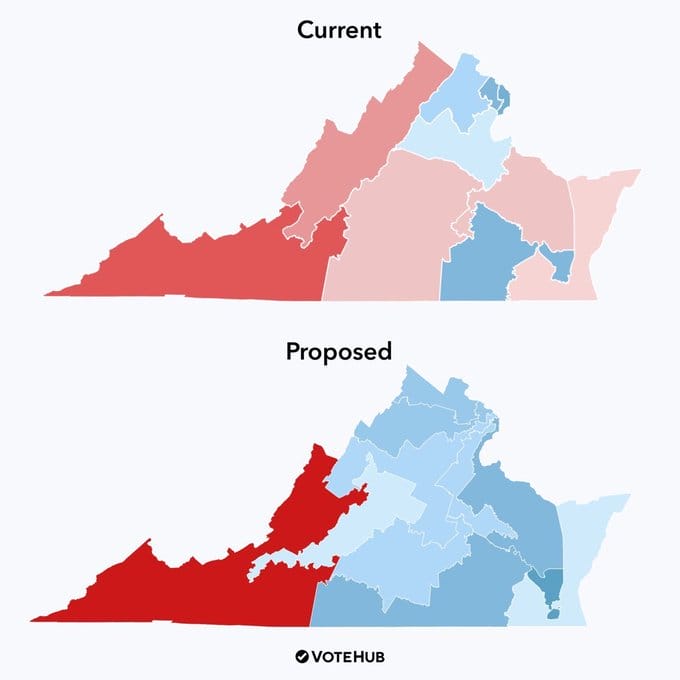
Polls opened across Virginia at 6 a.m. Tuesday for a special statewide election on a proposed constitutional amendment that would allow the Democratic-controlled General Assembly to temporarily redraw the state’s congressional districts ahead of the 2026 midterms. The measure, framed by supporters as a way to “restore fairness,” has ignited fierce debate over gerrymandering, voter representation, and the influence of out-of-state money in a battle that could reshape Virginia’s 11-member congressional delegation.
According to the Virginia Department of Elections, polls remain open until 7 p.m. Tuesday, April 21, with anyone in line at closing allowed to vote. Early in-person voting ran from March 6 through April 18, and absentee ballots requested by mail had a deadline of April 10. Results are expected later Tuesday night. The only item on the ballot is the constitutional amendment.
The exact ballot question voters will see reads:
“Should the Constitution of Virginia be amended to allow the General Assembly to temporarily adopt new congressional districts to restore fairness in the upcoming elections, while ensuring Virginia’s standard redistricting process resumes for all future redistricting after the 2030 census?”
A “yes” vote would greenlight the General Assembly to implement a new map drawn by Democratic lawmakers for the 2026 elections only. A “no” vote would keep the current map, drawn by the independent Virginia Redistricting Commission after the 2020 census.
The high-stakes politics behind the referendum
If approved, the amendment would clear the way for a Democratic-proposed map widely described as a 10-Democrat-to-1-Republican gerrymander. The current delegation stands at six Democrats and five Republicans. Analysts say the new map would likely unseat four sitting Republican congressmen, leaving only one safe GOP seat anchored in Southwest Virginia.
Virginia remains a competitive, purple state that generally splits its vote roughly 45 to 50 percent Republican in statewide races. Critics, including many voters, argue the move amounts to a massive disenfranchisement of millions of Republican-leaning Virginians by packing conservative voters into a single district while cracking Democratic strongholds to create safe blue seats elsewhere.
The proposed map would also shift political power dramatically northward. It would take a congressional seat historically tied to Hampton Roads and effectively hand greater influence to Northern Virginia Democrats. Under the new lines, five of the 11 congressional districts would be anchored in or heavily influenced by Northern Virginia, giving that populous, Democratic-leaning region a dominant hand over the statewide political map.
Big money fuels the fight
The campaign has seen an unprecedented flood of outside cash. Democratic-aligned groups, led by Virginians for Fair Elections, have raised and spent well over $40 million — with some tallies reaching $49 million to $64 million — much of it from national Democratic organizations. Key donors include House Majority Forward, the advocacy arm tied to House Minority Leader Hakeem Jeffries (D-N.Y.), which poured in approximately $20 million to $29 million. Additional funds came from The Fairness Project, the Fund for Policy Reform (linked to George Soros), and other out-of-state sources, primarily from California, New York, and Washington, D.C.
Republicans and conservative organizations have been massively outspent. The main opposition group, Virginians for Fair Maps, raised roughly $9 million, much of it dark money, with additional support from groups backed by Peter Thiel. Despite the cash disadvantage, GOP leaders have mounted an aggressive grassroots push to defeat the measure.
Voices from both sides
Democratic Gov. Abigail Spanberger, who authorized the referendum to move forward, has championed the “yes” vote as a necessary counter to Republican map-drawing efforts in other states. Sen. Louise Lucas (D-Portsmouth), a key architect of the plan, pushed aggressively for the 10-1 map, reportedly declaring “We said 10-1 and we meant it” in private discussions that later became public.
On the Republican side, former Gov. Glenn Youngkin and former Attorney General Jason Miyares have led the charge for a “no” vote, crisscrossing the state with rallies and warnings. Youngkin has called the effort a “shameless, reprehensible political power grab” and urged Virginians to “stand up and say no” to gerrymandering. Miyares has echoed that the map would “silence” voices from rural Virginia and Hampton Roads, saying, “Don’t lose your voice.”
