
Substation ruled inconsistent with city plan; residents blast water, trees, and transmission line impacts
The Fredericksburg Planning Commission has unanimously rejected a proposal to rezone more than 80 acres near Route 3 and Cowan Boulevard for a massive data center campus, after months of controversy over water use, tree loss, and high-voltage transmission lines near neighborhoods.
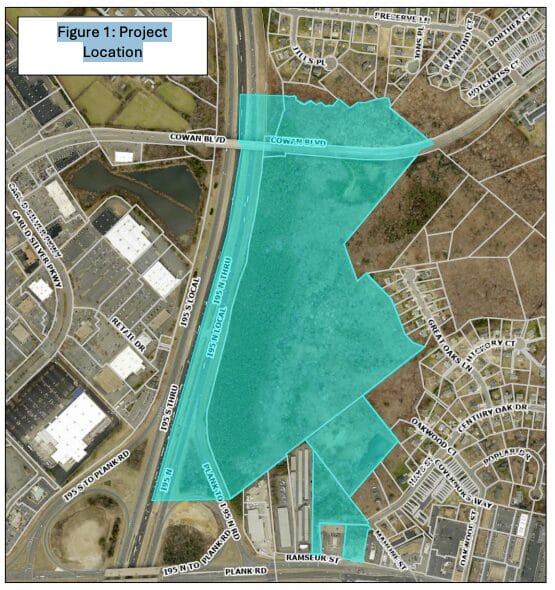
On Wednesday, December 10, 2025, the Commission voted 7–0 to recommend denial of both a Zoning Map Amendment and Special Use Permit for the 1500 Gateway Data Center project. In a separate 7–0 vote, commissioners also found that the project’s proposed electrical substation is not “substantially in accord” with the city’s Comprehensive Plan — a required determination under Virginia Code § 15.2-2232.
If built, the project would replace a planned medical campus with up to 2.1 million square feet of data center buildings, a new Dominion substation, and associated transmission lines. The city council will have the final say on the project.
What is Being Considered
According to the planning staff memo, the application from 1500 Gateway Venture, LLC sought:
- A conditional rezoning of 83.6 acres from Planned Development–Medical Center (PD-MC) to General Industrial (I-2)
- A Special Use Permit to:
- Increase the height limit for three of four data center buildings from 50 feet to 90 feet
- Allow a water-cooled system using reused wastewater, with potable water allowed as “temporary bridging” until the reuse system is built
The project area spans four parcels between Plank Road and Cowan Boulevard, including 1500 Gateway Blvd and two corners at Route 3 (Plank Road) and Mahone Street.
Under the plan:
- Up to 2,100,000 gross square feet of data center space would be developed
- A new substation would be constructed on-site to serve the data center campus
- The applicant would build and dedicate a four-lane extension of Gateway Boulevard from Route 3 to Cowan Boulevard, with:
- A traffic signal at Gateway/Cowan
- A shared-use trail and sidewalks
The site sits in Small Area Plan 3 (Plank Road/Route 3) and includes three Comprehensive Plan transects:
- T-1 Preserved Open Space
- T-4 General Urban
- T-5W Area-Core Workplace
Staff noted that while the T-5W portion can support employment-intensive uses, the T-4 area was envisioned to provide needed housing, not industrial data centers.
How Did We Get Here?
The Commission has now considered this project twice in five months.
July 9, 2025 – First public hearing and denial recommendation
On July 9, 2025, the Planning Commission held its first public hearing on the original ZMA/SUP request for the 1500 Gateway project.
According to the memo, commissioners and the public raised concerns about:
- Noise from generators and cooling systems
- Air pollution and energy demand
- Potable water usage and strain on the city’s limited supply
- Impacts on historic resources and tree canopy
- Transmission line routing and potential effects on Smith Run, wetlands, and nearby neighborhoods
- Building height and visual impacts
- Future decommissioning of the site if the data center use ended
- Cumulative impact of devoting more city land to data centers
The Commission voted 7–0 to recommend denial of the rezoning and SUP and found that the substation was not in conformance with the Comprehensive Plan.
July–August 2025 – Applicant appeals, then withdraws
On July 18, 2025, the applicant filed an appeal with the city council seeking to overturn the commission’s finding regarding the substation.
Under state law, the council would have been required to act on the appeal within 60 days. On August 1, the applicant requested a delay of the appeal until December to allow time to revise the project.
On August 26, 2025, the city council declined to delay the decision. Council members indicated that, once the application was amended, it should be returned to the Planning Commission for a new public hearing and recommendation.
The next day, August 27, the applicant withdrew the appeal and resubmitted a revised application for Planning Commission review.
November–December 2025 – Revised application
The revised submission, filed November 10, 2025, included several changes highlighted by staff:
- Potable water limited (on paper) to:
- Temporary “bridging” for a future reuse cooling system
- Domestic use
- Fire suppression
- A new proffer (later flagged by the city attorney) that the substation would not connect to any transmission line routed through or along a city-owned park or school within one mile
- An offer to convey Land Bays A, B, and/or H to the city upon request — including areas with sensitive environmental features near Smith Run
- A $200,000 contribution to the city schools’ Career and Technical Education (CTE) program
- Revised building design standards to align with the city’s data center design rules (differentiated facades, screening of equipment)
- Generator yards flipped to face I-95 instead of Gateway Boulevard
- The height of the Gateway-facing building, DC, was reduced from 90 feet to 50 feet
- Construction of four lanes of Gateway Boulevard (instead of two) was required before the first data center could get a certificate of occupancy
- A new noise study assuming an air-cooled system
Despite those changes, staff described the project as still having “significant unresolved issues,” particularly regarding water, transmission lines, and compatibility with the city’s long-term land-use vision.
What Staff Flagged: Big Economic Upside vs. Big Unknowns
Staff’s Application Summary Factors laid out the trade-offs.
Potential benefits, according to staff and the applicant
- Estimated annual tax revenue over $50 million at full build-out
- Hundreds of construction jobs and some new permanent jobs
- Minimal impacts on schools compared to a large residential project
- Construction and dedication of Gateway Boulevard’s four-lane extension between Route 3 and Cowan
- A voluntary $200,000 CTE contribution and proffers aligned with the city’s Capital Impact Study
- An offer to convey Land Bays A, B, and H as open space, including environmentally sensitive land near Smith Run
Major unresolved or negative factors
- Water for cooling
- Applicant requested a water-cooled system using reclaimed wastewater
- Proposed to use potable water for “temporary bridging”, but did not specify:
- How much water
- For how long
- Any reuse water service would require a Water Service Agreement approved by the city council after a public hearing
- Staff warned the city must be able to confirm capacity for non-potable cooling plus temporary potable bridging — and might have to force the project to switch to air-cooling if capacity is not available
- Substation and transmission lines
- The Comprehensive Plan does not contemplate a substation on this site (new substations are discussed only in the Technology Overlay District area)
- A substation is not required to develop the site under its current medical campus zoning
- Staff noted the applicant had been clear that the substation requires a new high-voltage transmission line, with potential impacts to:
- Smith Run
- Canopy trees and wetlands
- Floodplains
- Hugh Mercer Elementary School and the police station
- Adjacent neighborhoods
- The applicant offered a proffer to avoid park and school properties, but the city attorney advised it could not override the State Corporation Commission (SCC), which controls the siting of 230 kV lines
- Land use & Comprehensive Plan conflicts
- The site’s T-4 designation was intended to provide some of the housing inventory the city needs; the data center plan includes no housing
- The development’s secure-campus format conflicts with the Comprehensive Plan’s mixed-use, walkable community vision for T-4 and T-5W
- The project omits the long-planned I-95 crossing envisioned in the city’s transportation plan — a connection staff described as necessary to the area’s future street network.
- At 84 acres, the campus is smaller than the 150-acre minimum contemplated for data centers under the TOD and would expand data-center-zoned land from 3.8% to 5% of the city’s total land area.
- Design and screening
- Proffers meet, and in some cases mirror, the TOD’s design standards: differentiated building façades and screening of accessory equipment
- Substation and transmission facilities would be subject to buffering and fencing rules
- But staff noted the proffer’s tighter definition of “mechanical equipment” could exclude some items that the city’s broader “accessory equipment” standard would typically require to be screened
Residents Hammer Water, Trees, and Transmission Lines
Speaker after speaker urged commissioners to reject the project.
“Eighty-four acres of trees”
Libby Wassom, of Albert Reynolds Drive, said neighbors feel like they are being sacrificed.
“We are going to lose eighty-four acres of trees, and there’s no way to replace that in my lifetime… It’s going to change the character of our city,” Wassom said. “These buildings are huge, megalithic concrete structures… I don’t want it in my neighborhood.”
Friends of the Rappahannock: “Very close to housing communities”
Brent Hunsinger, of Fall Hill Avenue, speaking for Friends of the Rappahannock, focused on the transmission line corridor along Cowan Boulevard.
“The preferred route corridor of the new transmission lines would create a corridor adjacent to Cowan Boulevard along and very close to several housing communities,” Hunsinger said. “JLARC specifically recommends keeping all data center development, including transmission infrastructure, away from residential areas.”
He also criticized the lack of public water-use numbers for cooling.
“I don’t want constant humming in my backyard”
Erica Kasray, of Great Oaks Lane, whose backyard would face the project, said she and her family moved to Fredericksburg to escape Northern Virginia’s data-center sprawl.
“I’m urging you to reject this project because it will remove eighty-four acres of our forest,” Kasray said. “I don’t want constant humming noises generated in my backyard. I don’t want headaches. I don’t want the peace that my family moved to Fredericksburg away from Northern Virginia taken from us.”
“Best final use plan for this tract of land”
Marjorie Lucas, of 1014 Black Oak Court, asked commissioners to reconsider using a key gateway site for data centers.
“I really want you to contemplate seriously on the best final use plan for this tract of land,” she said. “I’m not for rezoning it.”
Commissioners: TOD Promises, Water Unknowns, and More Land for Data Centers
Several commissioners said the revised plan still conflicted with both the city’s long-range land-use map and the political promises made when the Technology Overlay District was created. Vice Chair Carey Whitehead said the application left too many key details unresolved.
“I remain concerned about the water impact and the unanswered questions there,” she said, pointing to the lack of quantified cooling demand. She also noted that approving the project would boost the share of city land devoted to data centers from 3.8% to 5%, while providing no housing in the portion of the site designated T-4 for general urban residential use.
Commissioner Mary-Margaret Marshall framed her opposition based on resident trust and prior policy direction.
“The technology overlay district was pretty clear why we were doing it,” she said. “It stayed in one place. It was on a campus. It was given to the residents for that reason. I can in no way, shape, or form support this.” Commissioner Jane McDonald focused on the biggest unknown: water. “We don’t know how much water we’re going to use. We don’t know if that’s going to affect us as residents,” she said. “I’m concerned about environmental impacts and the electricity questions.”
Commissioner Dugan Caswell said the staff’s list of pros and cons still came out lopsided. “For me, there’s just more in the detriment column than the benefit column,” he said. Commissioner Joseph Winterer added that too many critical pieces — especially traffic impacts and transmission line impacts — were still not finalized.
“There are a lot of issues we need additional information on,” he said, calling for more detailed transportation analysis.
Chair David Durham closed the discussion by thanking residents for their participation and noting the volume of public input before the commission took its two unanimous votes: first, finding the substation inconsistent with the Comprehensive Plan; then, recommending denial of the rezoning and special use permit.
What Happens Next
The Planning Commission’s recommendation now moves to the Fredericksburg City Council, which will make the final decision on:
- The rezoning from PD-MC to I-2
- The Special Use Permit for building height and water-cooled systems
- The §15.2-2232 finding on whether the substation is in accordance with the Comprehensive Plan
If the council were to approve the project, the city would still have to:
- Negotiate and adopt a Water Service Agreement for any reuse-water cooling system
- Potentially amend the Comprehensive Plan to show a preferred transmission corridor that could influence SCC routing
- Hold additional public hearings if any city-owned land is proposed for transmission easements