
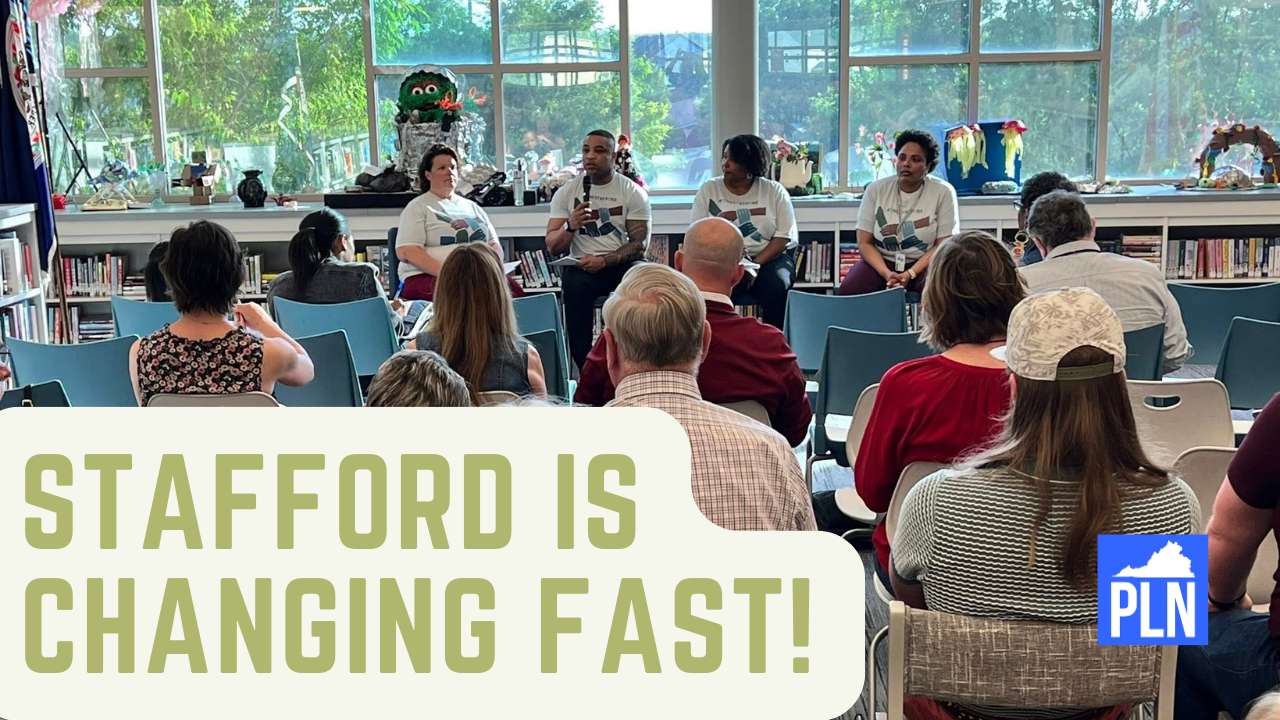
STAFFORD, Va. – Concerns over development, infrastructure, education, and environmental protection took center stage at a packed town hall meeting held Tuesday, April 29, at Colonial Forge High School. The meeting brought together Board of Supervisors Chair Deuntay Diggs, Supervisor Tinesha Allen, and School Board members Maureen Siegmund and Maya Guy, who answered questions from roughly 60 residents over two hours.
Development Pressure: Attain at Stafford Draws Scrutiny
One topic that sparked debate was the proposed Attain at Stafford, a mixed-use development that would bring 300 apartments and over 57,000 square feet of commercial space near Stafford Hospital. Though the Planning Commission approved the rezoning request earlier this month, the project still awaits a final vote by the Board of Supervisors.
Residents questioned whether the project would include affordable units for public servants like teachers, nurses, and law enforcement officers. Officials responded that while Attain is aimed at attracting high-end tenants, broader affordable housing efforts are complicated by density limits and a competitive state tax credit system.
Supervisor Allen said two recent affordable housing proposals failed because Stafford’s density preferences—driven by community pushback—made them financially unworkable. “If we’re not willing to allow density, we’re not ready for affordable housing,” she said.
Infrastructure Strain and Revenue Hopes
Residents also raised concerns about the burden new development places on utilities and roads. County leaders acknowledged that upgrades to the Aquia wastewater treatment plant and other infrastructure are costly, but said developers—particularly data centers—are contributing millions to help offset the impact.
While these contributions could ease pressure on future utility bills, road improvements are harder to mandate. Under VDOT regulations, transportation improvements must be directly tied to the immediate area of a project, limiting the county’s ability to require broader road fixes.
Strategic Planning and Growth Concerns
Multiple residents challenged the county’s strategic plan, calling it outdated and disconnected from reality. One speaker asked whether the vision of “a flourishing community” still holds when traffic, overdevelopment, and school crowding remain persistent problems.
Diggs called the strategic plan a “living document” and acknowledged that the county often finds itself reacting rather than planning, especially amid changing political pressures and budget limitations.
Mental Health and School Performance
Public education was another major focus, as parents expressed concern over bullying, academic progress tracking, and mental health resources in schools. One parent described how her autistic son has struggled since transferring into the county system and said she received little support from administrators.
School Board members emphasized that schools are using tools like MAP testing to better communicate progress but said mental health care remains under-resourced, both in the school system and across the region. Supervisor Allen, a nurse, added that the county faces a shortage of qualified mental health providers in both public and private sectors.
Preparing for Uncertain State and Federal Education Cuts
Both boards are bracing for potential cuts in federal education funding, but said they cannot build contingency plans until clearer guidance comes from Richmond or Washington. “We can’t plan for the unknown,” said Chair Siegmund, though officials noted close coordination between the new county administrator and superintendent is helping ensure preparedness.
Drew Middle School Location Raises Road Safety Questions
The planned replacement of Drew Middle School at Cliff Farm (Flipo Farm) raised concerns about road safety and community impact. Residents urged leaders to invest in road straightening and traffic control improvements before construction begins.
Supervisor Diggs said VDOT will determine if improvements are necessary and whether the county must foot the bill. School officials welcomed suggestions for collaboration and noted that future school campuses could share the 181-acre site, potentially supporting more than one school long-term.
Development Oversight and Environmental Protection
Several residents spoke passionately against proposed data center projects in rural South Stafford, particularly near the Sims property on Kings Highway. They cited concerns about noise, wildlife disruption, water consumption, and proximity to the endangered Rappahannock River.
Officials reiterated that no decisions have been made and emphasized that all rezoning applications must follow a public process. Any potential water use from the river is likely off the table. “I would never vote for pulling water from the Rappahannock,” said Allen, whose district includes the area in question.
Budget and Impact Fees
The Board of Supervisors is expected to adopt the FY2026 budget in late May. The budget will determine the final real estate and personal property tax rates, as well as whether to adjust the meals tax.
Supervisors also face decisions about transportation impact fees, which were increased last fall but may now be reconsidered due to legal concerns. Supervisor Diggs said the board wants to avoid lawsuits by ensuring fees are based on accurate, defendable data.