

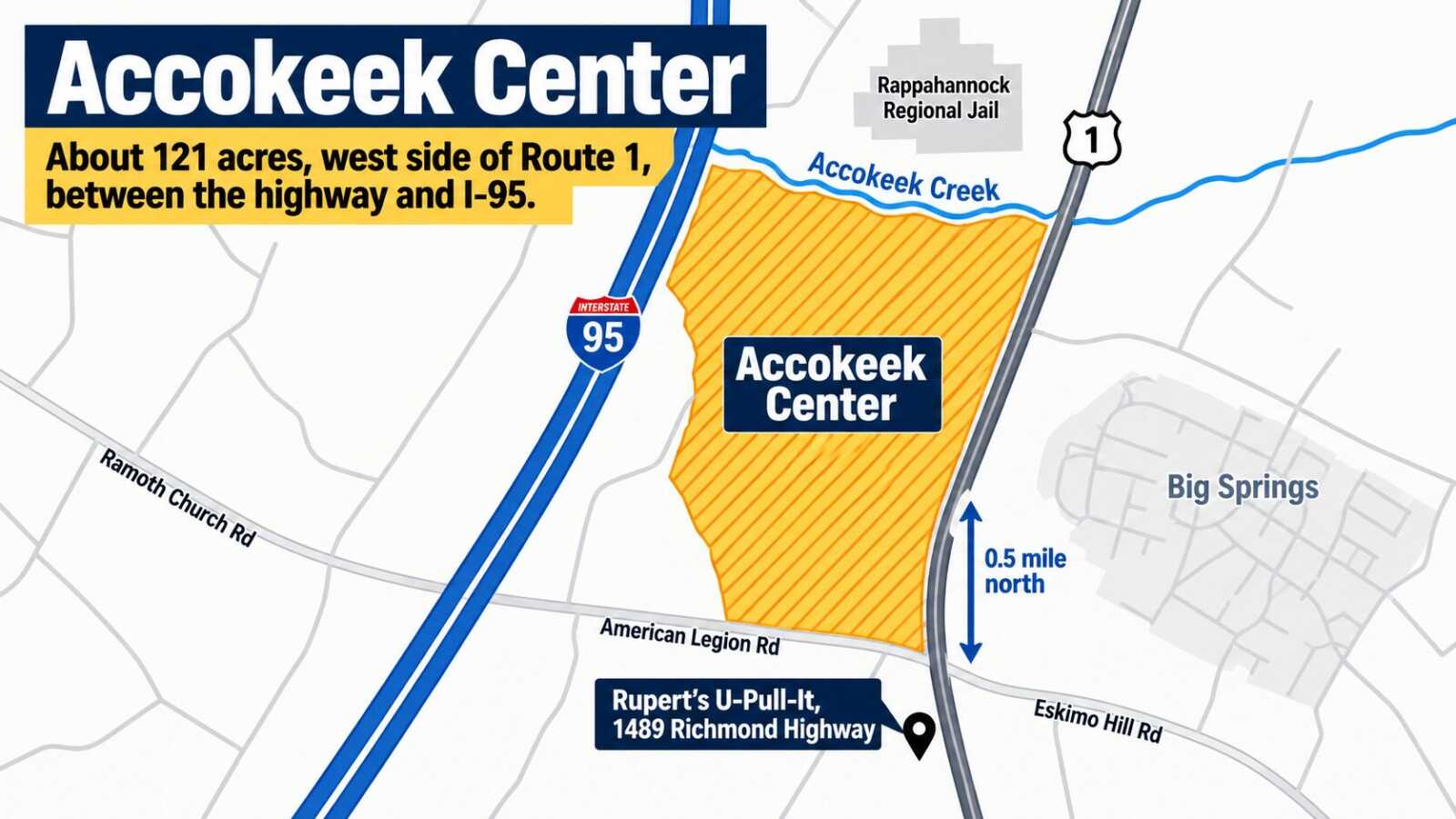
Stafford supervisors approved the Accokeek Center data campus in the Falmouth District late Wednesday, 4-3. The vote followed a failed attempt to delay it for revenue numbers, a fight over setbacks, and a proffer packet corrected the day of the meeting.
Where it is
The land is on the west side of Richmond Highway (Route 1), about half a mile north of Eskimo Hill Road and Rupert’s U-Pull-It, the self-service yard at 1489 Richmond Highway. It sits in the strip between the highway and Interstate 95.
Accokeek Creek and its floodplain run along the north end. Most of the 121 acres is vacant.
Two single-family houses and outbuildings already stand on the land. Houses sit across the highway.
Three votes
The board took three votes. Supervisor Crystal Vanuch (Rock Hill) moved to leave the meeting open and bring the project back Oct. 20 at 4 p.m. so staff could pull the revenue numbers and add in the incentives.
That substitute failed 5-2. Vanuch and Supervisor E. Darrell English voted yes. Chairman Deuntay Diggs, Dr. Pamela Yeung, Supervisor Kecia Evans, Vice Chair Maya Guy, and Supervisor Tinesha Allen voted no.
The rezoning then passed 4-3. Proposed Ordinance O26-16 changes the land from agricultural, rural residential, and office to M-2 heavy industrial, with the proffers revised that night.
Evans (Falmouth) made the motion. Allen (Griffis-Widewater) seconded. Yes: Diggs, Evans, Guy, and Allen. No: Vanuch, English, and Yeung.
A companion resolution, R26-128, the conditional use permit for an electrical substation, passed 4-3 on the same split. Evans moved it and Allen seconded. The chair called it the conditional use permit and number 26. The title was not read into the record.
What was approved
The county staff report for Wednesday’s hearing describes two data-center buildings, up to two stories, totaling 590,000 square feet, set on the western part of the land next to I-95, plus the substation. Two driveways would meet Richmond Highway.
The northern driveway would be the main entrance. The southern one would be for emergencies, large deliveries, and construction.
Setbacks
The applicant asked to go below the county’s 750-foot primary residential setback, allowing the data centers closer to homes. The applicant used a figure of no less than 550 feet to the south.
Speakers also cited a 399-foot setback. The applicant said the Planning Commission had been at 500 feet.
The staff report, written after the Aug. 26 commission hearing, lists a different measurement: a proffered primary-building setback of 1,350 feet from the western line of tax map parcel 38J-2-A, to the east, and an accessory setback of 700 feet from that same line. The report also proffers at least 45 acres of tree preservation, including tree save within 200 feet of the Route 1 right-of-way.
The applicant said the project started at three buildings and a 260-foot setback, then dropped a building. The county rule caps data-center noise at 55 dBA at the project line, about a normal conversation, measured 1.5 meters above the ground.
If the sound carries a prominent low hum, that cap drops to 52 dBA. Generators were described as Tier 4.
The staff report says a sound study put the level at no more than 48 dBA at the closest property line and 44 dBA at the closest house, below existing ambient noise.
Water
The applicant said the campus would use reuse water, not potable water and not groundwater, with closed-loop or air cooling held as a fallback if reuse water is unavailable. The staff report says the proffers bar potable water for industrial cooling in any case.
The applicant would not proffer a ban on eminent domain for the purple-pipe extension. The expected connection is across Route 1, and the water-service agreement is not drafted.
County Attorney Rysheda McClendon told the board eminent domain cannot be proffered or contracted away. It would still take a board public hearing.
Chris Edwards, on the utilities staff, said about 90 percent of the reuse system is spoken for, and about 10 percent remains, enough in his estimate for about five to seven more buildings. A speaker said the Planning Commission had been told 95 percent was spoken for.
What the public said
The hearing was moved up so the crowd would not sit through the comprehensive-plan item. It drew construction workers, nearby residents, and speakers from the technology industry.
Residents used the 399-foot setback figure and challenged the revenue claim. Speakers and Vanuch said the applicant’s $13 million to $15 million a year is gross and does not subtract the technology-zone business personal-property rebates or the Amazon performance-agreement refund.
The meeting did not produce a net number. Vanuch said that was why the vote should wait until Oct. 20.
The packet
The proffer packet arrived in dispute. Stormwater language was removed at staff request.
Paul Santay, director of development services, said the old proffer language could handcuff site-plan enforcement. The applicant volunteered an 80 percent phosphorus reduction, against a 75 percent code minimum.
Deputy County Administrator Donna Krauss said comments went to the applicant Sept. 23, the submission came back Sept. 28, and an incorrect version had been posted and was corrected the day of the meeting. Vanuch had earlier moved to pull the item so the public could read the packet.
Evans offered a substitute: a five- to 10-minute recess before the hearing so the board could read the proffers. Vanuch asked that the staff print copies for the public.
The substitute passed 5-2. The board then adopted the agenda 6-1.
What the proffers add
Late proffer edits accepted with the vote prioritize qualified local contractors and a private-well remedy for Shady Hill and Buttercup. The words “directly and causally” were removed, so the county makes the call.
Vanuch had asked that the well remedy cover nearby homes, or a 1,500-foot radius. The board left it at those two streets.
The comprehensive plan
Staff told the board the campus is not what the future land-use map calls for. That map puts the land in the Central Stafford Targeted Development Area as mixed-use, commercial, and residential.
Staff still recommended approval, saying the project fits other comprehensive-plan goals on where growth goes, jobs, and infrastructure. The applicant also called it consistent.
Several speakers and Vanuch said it is not. The board did not make that finding.
Subscribe to our FREE email newsletter to get local news you can trust.
