

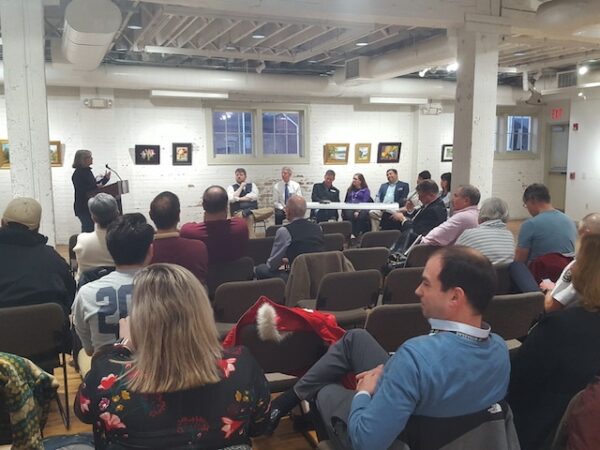
MANASSAS — Despite ample seating, there were plenty of empty chairs.
“This room should have been filled with people,” said Manassas Councilwoman Michelle Davis Younger.
Those residents who came to a town hall meeting had the opportunity to have their voices heard by members of the Manassas City Council and city staff on Monday night at the Center for the Arts at the Candy Factory.
Mayor Hall Parrish II said that the two biggest things that city council does are develop the city budget and hire the city manager. Parrish held up the thick 500-page budget document for the fiscal year 2019 which takes effect July 1, saying everyone was welcome to come up and read it after the meeting.
Parrish briefly ran through the details of the $244.5 million budget – such as a 3 percent funding increase for schools, a 2 percent debt service increase, and a proposed 2-cent tax increase that would raise the average homeowner’s property tax bill by $219, as well as a continuation of the city’s triple-A bond rating and competitive pay for the city’s employees.
The first questions were predominantly answered by city staff, the first of which focused on crime and safe neighborhoods. One woman asked if she’s safe in her neighborhood at night.
City police Chief Colonel Douglas Keen told her to call the 911 dispatcher and if the dispatcher doesn’t answer her questions, to ask for the duty supervisor. He said if the duty supervisor doesn’t answer her, to call him directly.
The conversation then turned to traffic and roadways. One man asked about the status of the city’s efforts to install new traffic control software that will be used to manage signal lights on city streets. Deputy City Manager Bryan Foster said this joint project with VDOT should be implemented in the next six months. The new software and timing optimization will provide a “marked improvement” in the city’s corridors, Foster said.
As the city continues to add more people and more development, like Micron’s anticipated 1,100 new jobs over the next 10 years, a woman asked if signs used around the city to advertise public hearings could have larger text to read easier. She also asked if Downtown Manassas could have fewer high rises and the buildings could be kept to a lower height, an apparent reference to the new Messenger Place building that will house 94 new apartment homes.
Matt Arcieri, Planning and Zoning Manager for the city, said city staff has “actually looked at increasing the sizes” of the public hearing signs.
Arcieri took the Downtown building size comment as a chance to “plug” a series of ongoing meetings about city’s comprehensive plan, which serves as a comprehensive roadmap for how the city is developed, where citizens are welcome to provide input. Phase 1 of the Comprehensive Plan Committee Planning is set to wrap up in June. The committee’s next meeting is Wednesday night, March 20, 2019, at the Manassas Museum.
Tom Osina, of Georgetown South, talked about an ongoing parking problem in the neighborhood of townhomes. He said a combination of the streets being too narrow and too many parked cars make it difficult to navigate the streets.
He also asked what the city is doing regarding the opioid crisis, and he also requested Spanish translators be present at city council and school board meetings.
Keen said that there “there’s not going to be a good fix” for the parking situation because it’s a public street. He said that if people want to improve the street parking they can talk to their homeowners association and try to assign a number to individual parking spots, but it’s “not an easy fix.”
As for opioid abuse, Keen said Prince William County Health Department has educational outreach campaigns directed at the opioid crisis. Keen said that, regionally, “health departments are all working together” to address the “global” aspect of the crisis. He also said that the Manassas police will address high school students about the opioid crisis.
City Manager William Patrick Pate added that the opioid crisis it’s “not a city problem – it’s a regional problem.” Pate said that the whole Washington, D.C. region is looking at how to best address the opioid crisis.
Councilman Ken Elston added that “there’s a large social conversation [about the opioid crisis] that has to happen, and it is happening.” Councilwoman Theresa Coates Ellis said that the opioid crisis isn’t just in Georgetown South or Wellington neighborhoods – it’s everywhere. She said that it’s important to educate students on how to avoid opioid abuse.
Some residents wanted to speak about the potential of multiple families living in single-family homes.
Businessman and former city council candidate Amalfi Arias spoke about a house for sale on Liberia Avenue that has three front doors and three locks. He said that “The only way that house makes sense is if you’re an investor looking for tenants.”
“These are egregious violations,” he added, urging the city to address these issues.“We’ve become a magnet for this type of housing.”
Arias asked how does the city school division plan and budget “when you have three families living in one house? You can’t.”
Patrick Geary asked about the future of the E. G. Smith Baseball Complex near Micron. Pate said the city intends the land to remain a park, but it could be used for development — although he doesn’t see it happening now.
Manassas Economic Development Director Patrick Small said if private individuals want to invest in the property, they are welcome to do so. Wolfe added that there is a million in the budget now for the parks that will be put before council in April.
