
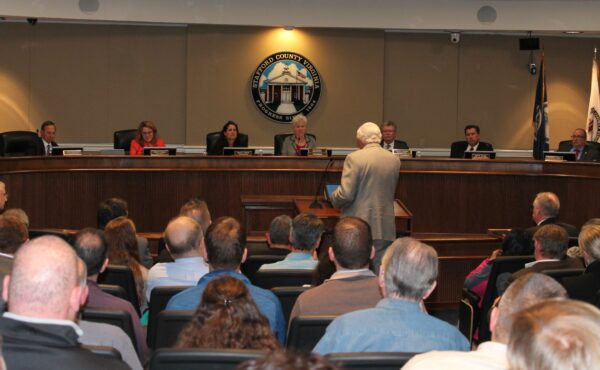
STAFFORD — The Board of Supervisors is prepared to fund a cost-of-living raise for Stafford County teachers — something they’ve wanted for a long time.
“Our schools are hemorrhaging people, from teachers to paraprofessionals, to bus drivers,” said George Washington District Supervisor Tom Coen, who works as a history teacher at Stafford High School.
The Board on Wednesday approved its $305 million budget for the fiscal year 2019 beginning July 1. It includes $4 million more for schools than last year’s budget. And it includes $5.7 million allocated for teacher raises, as the Board chose to categorically fund certain line items for the more than $121 million in local funds it allocates to the School Board.
The School Board can’t levy taxes and is dependent upon these local, state and federal funds for its $350 million operating budget. And some of that money — $5.7 million — is dependent upon the School Board giving teachers a raise when it begins to work out employee contracts in next month for the 2018-19 school year.
Supervisors said they provided funds to the School Board that were allocated for raises, but said teachers never got them. The funds, they said, were used pay for schools operations.
If the raises come, the Board will handover the holdout money to the school later this summer.
All of this comes after months of budget discussions between the Board of Supervisors and the School Board. Supervisors also hiked the tax rate this year to 99 cents per each $100 of assessed property value. That tax hike gives the county government $4 million more in the coming year, and residents will see their average property tax bill increase $221, generating an average tax bill of $2,983.
.
When it came to what to fund and what to cut, Supervisors weighed their priorities. While Stafford, one of the region’s fastest-growing counties, has some of the region’s most antiquated two-lane roads, leaders cut $183,000 from county’s transportation fund and instead placed into a capital projects fund.
“This totally ignores our transportation need,” said Garrisonville District Supervisor Mark Dudenhefer, who, along with Aquia District Supervisor Cindy Shelton voted against the budget Wednesday.
Dudenhefer, whose long campaigned on improving Stafford’s roads, said he initially supported the tax increase because he thought the county would have more money for road construction.
“I voted for the tax increase under false pretenses,” he said. “Had I known this, I wouldn’t have voted for it.”
Rock Hill District Supervisor Wendy Maurer lead the charge for increased funding to schools. She reminded her Board of a county-wide road study underway to determine which transportation projects are most important, and how much it’ll cost to get them going. Once the study results are in later this year, she suggested using year-end funds to pay for the needed improvements.
“Transportation is still funded… once these projects are racked, stacked, and justified, then we will pivot,” said Maurer.
The final step in this year’s budget process will come June 5, when the Board of Supervisors will vote on its 10-year capital improvement plan that will identify what infrastructure projects are most important, to include new school construction and its planned courthouse which currently ranks at the top of the list.