
The Stafford County Planning Commission recommended approval of the Accokeek Center data center campus in Falmouth after a packed hearing that began Aug. 26 and ran past midnight into Aug. 27.
On separate 4-3 votes, the commission recommended that the Board of Supervisors approve a rezoning with proffers, and a conditional use permit for the substation.
The site is 121 acres west of Richmond Highway (U.S. 1), about 2,500 feet north of Eskimo Hill Road, between the highway and Interstate 95 in the Falmouth District. The eight parcels — tax map Nos. 38-96, 38-74A, 38-45, 38-45H, 38-45I, 38-45L, 38-44A and 38-73 — would be rezoned from A-1 Agricultural, A-2 Rural Residential and B-3 Office to M-2 Heavy Industrial. The applicant is Falmouth Tech LLC, represented by Charlie Payne of Hirschler.
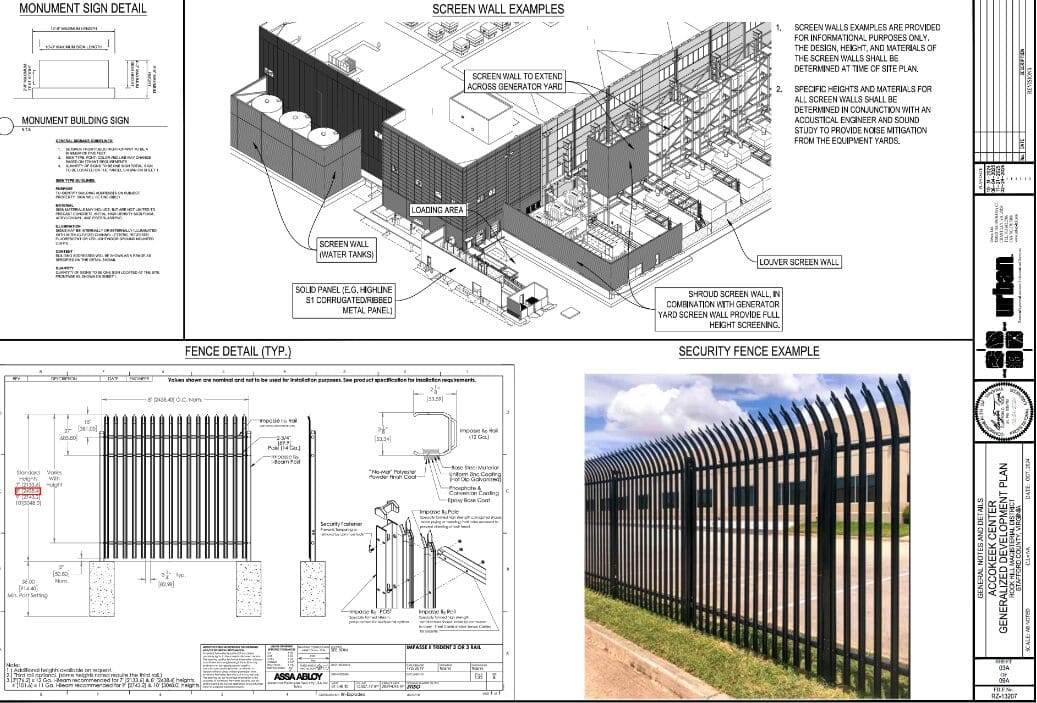
Staff planner Amy Taylor told the commission the August generalized development plan shows two data-center buildings totaling 590,000 square feet, two stories and no taller than 65 feet, plus a centrally located substation of no more than eight acres. The requested load is 122 megawatts. An April version of the same application proposed three buildings and about 690,000 square feet, with the substation closer to homes on the south side of the site.
The meeting room was full; an overflow area was in use; and 44 speaker cards were submitted for the Accokeek items. Chair Barnes took public comment before commission questions so residents’ points could shape the questioning. The session was described as the longest Planning Commission meeting since the 2021 Vulcan quarry hearing.Taylor recommended approval of all three applications. Staff listed the project as consistent with several comprehensive-plan data-center recommendations: location inside the Urban Services Area and the Central Stafford Targeted Development Area, proximity to an existing transmission corridor, generator yards oriented generally away from homes, tier-4 generators, a 443-trip daily cap, a 10-foot shared-use path and turn lanes on Route 1, a prohibition on potable or groundwater for industrial cooling, and a minimum 40 percent open space.
Staff also listed inconsistencies: the future land-use map designates the property mixed-use commercial and residential, not business and industry, and the plan advises avoiding large tracts of mature forest and high-biodiversity areas.
Other staff negatives included unknown transmission-line alignment, no load letter because Dominion Energy now batches high-load projects to the State Corporation Commission, possible utility crossings through tree-save areas, and limited detail on substation height and type.
The applicant requested reductions from the October 2025 data-center standards of 750 feet for primary buildings next to residential uses, 300 feet for accessory uses such as the substation and drives, and 200-foot residential buffers. Those reductions include a 550-foot primary setback along I-95 and several southern parcels, a 399-foot primary setback to one parcel proposed for a no-build covenant, a 60-foot I-95 buffer, and accessory setbacks as tight as 47 feet along the southern emergency entrance. The substation pad would sit about 369 feet from the southern property line.
Payne said the April-to-August redesign dropped a building, moved the substation to the center of the site, and increased buffers and tree save. He cited $6.4 million in cash proffers due before the first certificate of occupancy, modeled facility-only noise below existing I-95 and Route 1 ambient levels, reuse water or air cooling only, and a by-right alternative he said would generate far more traffic and school demand.
Most speakers opposed the project. Recurring points were the requested setback waivers, the missing transmission route across Accokeek Creek and the resource protection area, cooling and reuse system timing, and the mixed-use future land-use designation.
Fewer speakers and neighboring letters cited in the applicant’s presentation supported the project or its projected tax revenue. Staff estimated about 64 jobs and peak annual tax revenue of about $15.5 million in 2029, stabilizing near $13.5 million in 2035.
Vote comments were short. Supporters pointed to the redesign after the April hearing.
Opponents cited unmet 750-foot setbacks, unknown transmission routing, and inconsistency with mixed-use future land use. Falmouth Commissioner Marcus Oates, who made the three motions, said the changes responded to public and commission input.
Commissioner Carlos Bratton also supported the recommendations. Commissioner Caudel voted no, saying remaining compatibility, setback, and power-sequencing issues were unresolved. Chair Barnes voted no, citing comprehensive-plan inconsistency, the unknown lines, the setback standard, and unclear net fiscal impact after incentives.
The three recommendations now go to the Board of Supervisors.