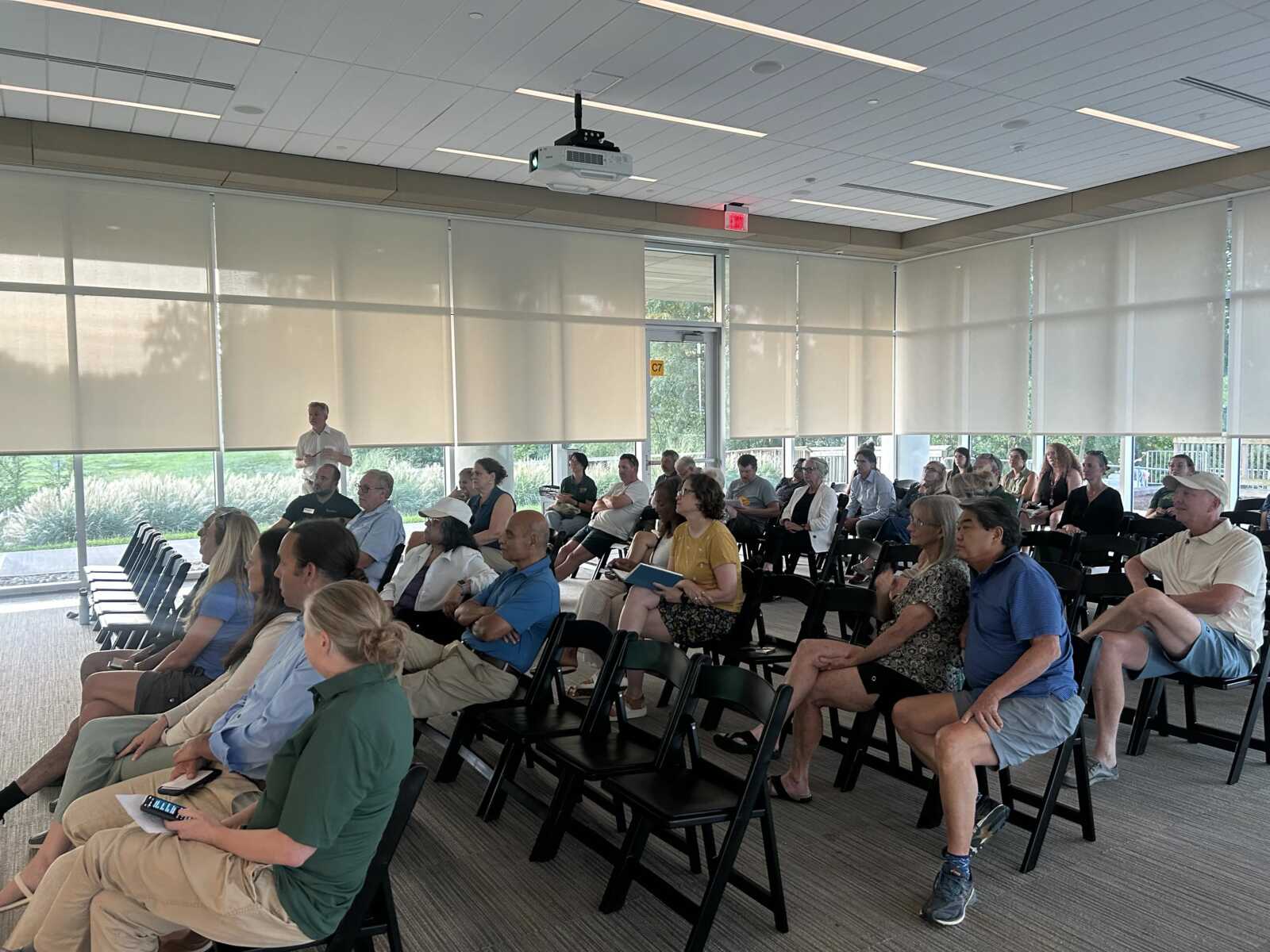
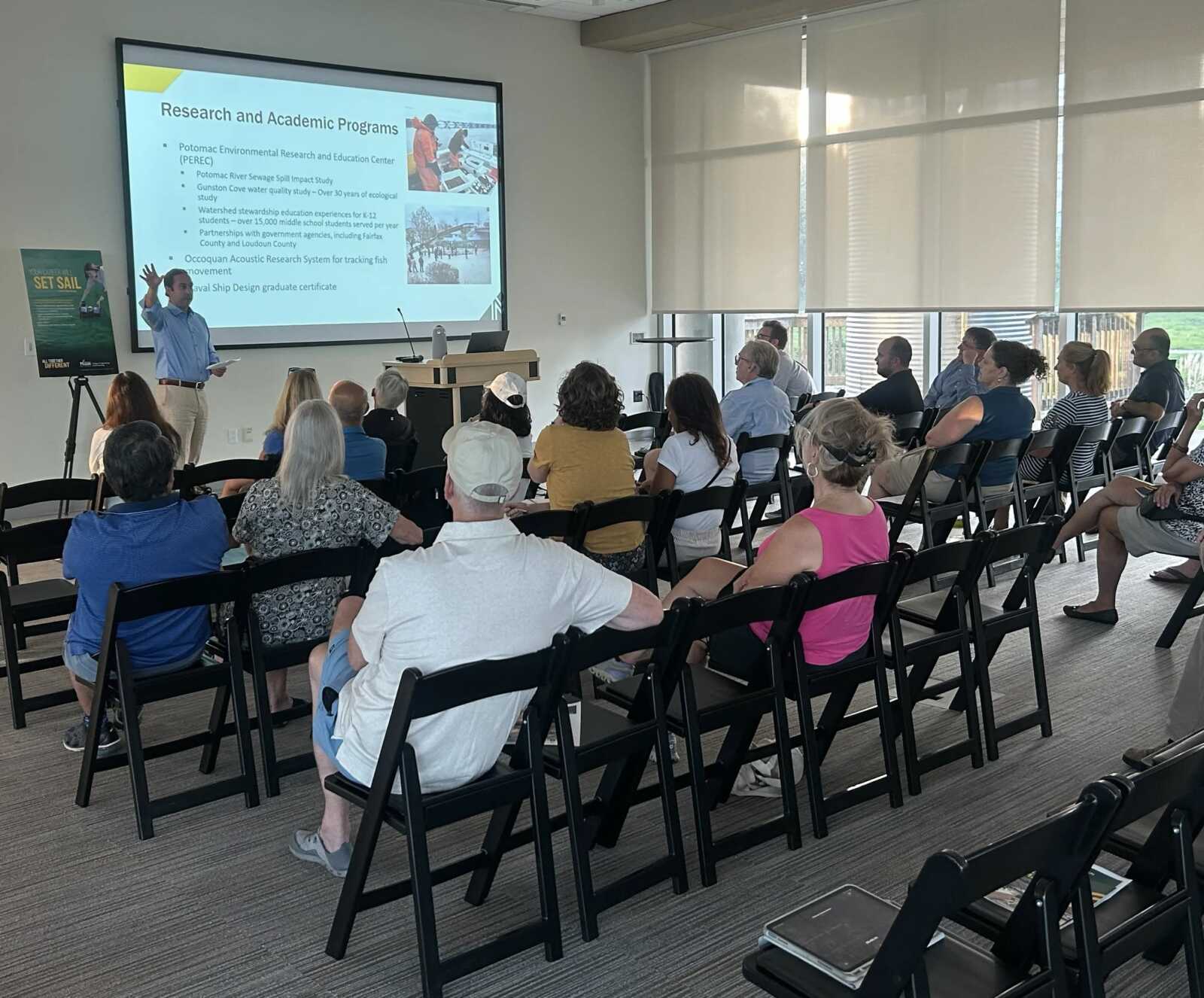
University officials said the pier will give scientists, students, and research vessels direct access to the Occoquan River after nearly a decade of limited water access. Neighbors and local paddling groups raised concerns about the structure’s length, kayak passage, barge safety, and visual impact during the two-hour town hall at the center, located at 650 Mason Ferry Ave in Woodbridge.
The facility opened in 2017 as a 50,000-square-foot research and education building, but its existing short platform reaches mudflat at low tide. Researchers currently must trailer boats to other docks, limiting class instruction, continuous monitoring, and rapid response work.
“We need access to the water,” said Mike Herman, senior project manager for facilities. The proposed design features a fixed pier extending from shore connected by a gangway to a floating dock, with electrical and water service planned. The structure is intended to stay outside the federal channel, ending approximately 50 to 70 feet from it.
T. Reid Nelson, assistant professor of environmental science and policy and a faculty fellow at the Potomac Environmental Research and Education Center, outlined ongoing fisheries research that would benefit, including studies of sewage spill impacts, invasive species interactions, striped bass mortality, and river herring migration. Leigh McCue, professor and chair of the Department of Mechanical Engineering, noted that senior design projects in maritime robotics and a naval ship design certificate program are currently constrained by the lack of deeper water access.
Amy E. Fowler, associate professor and associate director of PEREC, described the center’s long-standing focus on Potomac River restoration and environmental education.
Several residents questioned the scale. Priscilla Dando, president of the Belmont Bay Paddlers, said the planned length and spacing between piles could make it difficult or unsafe for kayakers to pass underneath. She noted that paddles commonly measure 6 to 8 feet and that the club advises members to stay out of the main channel.
KP Lau, a Belmont Bay resident and co-founder of the Belmont Bay Paddlers, called the pier “humongous” and expressed concern about its proximity to regular barge traffic, citing past incidents of barges going off course. He suggested a shorter structure combined with limited dredging.
Chris Hamilton of Potomac Riverkeeper asked about ice impacts on the floating dock. Staff responded that ice, wind, and wave loads are being treated as controlling design factors and that a concrete floating dock remains under consideration.
University representatives said the design is still conceptual. Geotechnical borings were completed the week before the meeting. Design completion is targeted for February 2027, with permitting aimed for early June so construction can avoid the spring fish spawning season. Most work is expected to occur from the water.
Officials said they will review kayak clearance with the new geotechnical data and continue sharing updates through a project website and attendee email list. Kevin Costello, Prince William County’s director of tourism, and Christina Winn, executive director of the county’s Department of Economic Development and Tourism, attended the meeting.
The pier will be named for the late Donald P. Kelso, George Mason’s first marine and freshwater ecologist, who joined the faculty in 1970.