

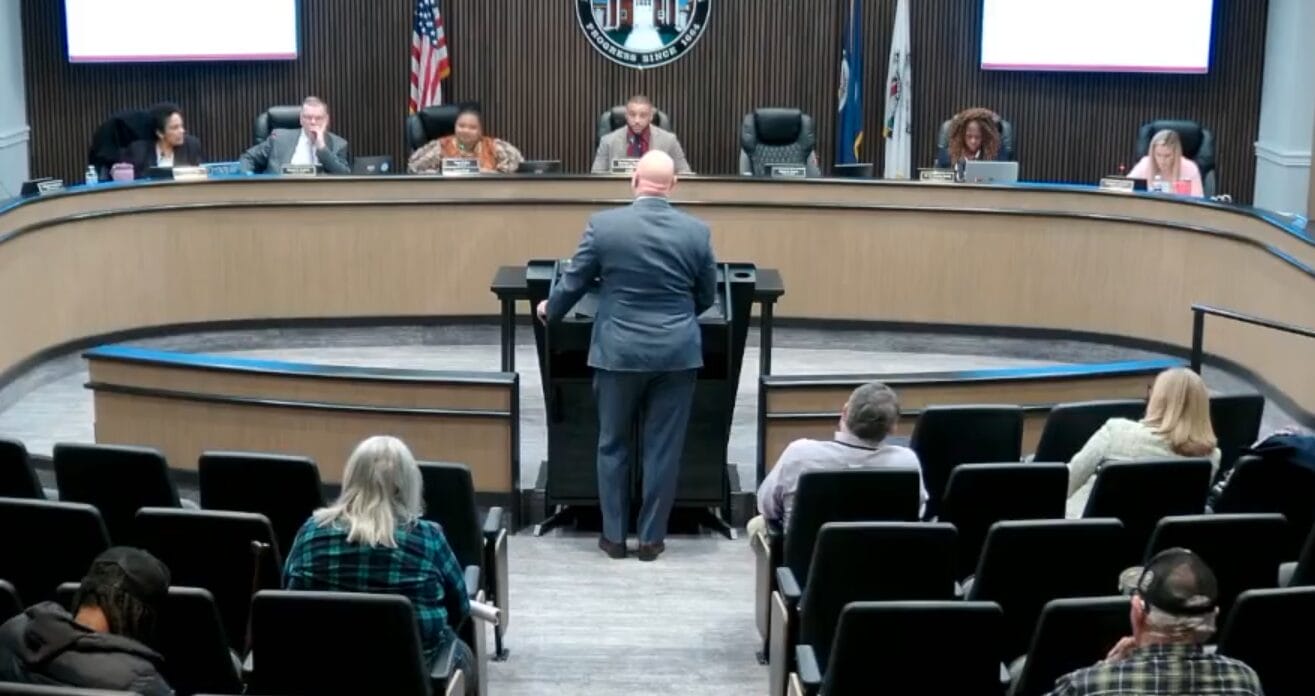
 County Administrator Bill Ashton. Photo: Potomac Local News / file.
Stafford County supervisors failed early Wednesday to adopt a Business, Professional and Occupational License tax after a marathon public hearing that stretched past midnight.
Chairman Deuntay T. Diggs announced that the motion to approve Proposed Ordinance O26-34 as advertised “failed.” The meeting, which began at 5 p.m. Tuesday, adjourned at 12:59 a.m.
The vote leaves Stafford without a BPOL tax. The county repealed its last version around 2008 and has since collected a merchants’ capital tax on retailers’ inventory, which staff put at about $1.1 million in the fiscal 2027 budget.
BPOL is a local tax on a business’s gross receipts — total revenue not profit. Under the advertised ordinance, firms under a $2 million gross-receipts floor would have paid a $50 license fee. Firms above that threshold would have been taxed from the first dollar, generally at 16 cents per $100 of receipts on the main categories staff described, with wholesalers at 5 cents. County Attorney Rysheda M. McClendon told the board other rates and flat fees sit in Section 6.5-11 and are not identical across categories.
Staff said the $2 million floor could be raised Tuesday night but could not be lowered without a new advertisement. In one example discussed in the meeting, a 16-cent rate on a business above the threshold produced a $4,000 tax. Commissioner of the Revenue Scott A. Mayausky said he still cannot require firms to report gross receipts unless the tax exists, so any revenue figure remains an estimate. Related resolution R26-341, which would have funded two positions and software in his office, was tied to adoption and was not created after the ordinance failed.
Stafford homeowners are already carrying a heavier bill. In April, supervisors set the calendar-year 2026 real estate rate at $0.9675 per $100 — up from $0.9236 — as part of the FY2027 budget that took effect July 1. Using Commissioner of the Revenue figures cited in April by Supervisor Crystal L. Vanuch, the average tax on a home assessed under $500,000 rose from $2,994 in 2021 to $4,764 at the new rate, a $1,770 increase. During Tuesday’s hearing, Renee Kendall of the George Washington District put the five-year climb at 56 percent.
Potomac Local has tracked that homeowner squeeze and the BPOL fight through the budget and into this hearing. Read our earlier coverage: Stafford supervisors approve the tax-rate hike, the proposed FY2027 homeowner increase, and the Sept. 15 hearing preview. Independent reporting like this is what a Locals Only membership pays for. Join Locals Only
Supporters on the board cast BPOL as a way to take pressure off those homeowners. Supervisor Dr. Pamela Yeung, Garrisonville District, moved to adopt the ordinance as advertised. She said homeowners should not carry the load alone and that collecting gross-receipts data was the only way to see which firms were truly small.
“Equity for me is about asking to help pay … instead of leaving homeowners to carry this burden alone,” Yeung said.
Supervisor Tinesha O. Allen, Griffis-Widewater District, said the question was whether Stafford’s revenue mix is too dependent on residential property taxes.
This is not being anti business,” Allen said. “I want businesses to prosper here in Stafford. But I also want people who work for those businesses to be able to afford to own a home in Stafford.”
Diggs said the county has kicked the issue down the road since 2009 and that “no, no, no” is not a budget plan. He said he was torn because he did not want to slow growth. After the ordinance failed, he warned that he will vote yes on economic-development projects going forward, citing about $44 million to fill and $1.9 billion in school needs.
Opposition on the board was blunt. Supervisor E. Darrell English, Hartwood District, said he ran a small business in the 1990s, folded it, and would not have survived a gross-receipts tax on top of payroll taxes and insurance.
I’m not supporting this [BPOL] tax, English said. “I don’t think [BPOL] is the right way of doing it.”
Vanuch said the board lacked the information it needed and that economic-development staff would not get the clustering data they actually want from a BPOL file. She urged the board to find a handful of large parcels for manufacturing instead.
It is not the role of our county government to have a registry of all of the local small businesses,” Vanuch said.
Supervisor Kecia S. Evans, Falmouth District, asked whether a Hanover-style approach would produce the gross-receipts file staff said they lack. Mayausky said the data follows the bill: if the rate and threshold are high enough that a business owes tax, his office gets filings on four of five categories. Retail can be checked against state sales-tax records. Hanover itself does not run a broad BPOL; it taxes contractors above $100,000 in receipts and does not levy the license tax on other firms. Evans said her district wants restaurants and places to go, not manufacturing.
Vice Chairwoman Maya P. Guy, Aquia District, joined the meeting by video. She did not give a long floor speech on the merits.
Public comment ran for hours and was heavily against the tax. Speakers said a levy on gross receipts ignores thin margins, gets passed to customers and workers, and undercuts the county’s pitch that it does not have BPOL.
Ryan Dean, an Aquia plumbing-business owner, asked the board to vote no.
“BPOL may be called a business tax, but the burden doesn’t stay with the owner,” Dean said. It flows through to employees, to customers, to the community as a whole.”
Mark Smith, a commercial-insurance agent who works with Stafford contractors and restaurants, said the cut comes after payroll, rent, and card-processing fees. Kendall said stacked local taxes already land on residents. Barry Boyd of Barley Naked Brewing Company told the board BPOL “is not the way to go.” Elizabeth Freund Larus, who runs a small Falmouth consulting firm, said a tax on gross receipts was grossly unfair and would mean hiring fewer people.
Edward Hendry cited National Bureau of Economic Research work that, he said, found most of a business tax is borne by consumers and workers, not the firm. Tom Sablan of Hartwood called the absence of BPOL the county’s best marketing line. Jeff Simons, a Rock Hill resident with a Garrisonville business, said taxing gross revenue is insane” and that he had already sat through the 2009 fight until 3 a.m.
Opposition was not only from people at the microphone. On Sept. 9, the Fredericksburg Area Association of Realtors sent a letter opposing the tax on behalf of about 1,700 members. The Fredericksburg Regional Chamber of Commerce followed on Sept. 10. Chamber CEO Susan Spears said a new gross-receipts tax “could undermine Stafford’s competitive position at a time when businesses of all sizes are already managing increased costs for labor, insurance, utilities, materials, and other operating expenses.”
The clearest named speaker for the tax was Susan Depp of Hartwood, who said Stafford ranks near the top of Virginia in population and near the bottom in business-tax collections.
“I think Stafford is long overdue for BPOL,” Depp said.
The path to the failed vote was messy, and much of the friction ran through Guy’s remote connection. The board authorized her virtual participation unanimously at the start of the meeting after Diggs noted she was logged in. She was not in the chamber with the six supervisors who appeared in person.
That showed. On the first vote of the night — a time-sensitive add to the agenda for the Potomac Creek Campus extension — Guy abstained because she said she could not find the document. Later, Vanuch tried to pull the BPOL hearing off the agenda. That motion was first announced as passing 4–3. Guy said she had voted wrongly. The board recalled the vote; the motion then failed, and the agenda with the Potomac Creek add-on passed 6–1.
English later moved to jump BPOL to the first public hearing. Meeting records show a 4–2 result with one member not voting. McClendon said a reorder needs two-thirds. It failed.
On the ordinance itself, Yeung moved to adopt the advertised draft. Vanuch offered a motion to deny it. The chair had to confirm Guy understood which question was up. She voted no. Diggs announced that motion failed. The board returned to Yeung’s motion. When the clerk came back to Guy, she asked whether it was the original motion, then said, “I vote now.” Diggs said it failed. He briefly treated the meeting as adjourned before the clerk called for member reports.
Board members talked over one another, asked for motions to be restated, and waited on Guys microphone and voting button. Meeting records do not give a clean named tally on the final adopt vote. What they do give is the chair’s result: the advertised BPOL ordinance failed, and Stafford still has no BPOL tax.
Related:
Stafford BPOL tax September 15 hearing preview
Stafford eyes business tax after hitting homeowners hard
Stafford supervisors approve the tax-rate hike
Stafford homeowners face proposed FY2027 tax increase
Support this reporting. Join Locals Only
