

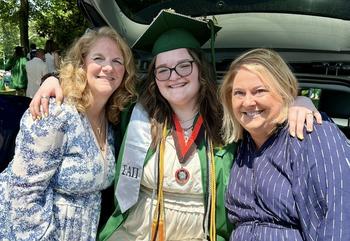
Lewis, since the beginning of 2024, has faced medical struggles associated with Functional Neurological Disorder (FND). According to the National Institute of Neurological Disorders and Stroke, FND is a condition that is caused by changes in how brain networks work rather than changes in the brain’s physical structure.
Symptoms vary across the individuals who are diagnosed with FND each year, including seizure-like episodes, dizziness, speech difficulties, pain, numbness and movement problems.
Lewis said on Jan. 31, 2024, at exactly 12:32 p.m., she remembers losing feeling in her legs for the very first time.
“I was alone. I was confused. I was scared. … I didn’t really understand what was happening to me. I was denied from every rehab facility in the DMV. And every time I spoke up or said something was wrong, they gave me morphine,” Lewis said.
She said initially, she was dazed from all the medication doctors were prescribing for her because they couldn’t figure out what was wrong.
“I spent almost six months unable to walk. At first, I didn’t even realize what was happening. I was dazed from the meds. I thought maybe I was hallucinating,” Lewis recalled. “… It still breaks me to think about how easily they silenced me with medication — how close I was to developing an addiction, not because I sought those drugs, but because they were the only response the hospital gave me.”
The then-20-year-old graduated college in just three years and 36 years after her late father, Matthew. Lewis said shortly after her father died, she became motivated to head to her father’s alma mater.
“It wasn’t just about the school. It was about connection. It was a way to stay close to him,” she said. “He gave me the blueprint. All I had to do was follow it — one step at a time. … I know he would’ve been so proud of me. I wish I could’ve hugged him, but even though I couldn’t, I felt him with me.”
The psychology graduate said her background in the field changed her perspective of medical treatment.
“My psychology background didn’t necessarily help me cope by giving me textbook principles to lean on — it helped me by sharpening my observational skills and deepening my understanding of systems,” Lewis recalled. “Psychology is a research-heavy field, and I don’t rely on Google when I can go straight to the scholarly articles and data doctors use themselves. When I wasn’t getting answers, I went looking. I asked hard questions. I read the research. I learned what they weren’t telling me.”
Lewis continued, saying that medical treatment isn’t always about solving a problem or finding a solution.
“Real growth comes when you stop just treating the surface problem and start tailoring the solution to the person. That’s what I brought into my own healthcare journey — I didn’t care whether they could find a structural issue. The bottom line was: I couldn’t walk. And they were sending me home, relying on my mom — a nurse working three floors above me — to care for me without ever really addressing what was wrong,” she said.
She recognized that ultimately, her studies in psychology helped her become her own advocate.
“It helped me advocate in a system that wanted to ignore me. It gave me language, insight and the ability to see that something deeper was wrong — and the courage to keep demanding better care not just for me, but for everyone who comes after me,” she said.
Lewis said her journey to graduation wasn’t easy, but it reflects the values her father instilled in her from a very young age.
“It was emotional. It was exhausting and painful. But it also changed me. It taught me how to let go of just surviving and step into something deeper,” she said. “And that was my dad’s legacy: his faith, his strength, his love, his unwavering belief in me — and the way he showed me that thriving is possible.”
And now, a month after graduation and just days from turning 21, Lewis said she’s focused on resting and discovering what life is like outside of academia.
“I’m learning that it’s okay to not have every next step mapped out. On June 9, I was officially discharged from physical therapy,” she said. “That doesn’t mean the work is done. There’s still plenty I need to manage, strengthen and rebuild. … I’ve spent so long focused on survival and school that I haven’t always had the chance to just live. And I want that now.
“As I figure out what’s next professionally, I’m also discovering who I am without a textbook or a class schedule,” Lewis continued. “I’m learning what I need — emotionally, spiritually physically — and taking time to breathe after years of pressure and nonstop movement.”
She acknowledged that her recovery from FND is lifelong and won’t disappear overnight.
“It’s something I’ll manage long-term — sometimes with flares, sometimes without. But understanding it better means I can also help others understand it, too. Advocacy for FND and other misunderstood or invisible illnesses is definitely something I want to pursue,” she said.
