

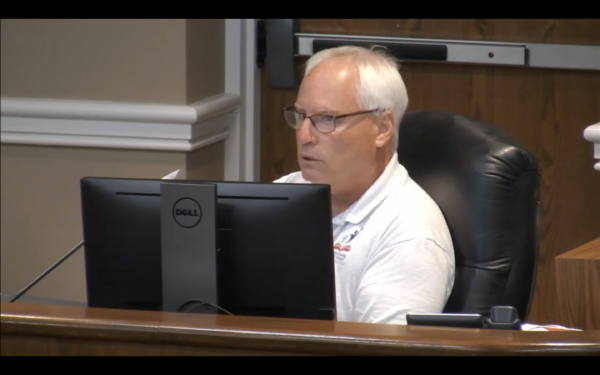
After delaying its initial vote and calling for a special meeting, the Stafford County School Board has made the decision to reopen schools fully virtually.
During its July 29 meeting, the Stafford County School Board approved Superintendent Scott Kizner’s return to learning plan, which begins the school year virtually for students, with exceptions for those in special groups such as special education. For middle school and high school groups, this means students won’t be stepping foot inside school buildings until at least after winter break.
The division’s students will be utilizing the learning management system Canvas, which allows students and teachers alike to conduct education from home.
This approval follows in the footsteps of Prince William County, Manassas City, and Fredericksburg City Public Schools, who have all voted to begin the school year virtually, but does not align with the wishes of the division’s parents. In a survey conducted by Stafford County Schools, only 27% of parents wanted a completely virtual schooling model for all of the division’s students.
“[The goal of this plan is] to create a safe return to school environment for students and staff, where students can actively participate in learning,” stated Kizner’s return to learning plan.
Kizner also cited multiple staff resignations due to coronavirus concerns during the Tuesday night meeting.
In a survey conducted by the school division, 36% of staff (1,210) wanted “virtual instruction only for all students, with certain exceptions based on student needs, until the second semester,” according to Kizner’s return to learning plan.
“Just from June 15… we’ve had 50 total resignations/leave of absences: 39 teachers, 5 paraprofessionals, and 6 other service staff. In the past two weeks, we’ve had 15 resignations: 10 teachers (6 cited COVID concerns), 2 paraprofessionals (both cited COVID concerns), 3 service staff, and additionally 5 new teachers have rescinded their acceptance,” Kizner said.
The decision to go virtual comes merely two weeks after the board approved a hybrid in-person/virtual model that is no longer in effect.
The division will not be transitioning back into a hybrid learning plan until health and academic data analysis is completed and a possible pilot program is conducted.
The pilot program would utilize volunteer students and staff to test the hybrid model for safety and feasibility, among other things. It could begin as soon as October 6.
“We’d like a test run. What we’re saying is take a small cohort of students, test the hybrid plan so that we can see what the logistics are, what the problems are, and if it works,” Griffis-Widewater representative Dr. Elizabeth Warner said.
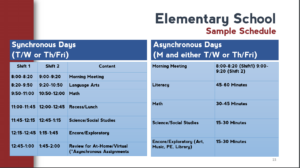
Under the virtual plan for fall, the transition period into a hybrid learning model will be different for each grade level. Those in elementary school will participate in virtual learning from Aug. 31 to Oct. 1, with health and academic data analysis being conducted on Sept. 21 to determine if a hybrid plan is plausible. A decision on the matter will then be announced on Sept. 24.
Elementary students and parents will attend a face-t0-face orientation program during the weeks of Aug. 24 and 31 to aid them in transitioning into online learning.
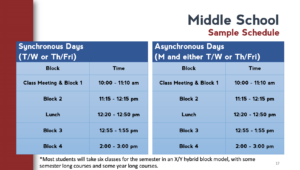
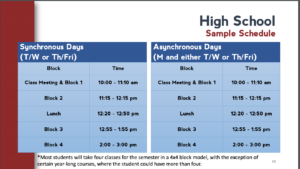
Those in middle and high school will participate in virtual learning from Aug. 31 to Nov. 5, with health and academic data analysis being conducted on Oct. 26 to determine if a hybrid plan is plausible.
A decision on the matter will then be announced on Oct. 28, but a hybrid plan will not be offered until after winter break, according to a motion from the school board.
The Aug. 31 start date is pushed back from the Aug. 17 start date that was approved in late June.
Earlier in the year, the school board and the Stafford County Board of Supervisors approved the purchase of 9,000 Chromebooks, which would allow all the county’s students to have a device at home, according to the division.
It is unknown when the Chromebooks will arrive and how they will be distributed. According to the board, they will be in the hands of students in time for the start of the next school year on August 31.
The virtual plan is projected to cost the division $3.5 million in additional unfunded costs according to Kizner’s plan.
More information will be released as the school year draws nearer.
Students have not set foot into a school building since early March when Virginia Gov. Ralph Northam ordered schools closed due to the coronavirus pandemic.
