

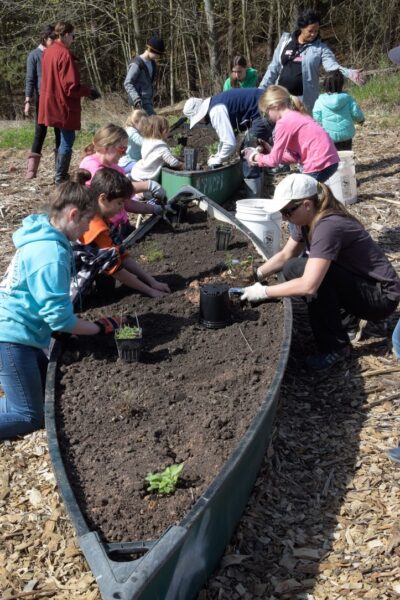
Multiple volunteers worked to plant a pollinator garden at the Prince William County Landfill.
From a press release:
Repurposed canoes, pallets, and tires were used to create raised garden beds, a native bee hotel, and a walking path through a pollinator-friendly meadow. These upcycled goods will support the health of native bees, honeybees, insects, and other wildlife for years to come.
The project was a joint effort that brought several community organizations together. Keep Prince William Beautiful secured $20,000 from a Keep America Beautiful/Lowe’s Community Impact grant to fund the project. The Prince William County Solid Waste Division, Bees in Schools, LLC, the Prince William Conservation Alliance, and George Mason University’s Potomac Environmental Research and Education Center all worked together to make the undertaking possible. Volunteer planting days open to the community were held on April 14 and April 21 in celebration of Earth Day.
“Our whole goal is attracting pollinators to a spot where we know there are very few right now,” said Dr. Cynthia Smith, Associate Professor at George Mason University, as she thanked the crowd of 101 volunteers on the first work day, “In three hours we took a field with some mulch and now we’ve got a pollinator garden with seeds installed, before the rain tomorrow. We could not have done this without your help.”
Janelle Bryant, a member of the Virginia Cooperative Extension Master Gardeners, shared her motivation for volunteering for the project, “It’s gratifying to see that the county is planting these gardens to attract native bees – if we don’t create these gardens now we could lose many of our important pollinators.”
Bee population numbers are declining rapidly due to factors such as colony collapse disorder, pesticides and herbicides from modern agriculture, and habitat loss. The bee hotels will serve as nesting habitat for native bees, who will utilize plants in the raised beds and the flower meadow as food sources. Louise Edsall, a beekeeper and founder of Bees in Schools, will also install bee hives to produce local honey at the landfill and each hive can be home to about 60,000 bees. Edsall is expecting about 180 species of native pollinators to make the site home.
The volunteers completed their work last month.
