

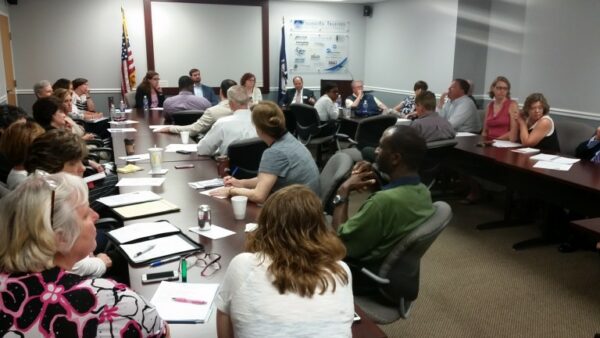
The Prince William Chamber of Commerce met with business owners to discuss sweeping changes coming to full-time employee salaries.
President Obama signed new legislation that redefines what it means to be employed full time.
From the Department of Labor:
Key Provisions of the Final Rule
The Final Rule focuses primarily on updating the salary and compensation levels needed for Executive, Administrative and Professional workers to be exempt. Specifically, the Final Rule:Sets the standard salary level at the 40th percentile of earnings of full-time salaried workers in the lowest-wage Census Region, currently the South ($913 per week; $47,476 annually for a full-year worker);
Sets the total annual compensation requirement for highly compensated employees (HCE) subject to a minimal duties test to the annual equivalent of the 90th percentile of full-time salaried workers nationally ($134,004); and
Establishes a mechanism for automatically updating the salary and compensation levels every three years to maintain the levels at the above percentiles and to ensure that they continue to provide useful and effective tests for exemption.
The law allows non-full time employees to now collect overtime pay.
The effective date of the final rule is December 1, 2016. The initial increases to the standard salary level (from $455 to $913 per week) and HCE total annual compensation requirement (from $100,000 to $134,004 per year) will be effective on that date. Future automatic updates to those thresholds will occur every three years, beginning on January 1, 2020.
From Prince William Chamber:
Betty Dean, Chair of the Chamber’s Policy Committee and Owner of Dean & Associates summarized the reactions of member businesses saying, “I think it’s fair to say that the biggest concern from the members’ perspective was the increased costs that are likely to result, but that was followed closely by concern about how to manage the potential, unintended consequences of the new regulations. Many businesses and especially not-for-profit organizations have employees whose salaries are below the new threshold.” Dean went on to note that employees often require a great deal of flexibility to do their jobs; attending before/after-hours events, traveling from location to location and scheduling appointments outside of normal business hours.
Allison Dembeck, executive director for education, labor and workforce development, congressional and public affairs for the U.S. Chamber of Commerce was on hand to hear questions from Prince William Chamber members.
Questions included how to regulate employee use of mobile devices during non-business hours and how that time can be tracked. Committee members also discussed the likelihood that mobile communications will need to be strictly curtailed; likely having a negative on business as well as a chilling effect on employee morale.
We asked several area politicians to weigh in on the move. Virginia State Senator Scott Surovell replied:
@UriahKiser I generally support a higher minimum wage and fair overtime rules. Many employers refuse to pay overtime due employees.
— Scott Surovell (@ssurovell) June 27, 2016
@UriahKiser Anything that provides greater clarity and guidance to employers and employees will help avoid unnecessary conflict.
— Scott Surovell (@ssurovell) June 27, 2016
