


Marching in the Dale City Independence Day Parade this year with my son’s Cub Scout pack, I actually paid attention.
I’ve marched in the parade several times in my life as a cheerleader with Dale City Sports Club, as a political supporter, and even on a church float –– but this year was different. This year we were marching with a flag displayed.
It was also different because a few days before I’d started something of a controversy on our PotomacLocal.com Facebook page with (what I thought was) an innocent picture of children working to prepare our parade float.
It was that controversy that sent me on a quest to answer the question “What are we teaching our kids about respecting the flag?”
And that question made me pay attention in the parade, where I noticed almost no one rose for the flag, and even fewer removed their hats. Those that did seemed to be universally veterans, although in a crowd so large it’s possible I missed others.
Following the parade, I promised to follow up on what we’re teaching our children about the treatment of flag. I apologize for the wait, but after ten days and seven phone calls, what I’ve come up with is slightly complicated.
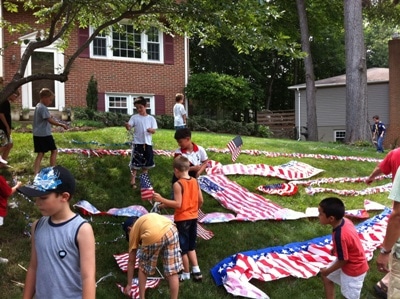
I want to admit to you that I don’t have an expert. Any of them I could find referred me back to the flag code, which I will break down for you here:
According to the code, which is fairly broad, a “flag” is “any flag, standard, colors, ensign, or any picture or representation of either, or of any part or parts of either, made of any substance or represented on any substance…upon which shall be shown the colors, the stars and the stripes, in any number… by which the average person seeing the same without deliberation may believe the same to represent the flag, colors, standard, or ensign of the United States of America.”
This means that the logo on your bank statement, and even your strawberry, whipped cream and blueberry cake could be considered to fall under the jurisdiction of the code if they can be believed to “reasonably considered to represent the flag”.
It also seems to me that none of us are really following the Flag Code, with a disregard so widespread that we don’t know what to teach our children. Reading the flag code, I noticed I have personally violated it several dozen times in my life.
The code also notes that the flag should never be embroidered onto cushions or garments or embossed or stamped onto disposable items (such as the disposable napkins I bought to match the disposable plates for my barbeque). It also, however, notes that no part of the flag should be used as an athletic uniform, which seems odd given that the U.S. 2010 Ski and Bobsled teams’ approved uniforms were comprised of stars and stripes.
Growing up in Washington’s shadow, many of our children were also exposed to the media coverage of the 2009 inauguration, where some flags donned our president’s face, another violation of the flag.
So aside from teaching our kids not to throw the flag on the ground, or that it’s burned when it’s dropped, which are the only two pieces of information beyond the pledge I could get when I interviewed over 20 children of various ages in the process of writing this article, it seems we’re not teaching our kids much about respect for the flag- but it seems like that’s because our adults don’t know either, bombarded by forbidden napkins, shirts, tablecloths, and items from the dollar store. I don’t claim to have a solution for this, other than to start by educating my own children, and our scout pack, and I hope that others will take the time to do the same.
