

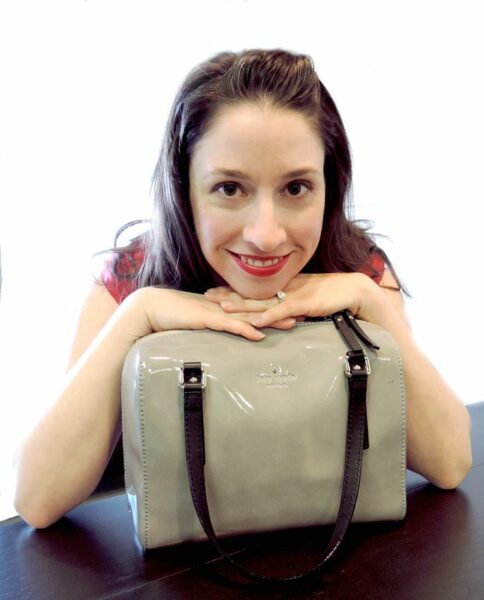
Danielle Watson may seem like your everyday business woman, but the entrepreneurship she started called The Purse Process may change your mind.
This is the roots of her business, a tool that Watson, 37, of Bristow, developed based off of three basic principles delved from archeology:
1. Objects convey meaning.
2. Objects within a collection convey meaning in relationship to one another.
3. An object or a collection of objects convey the most meaning in their original context.
With these principles in mind, Watson developed a process encompassing her examining the contents of a woman’s handbags as if it were an archeological dig site.
“By sifting through the collection of objects in a woman’s purse, I can get a clear picture of her personal culture, such as: what she values, what she believes about herself, how she makes decisions, and what she believes about the world around her. I use this insight to help women better understand their default patterns so they can make more conscious choices about the things that matter to them like relationships, family, even career,” she said.
Watson believes that every woman’s handbag is exactly like a collection of treasures left behind by a lost civilization and can be examined as such. Watson compares items within a woman’s purse to “artifacts.”
Watson continued her research by diving into the handbags of women who were fine with having their bags sifted through, leading her to discover that every woman’s purse contents are unique and clearly indicative of the personalities of said women. She would use this information to create an archetype — calling them “Pursonalities” and “Pursona.”
“Once I started talking about how I’d applied principles of archeology to handbags it didn’t take long for word to spread like wildfire and for me to begin receiving invitations to appear on podcasts, radio shows, TV, and even be invited to give a TEDx talk. This was all completely unexpected, and I am so honored to have become the poster child for excellence in creativity, living life on your own terms, and for using conventional skills in unconventional ways to make money,” she said.
Watson was born and raised in Northern California. She attended California State University and studied anthropology.
“This surprised everyone who knew me because I’m a girly girl and I don’t like digging in the dirt or camping. I prefer skirts to cargo shorts and perfume to bug spray. Sometimes I refer to myself as a “Theoretical Anthropologist,” said Watson.
Her interest in business began when she moved to Northern Virginia, after completing her Masters Degree. She contemplated applying to work at one of the many museums located in Washington D.C. She quickly met the issue that many locals find themselves facing every day.
“I quickly learned that the traffic here was going to make that a long commute, which would have a negative impact on my quality of life,” she said.
Besides Watson’s degrees, she also yields a large amalgam of experience within practicing yoga, an activity that she took up in college in order to combat stress.
“I decided to get certified to teach yoga (a small investment compared to obtaining another more sensible or marketable degree). I quickly realized yoga teachers don’t get paid much money so I decided to go into business for myself and opened a mobile yoga studio,” she said.
This yoga studio was her first endeavor into entrepreneurship; albeit it took some time, she did build the business up from her bootstraps, making it into a success. However, after several years, she became bored due to not being challenged enough and decided to investigate other activities that would be more compatible with her interests and skill sets.
In five years, Watson hopes to see The Purse Process as something that inspires other graduates within the liberal arts to think “outside the box” for modalities to use their talents and skill sets in the workforce, and potentially become entrepreneurs of their own.
