

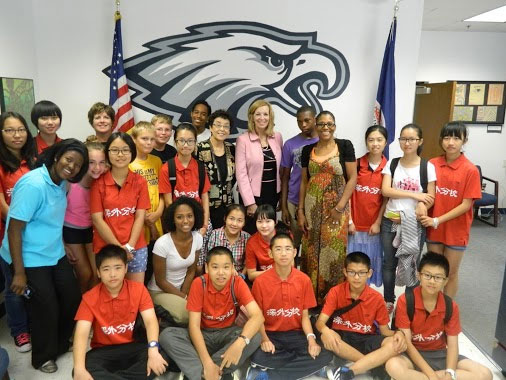
MANASSAS, Va. — In July, the City of Manassas Neighborhood Services Division hosted more than 100 international students from the Shenzhen Foreign Languages School (SFLS) in China at Osbourn High School (OHS).
The day-long project partnered SFLS students with OHS students. Supervisors for the program included Mike Dufrene, Freshman Academy Administrator for OHS, Project Infusion Executive Director Tina Murray, City of Manassas senior planner Morgan Brim and Neighborhood Services Manager Kisha Wilson-Sogunro.
Located in the Guangdong Province of China, SFLS is a K-12 school system renowned for its language studies (English, Japanese, French, German, Spanish and Russian), and for the high percentage (99 percent in 2011) of students admitted to universities in China and abroad.
Wilson-Sogunro, an alumna of Leadership Prince William in 2013, developed the partnership between City of Manassas,Manassas City Public Schools, the Astar Education Institute of Washington, D.C. and the Shenzhen Foreign Language School.
“We wanted to give students the opportunity to create a global neighborhood while learning what civic engagement is and why it is important to be involved in your community,” said Wilson-Sogunro. “The challenges we face in Manassas – housing, safety and better quality of life for all citizens – are universal challenges. Our student visitors live in China’s most populated province, a population of 80 million people. These pressing issues surpass local, national and international barriers.”
Tina Murray noted that as she observed the Osbourn and Chinese students working together, it was clear that a bond was being formed on common ground issues, regardless of their differences.
“The activities helped bring together what has been broken or separated and tore down our very own walls,” she said.
The students completed three activities. The first was an exercise with senior planner Morgan Brim. The students worked together to redevelop a section of the City on graph paper. They analyzed the need for green space, access to food, walkability and transportation, and added a mix of commercial and residential development. As a wrap-up, each group presented their vision to their peers.
“My neighborhood in China is very different as we have tall apartment buildings everywhere,” shared international student Zhang Zixu. “But as my group completed our neighborhood project, we shared the same concerns about transportation – how do we get around?”
