

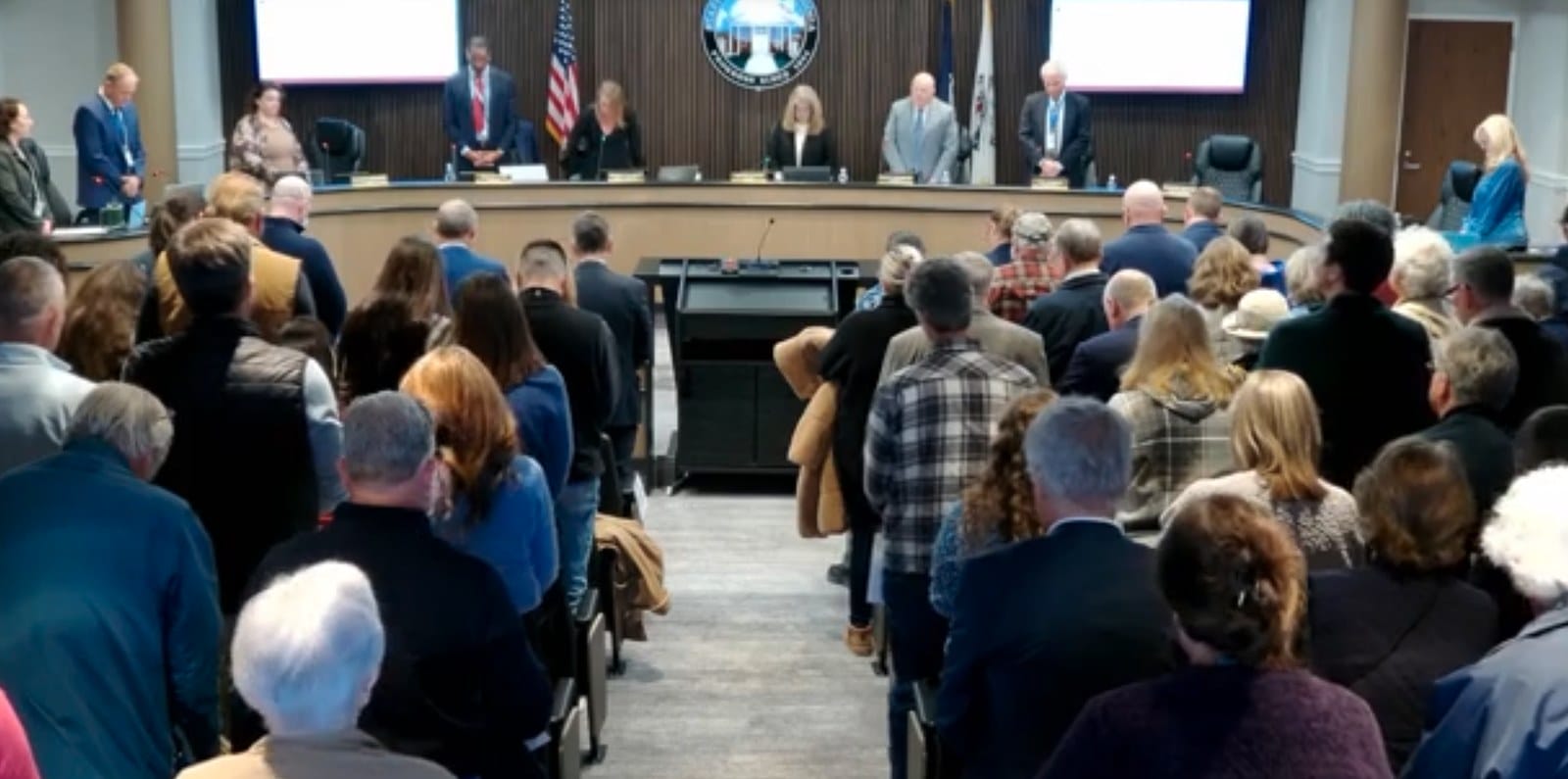
The Stafford County Planning Commission voted 4-3 early Thursday morning to recommend denial of all 11 related applications for large-scale data center projects covering Forest Lane, Sims Farm, Sisson North, and Sisson South.
The applications involved rezoning, comprehensive plan compliance reviews, and conditional use permits. Together the projects would total roughly 9 million square feet of data center space across about 1,400 acres in the George Washington District, largely outside the urban services area and including significant forest and agricultural land. The votes came after a lengthy public hearing and deliberation that stretched into the early morning hours of Nov. 19, 2026.
Commissioner Kelsey V. Caudill, whose George Washington District includes the project sites, moved for denial on the first application and said, “I can’t in good conscience approve this.” She described the area’s personal and historical significance to her family and called the proposals heartbreaking while acknowledging that the developers had met with the community and held public meetings.
Other commissioners supporting the denial recommendations cited the projects as outliers to the comprehensive plan’s rural character goals, the lack of decommissioning requirements for the buildings themselves, the scale of forest loss including high-conservation-value areas, and what they described as a de facto expansion of urban services through water and sewer extensions. One commissioner called the proposals “the most devastating application I’ve ever seen,” referencing the loss of old-growth forest and agricultural land and stating that “nothing that will ever bring that back.”
Commissioners supporting the projects, including Carlos Bratton, Maureen L. Siegmund, and Marcus T. Oats, pointed to compliance with Comprehensive Plan section 3.11 criteria that allow consideration of data centers outside the urban services area when certain factors are met. They cited the applicant Peterson Companies’ track record, mitigations such as berms, tree preservation, enhanced stormwater controls, stream restoration, and partnerships with Virginia State University and the University of Virginia for environmental monitoring. They also emphasized that the land would be developed either way and that the projects would give the county a say in the outcome.
Staff confirmed that the applicant’s tax revenue estimates, after a reduction of 2 million square feet, peak near $218 million and level at about $193 million at full build-out. Staff also confirmed that no potable water would be used for cooling, with the projects relying on reclaimed “purple pipe” water from the nearby treatment plant, and that construction hours would follow the county noise ordinance of 7 a.m. to 10 p.m. on weekdays and 9 a.m. to 10 p.m. on weekends and holidays. Commissioners discussed but did not advance tighter construction-hour restrictions.
Additional issues raised during deliberation included well-protection proffers for nearby residents, road impacts on narrow rural roads (with the applicant offering a pre-construction assessment of Forest Lane), generator noise based on manufacturer data rather than field tests, and the absence of a formal comprehensive plan amendment despite the proposed water and sewer extensions.
The Planning Commission’s recommendations now go to the Stafford County Board of Supervisors. The Board of Supervisors has not yet scheduled a meeting to hear this case. We will update you when they do.
