
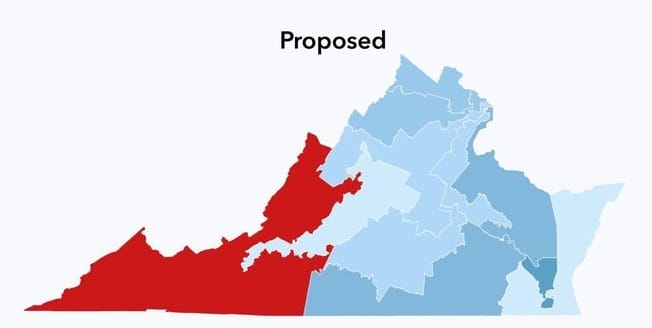
Virginia voters narrowly approved a constitutional amendment on April 21, 2026, allowing the General Assembly to redraw the state’s congressional districts mid-decade. Unofficial results from the Virginia Department of Elections show the “Yes” vote received 1,574,505 votes (51.45%) to 1,485,657 “No” votes (48.55%) — a margin of roughly 88,848 votes, or about 2.9 percentage points.
The measure now faces significant legal uncertainty. Multiple challenges — primarily originating in Tazewell County Circuit Court — are pending before the Supreme Court of Virginia. These cases argue that the General Assembly violated procedural rules, the single-subject requirement for constitutional amendments, and that the ballot language was materially misleading about the proposal’s scope and duration.
The Supreme Court previously allowed the referendum to proceed while reserving judgment on the underlying merits. Oral arguments on the consolidated cases are scheduled for April 27, 2026 (this Monday), with a decision expected in the coming weeks that could potentially invalidate the results.
Despite the narrow statewide Yes victory, a jurisdiction-by-jurisdiction comparison with the November 4, 2025, gubernatorial election (when Democrat Abigail Spanberger won with roughly 57.6% of the vote) reveals a clear rightward shift across much of Virginia.
The statewide average shift was approximately −6.1 percentage points, with Yes support for the redistricting amendment lagging behind Spanberger’s performance. Roughly 95 of the state’s 133 jurisdictions (counties and independent cities) moved further to the right on this ballot question.
Northern Virginia’s Modest Rightward Tilt
Even the high-population jurisdictions that provided the decisive Yes votes showed softer support than in 2025:
– Loudoun County: 60.66% Yes vs. 64.8% for Spanberger → −4.14 percentage point shift (largest rightward move among the four major NOVA counties).
– Fairfax County: 69.51% Yes vs. 72.9% for Spanberger → −3.39 pp shift.
– Stafford County: ~52.1% Yes vs. ~55.8% for Spanberger → −3.7 pp shift.
– Prince William County: 61.66% Yes vs. 64.5% for Spanberger → −2.84 pp shift.
Rural Southwest and Southside counties saw the largest rightward movements, often exceeding −11 to −14 percentage points. A handful of strongly Democratic urban areas, such as Petersburg City (+5.7 pp), Charlottesville City (+3.4 pp), and Richmond City (+2.8 pp), shifted leftward, helping offset rural opposition.
Reactions
Governor Abigail Spanberger hailed the outcome in a statement:
“Virginia voters have spoken, and tonight they approved a temporary measure to push back against a President who claims he is ‘entitled’ to more Republican seats in Congress. … I understand the urgency of winning congressional seats as a check on this President, and I look forward to campaigning with candidates across the Commonwealth working to earn Virginians’ trust — and their votes. Looking forward, I remain committed to ensuring Virginia’s bipartisan redistricting commission gets back to work after the 2030 census.”
Congressman Suhas Subramanyam (D-VA) added:
“Virginians have spoken, and the message is clear: we support evening the playing field. Voters approved a temporary measure to respond to what President Trump started in Texas and other red states. I look forward to running in the redrawn 10th Congressional District and taking back the House majority this fall.”
The Jefferson Forum, which has urged swift Supreme Court action, expressed strong concerns. Peter Lipsett, Executive Chair, stated: “This result reflects a campaign driven more by confusion than clarity. … Voters were presented with a ballot question that obscured the permanence and consequences of the proposal, while well-funded national interests flooded the airwaves with messaging designed to press a false ‘fairness’ narrative.” The group called on the Supreme Court of Virginia to review pending constitutional challenges from Tazewell County, citing violations of the single-subject rule, misleading ballot language, and a rushed process.
The approved amendment, if upheld by the courts, would allow a new map for the 2026 elections only; the standard process via the bipartisan Virginia Redistricting Commission resumes after the 2030 census.