
Welcome back to a Potomac Local News series, “Meet Prince William.”
We’ve started this series so Prince William County residents can get to know the important people working behind the scenes to make the county run smoothly and efficiently. This is an opportunity to learn from experts on the county. Potomac Local has asked each leader the same questions in bold, and their respective answers will be found below.
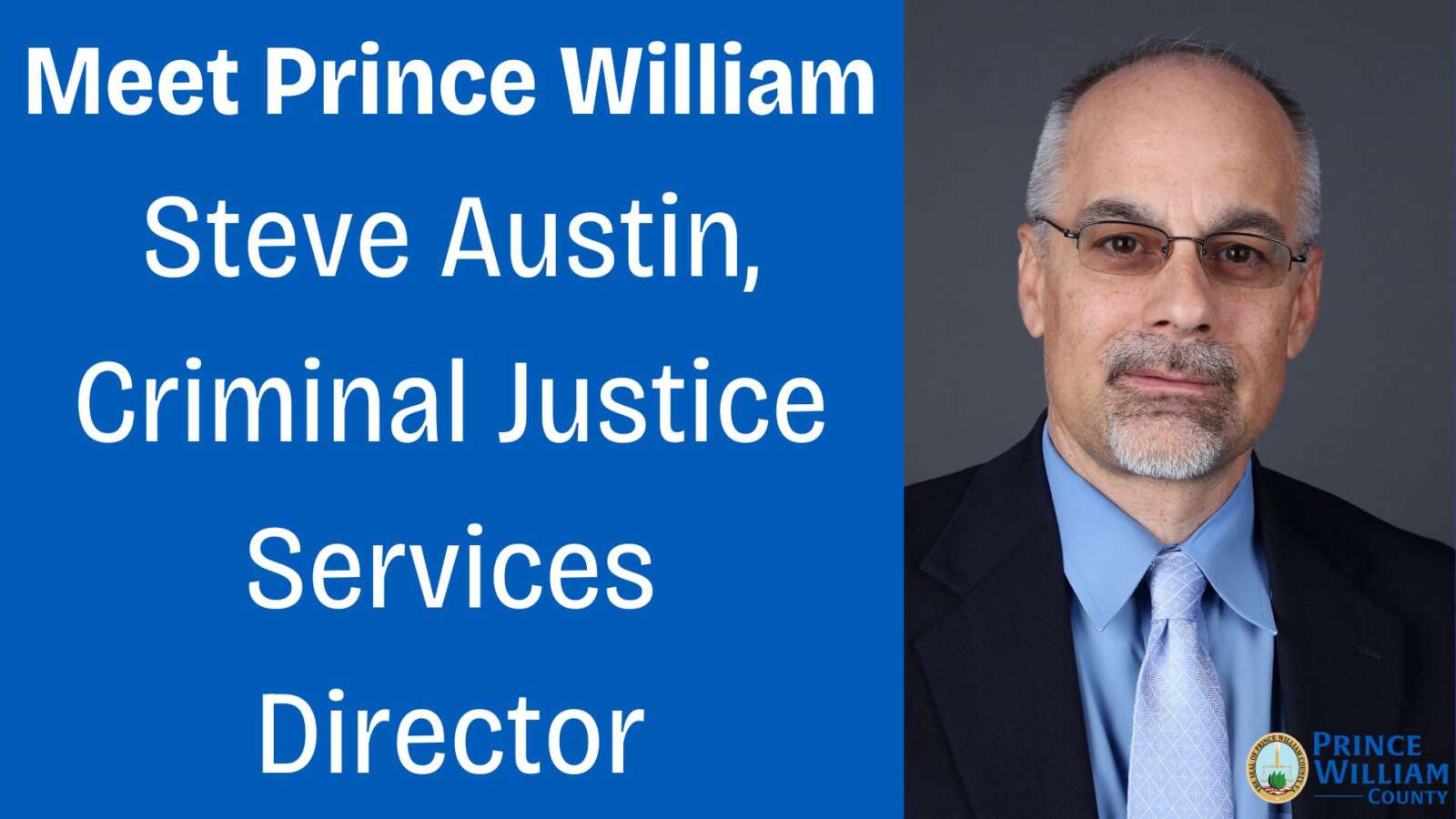
Today, get to know Steve Austin, the director of Criminal Justice Services for more than 15 years. Before coming to Prince William County, Austin worked in the National Institute of Corrections, as director of Community Corrections in Fredericksburg and as a state probation and parole officer for the Virginia Department of Corrections.
How have your previous roles in the criminal justice system prepared you for your current role as Criminal Justice Services Director?
I have been in my current position here in PWC for more than 15 years. In this position, I oversee local probation services, pretrial services, domestic violence services, as well as lead the administration of the Veterans Treatment Docket and the Adult Recovery (Drug) Court. … [I] began my professional career as a counselor in a correctional institution. In total, my experience spans more than 37 years in state, federal and local government in positions focused on criminal justice, corrections and implementation of policies that respond to criminal justice issues to improve criminal justice outcomes.
If there’s one thing you’d like the community to understand about the criminal justice system in Prince William County, what would it be?
Our local system in Prince William County is a very collaborative system that encompasses many stakeholders and service providers who work well together in our community with a unified interest in improving public safety. This collaboration is evident system-wide and has enhanced and improved the functioning of our local criminal justice system significantly over the past 10 years. The collaboration has been instrumental to ensure that our criminal justice system is using data and strategies that are proven to improve public safety for victims and citizens, reduce violence and provide services that reduce recidivism.
In your view, how does the criminal justice system balance ensuring public safety with addressing issues such as rehabilitation and reintegration for individuals in the system?
The criminal justice system in the greater PWC area has been very successful in establishing a large array of programs and services that work collaboratively to ensure accountability, reduce victimization and improve outcomes. This has always involved a careful analysis of ensuring public safety and accountability with services that help those involved in the criminal justice system to improve their lives, while at the same time ensuring that victims and citizens are protected.We have done this by being data-driven and focusing conversations on outcomes, data, using assessments and services that are demonstrated to produce better outcomes. This involves having stakeholders meeting regularly, sharing data whenever possible, and focusing on the outcomes. Many programs have been created to address substance use disorders, mental illness and domestic violence, and we have also addressed services to assist those incarcerated to help them be successful when they return to the community from incarceration. Programs such as the Veterans Treatment Docket and the Recovery Court have been cornerstones to providing services that are aligned with the needs of the community and reuniting families, while ensuring accountability and providing services that assist to improve the lives of the participants of these programs.We have also implemented risk assessment tools and services that are evidence-based, as well as implemented graduated sanctions and incentives. During the past year, we implemented the Public Safety Assessment, a new pretrial risk assessment that addresses pretrial release conditions that considers risk of re-offending, failing to appear in court, as well as the likelihood of violence.We have also implemented a new domestic violence risk tool that assesses likelihood to recidivate and lethality. We have been engaged in providing programs for individuals experiencing mental illness, as well as addressing trauma. Because of the work that was done with the Evidence-Based Decision Making team several years ago, the Greater Prince William County area has developed many programs and services that are improving our response to mental health, substance use disorders, domestic violence, and reentry services. The foundation of Evidence-Based Decision Making focuses on key system stakeholders addressing gaps in the local criminal justice system through the sharing and analyzing of data outcomes to ensure accountability in our local criminal justice system.
We will continue to make pretrial justice system improvements to result in a safer community. As noted above, we implemented a new pretrial risk assessment tool in the spring of 2024, the Public Safety Assessment; work will continue in this area to improve pretrial release outcomes and further expand pretrial access.Additionally, our agency is involved in major domestic violence initiatives, and we have been meeting with many partners, including the Prince William County Office of Community Safety, to improve our responses, enhance local services and seek out additional resources provided to all parties involved in domestic violence cases. This work includes the implementation of a Domestic Violence Fatality Review Team as well as re-establishing our local Domestic Violence Council.Our treatment courts will also likely grow to serve greater populations, and we will be working collaboratively to address crimes impacting our community that are mental health-related. We will also continue our partnerships with Community Services, George Mason University and other stakeholders to encourage expanding peers to work with justice-involved individuals.We will be working to improve resilience within our own organization to address the stress and trauma our employees face in their daily work. Working with justice-involved individuals can be daunting and stressful. We have recognized that improving the health and well-being of our employees can improve their responses to the challenges faced in their work in this field. We hope to make substantive progress in this area in the coming months and years.
Our agency has grown somewhat with the increase in population, and our county has assisted by expanding services in areas impacting the community. This includes supporting newer programs, such as the Veterans Treatment Docket and the Recovery Court. With our goal to reduce re-offending and improve criminal justice results, focusing on strategies, services and programs that are effective and evidence-based remains a high priority. Our collaboration with other departments within the County helps to maintain efficiency, as many departments are often working with the same population. As the county grows, the need for continued collaboration and data sharing and data analysis will also continue to grow across both the departments and the community.
How do partnerships — with law enforcement, social services, local businesses and community groups — contribute to achieving your goals within the criminal justice system?
Our collaboration with criminal justice agencies, community services, social services and community stakeholders are instrumental in our community’s success in maintaining a safe and secure community. Even with the increase of population and social issues constantly evolving, our partnerships with various stakeholder groups such as the Evidence-Based Decision Making Team and the Community Criminal Justice Board, have enabled great dialogue with both the stakeholders and the community. These stakeholder groups have enabled regular review of criminal justice data to identify problem areas and to formulate solutions to address these areas and effectively serve our community.These collaborative efforts also assist stakeholders and the community to understand the impacts of crime trends in the community, as well as the social determinants that can impact crime. Our partners are very data-driven, and many of our conversations are centered around the data, which is a major component of our culture. Because of this, there is a strong spirit of cooperation among stakeholders, and building new partnerships which allow for creativity and innovation.
