


After spending 19 years in the Army so far, Master Sgt. Bill Martin has secured his family a newly renovated home near Ft. Belvoir.
Their neighborhood, Woodlawn Village, is well-known among service men and women who work on and around Army base.
The homes, which sit off U.S. 1 and are not considered to be on base, were built 30-years ago as two, three and four-bedroom duplexes.
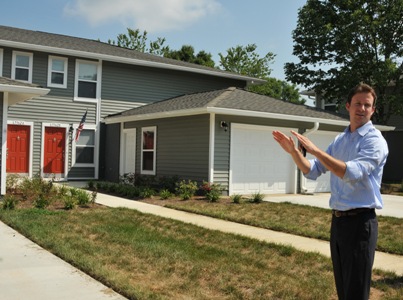
Now they’re getting a facelift, as the duplexes are being expanded, some to full-size homes with up to five bedrooms, large two-car garages, larger living spaces, bigger backyards, all which are being built around a new community center.
When the renovations are finished in November 2011, it will be a newly reconnected community.
“We’re really excited about moving into the new house. For a long time, this neighborhood has been thought of as the stepchild of Belvoir and now, we think, it will become the poster child for base housing here,” said Martin.
His wife, Leigh Ann, and their five children also look forward to trading in their old house for a larger model. One of the reasons why, the children say, is because of the neighborhood’s pool.
“We like it because it has a deep end and a shallow end, and it’s fun to swim in,” said 6-year-old Abby.
The Martins, along with thier newborn son, will move into the their new home in the renovated portion of the neighborhood soon. The home they’re in now sits in a series of streets where renovation work has yet to begin.
That area is near the community’s gated entrance, where much like at the Army base, a guard asks guests for a photo identification before they can enter.
Early in the last decade, the Army decided that is shouldn’t be in the businesses of managing military housing, and in 2004 hired a private firm to manage Woodlawn Village.
But when officials learned a year later that Ft. Belvoir would receive close to 20,000 new workers as part of BRAC, the Army wanted the homes renovated.
With 338 houses in the neighborhood open to anyone serving in any branch of the military in the National Capital Region, they’re expected to fill up fast.
“We got a lot of resident input on the project before we starting working here,” said Adam Owens, with Ft. Belvoir Residential Communities. “We asked them, ‘what do you like?’ and ‘what don’t you like in a new home?”
In addition to spacious floor plans, walk-in closets, durable carpet and bright lighting, new appliances and telecommunication features, they also learned residents wanted a center of community where it wasn’t absolutely necessary to go on base to attend neighborhood functions and family get-togethers.
A newly constructed series of sidewalks connects the houses with the new community center, workout rooms, pool, play grounds and a wetland that sits nearby.
Military members use their base housing allowances to pay the rent for the homes. The average lease costs $2,300 per month, but it can range from $1,794 to $2,914 per month, depending upon the military member’s rank and pay grade, and what size home they live in.
When it comes to who lives in the larger homes, that decision is based on a family’s need.
Since the Martins have five children they’re overqualified for their new five-bedroom home. Other families who might have a large number of children or are caring for older parents would also be allowed to live in the larger homes.
The private firm will manage the property for another 44 years, said Owens.
During that time, after the initial renovations are completed, the firm can opt to add smaller upgrades to the neighborhood.
Correction: An earlier version of this story incorrectly identified Master Sgt. Bill Martin. His name has been corrected.
