

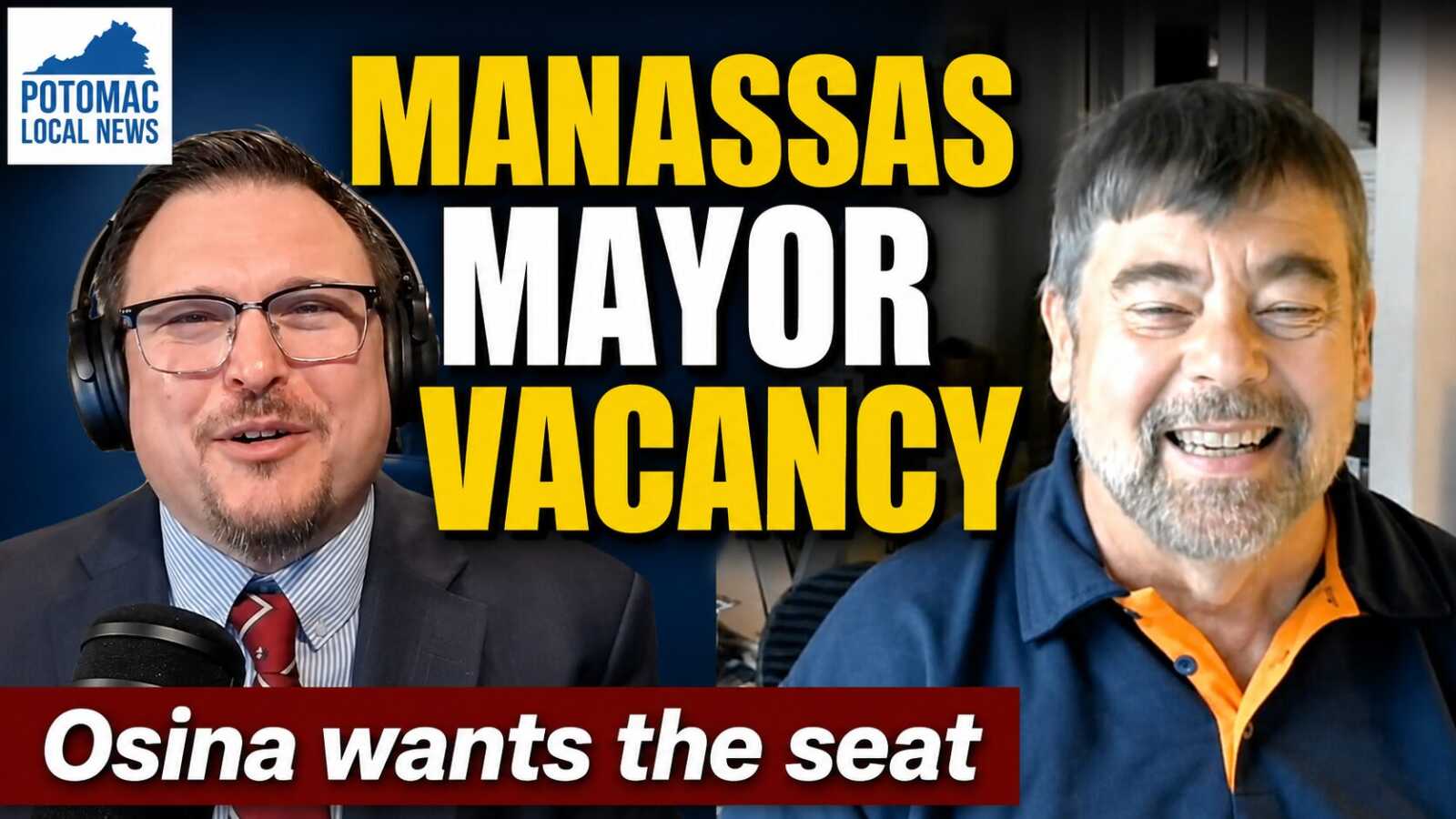
Manassas City Council member Tom Osina says he wants to succeed Mayor Michelle Davis-Younger — first as the council’s interim pick, then as the Democratic nominee whenever voters get a say.
Watch or listen to the full Potomac Local News Podcast conversation with Osina below. The interview is the source for what follows.
Davis-Younger leaves office Sept. 30, after a final council meeting Sept. 28. She won a new four-year term in 2024, then said in February she would serve only part of it and step down at the end of 2026. The city later confirmed the date had moved up by three months.
That starts a short clock. Osina told Uriah Kiser on the Potomac Local News Podcast that state law gives council from Oct. 1 to Nov. 14 — about 45 days — to appoint an interim mayor. If council does not act, circuit court judges can fill the seat.
“I’m interested in being the interim mayor, but my real goal is to be the nominee of my party to run in the election whenever that might be,” Osina said.
Vice Mayor Mark Wolfe has also said he wants the job. Both are Democrats. Democrats hold the council. Republican Theresa Coates Ellis is the lone GOP vote. Osina said it is “highly doubtful” the appointment lands in court.
He has run on a ticket with Wolfe in 2020 and 2024 and served with him for two terms. Their votes usually line up. When they do not, Osina said, the rule after the gavel falls is to move on.
“I expect that while both of us are interested, particularly for our party’s nomination, that it will be amicable,” he said. “Friendly.”
He does not want that choice made on camera. The six members have to talk about who is a fit and who is not, he said, and those conversations are easier in private than on the dais.
“That’s hard conversations to have with people that you’re working with,” Osina said. “It takes remarkable effort, strength of character, to not internalize that.”
A vote he would give up
The mayor in Manassas is not the policy vote. Council sets policy. The mayor runs the meeting, is the ceremonial head of the city, and breaks ties. Osina would give up a regular council vote to take the job.
The Wawa project was the example Kiser raised — a 3-3 vote the mayor broke. Osina said those votes have to be judged by what council knew at the time, not by hindsight.
Residents still call the mayor first, he said, not six council members. That is the part of the job he wants: outreach, neighborhood walks, and bringing “pain points” back inside City Hall.
He has spent two years on Saturday neighborhood walks with a school board member, knocking doors and asking for “the good, the bad and the ugly.” He drops into Historic Manassas Inc. when he is already in Old Town.
“I believe that I am better in my position when I hear more opinions,” Osina said. “That means doing the hard work of getting out of City Hall.”
Data centers, taxes, and a 10-square-mile city
The city is about 10 square miles and mostly built out. Industrial land still allows data centers by right. Osina said he has started asking staff — and wants a future work session — whether that should continue, whether every request should come to council, or whether there is a middle ground.
“When I first got on council, we were just starting to be approached,” he said. “Here we are six years later, and our understanding is a little bit different. We see more of the negative side.”
The only data center he described as operational inside the city is the old brickyard site on Godwin Drive. Others are under construction on Dean Drive. More county buildings sit just across the boundary, which is why he still gets calls about projects he said Manassas does not control.
On the tax bill, he would not promise a lower rate as mayor. Council, not the mayor, sets the rate. He said the better question is what residents expect city government to fund, then how to pay for it. Real estate taxes are still the city’s biggest source. Data centers coming online will add money, he said — “don’t think that it’s going to bring in like a hundred million dollars” — and council will have to choose whether that buys down the rate or pays for work such as a new fire station and a wastewater-plant expansion.
He is open to looking again at a school revenue-sharing formula. Manassas used one in the mid-2010s and dropped it before he reached the dais. He has pushed for more school funding in some years and lost that argument in the latest budget. Money is “part of the equation,” he said, not a switch that turns around a division that still ranks among the state’s weaker performers. Extra dollars that did go to schools, he said, went to salaries and coincided with a teacher retention rate the division once put near 93 percent.
What he would not try on the podcast
Kiser asked about School Board member Sara Brescia’s lawsuit and her claim that colleagues used closed session against her, including an allegation involving her children. Osina would not rule on the allegations.
“I’m not going to comment on any of the specific about the allegations,” he said. “It is a school board matter.” Voters and a court will sort it, he said. On his neighborhood walks, he added, the fight does not come up. People ask about quality-of-life issues.
He also would not adopt school board candidate Marina Dove’s social-media lines about putting God back in schools. Elected officials have personal beliefs, he said, and still have to represent the whole city and follow federal and Virginia law.
“I would expect that Ms. Dove, if elected, will follow what the laws are,” Osina said. “She is one of seven, just like I had to learn when I first got elected.”
Davis-Younger’s last month
Osina would not write a tidy verdict on the outgoing mayor. He said every officeholder has critics, including him. Davis-Younger’s standard, he said, will be the one the next mayor is measured against, the same way she was measured against Hal Parrish.
He credited her with making the office her own — White House and regional events earlier in the term, work on the Old Town Inn site that opened the door to Center Street, a parking garage, and a hotel conversation, plus recognition for women veterans and a habit of talking about Manassas in public as a place that works.
“She did take the position of mayor and changed it,” Osina said.
Council still has to pick who sits in the chair Oct. 1. Osina has asked for that appointment. Wolfe wants it too. The cameras, Osina hopes, stay off until the vote is done.
Watch or listen to the entire podcast
The quotes above are from Osina’s interview with Uriah Kiser. Watch or listen to the full episode for the complete exchange on the interim appointment, data centers, tax bills, schools, and Davis-Younger’s last month in office.
