

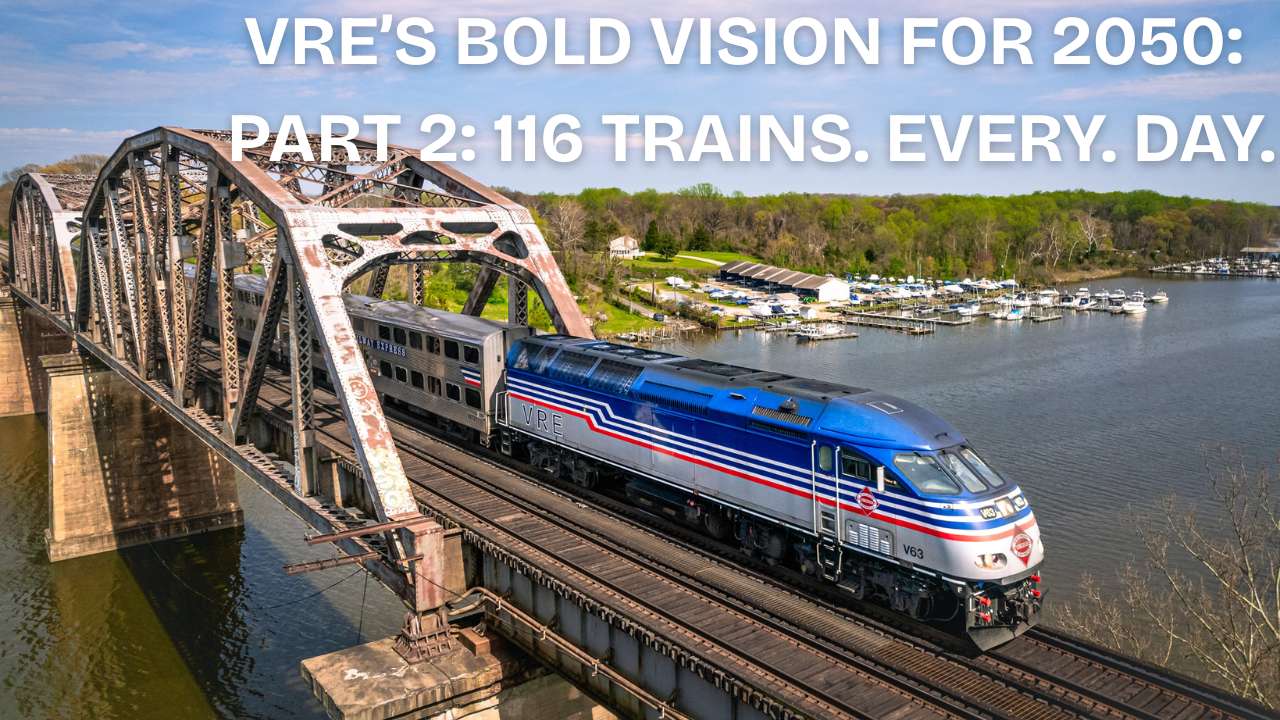
Editor’s Note:
This is the second in our three-part series on the future of Virginia Railway Express (VRE). We’re breaking down VRE’s bold System Plan 2050 — and what it means for you.
Stay informed on local news and transportation updates by signing up for our free email newsletter.
Part 2: More Trains, More Often: What Riders Can Expect by 2030 and 2050
If Virginia Railway Express’ plans come to life, the next 25 years will bring big changes for riders.
By 2030, VRE expects to have 52 weekday trains running smarter schedules — adjusting departure times to better match where and when people actually need trains. While the number of trains won’t increase immediately, the system will optimize when and how they run, with more options during off-peak hours and better reverse commuting opportunities.
The biggest shift comes later:
By 2050, VRE envisions running 116 daily trains and offering hourly weekend service in both directions on both the Fredericksburg and Manassas lines — something unimaginable a decade ago when VRE was purely a commuter-focused railroad.
Weekend travel is a major focus. Leaders say demand is already there: people want alternatives to sitting in Interstate 95 traffic for weekend trips, shopping, and family outings.
“This plan recognizes that people don’t just move Monday to Friday anymore,” planner Nick Ruiz said. “We need rail to be an everyday option.”
However, full Saturday and Sunday service will take time. Major infrastructure improvements, including track upgrades and new storage facilities, must be completed first — likely by the early 2030s.
In the meantime, VRE is exploring limited Saturday service and partnerships with Amtrak that could allow VRE ticket holders to ride Amtrak trains on weekends. Still, cost remains a concern, with Amtrak tickets significantly more expensive than VRE fares — a potential barrier for families.
Behind the scenes, VRE CEO Rich Dalton praised the customer service team for helping smooth the return of riders, many of whom are using VRE Mobile, the app for purchasing tickets. About 70% of riders now use VRE Mobile, a major jump from pre-pandemic habits.
Dalton also noted a shift in rider purchasing behavior:
- Before COVID-19, monthly passes were dominant.
- During and after the pandemic, riders switched to 10-trip flex passes.
- Now, VRE expects many to return to monthly passes as commuting stabilizes, though officials are monitoring ticket trends carefully.
“There’s a lot of work behind the scenes to make all this happen,” Dalton said. “It takes about 240 people to operate VRE every day, but only about 60 are regular VRE staff. The rest are our partners — and they’ve stepped up.”
What’s Next:
In Part 3, we’ll tackle the big question: How will VRE pay for all this? We’ll break down the price tag, the challenges ahead, and why leaders say the investment is worth it.
Get future updates straight to your inbox. Sign up for our free newsletter here.
