
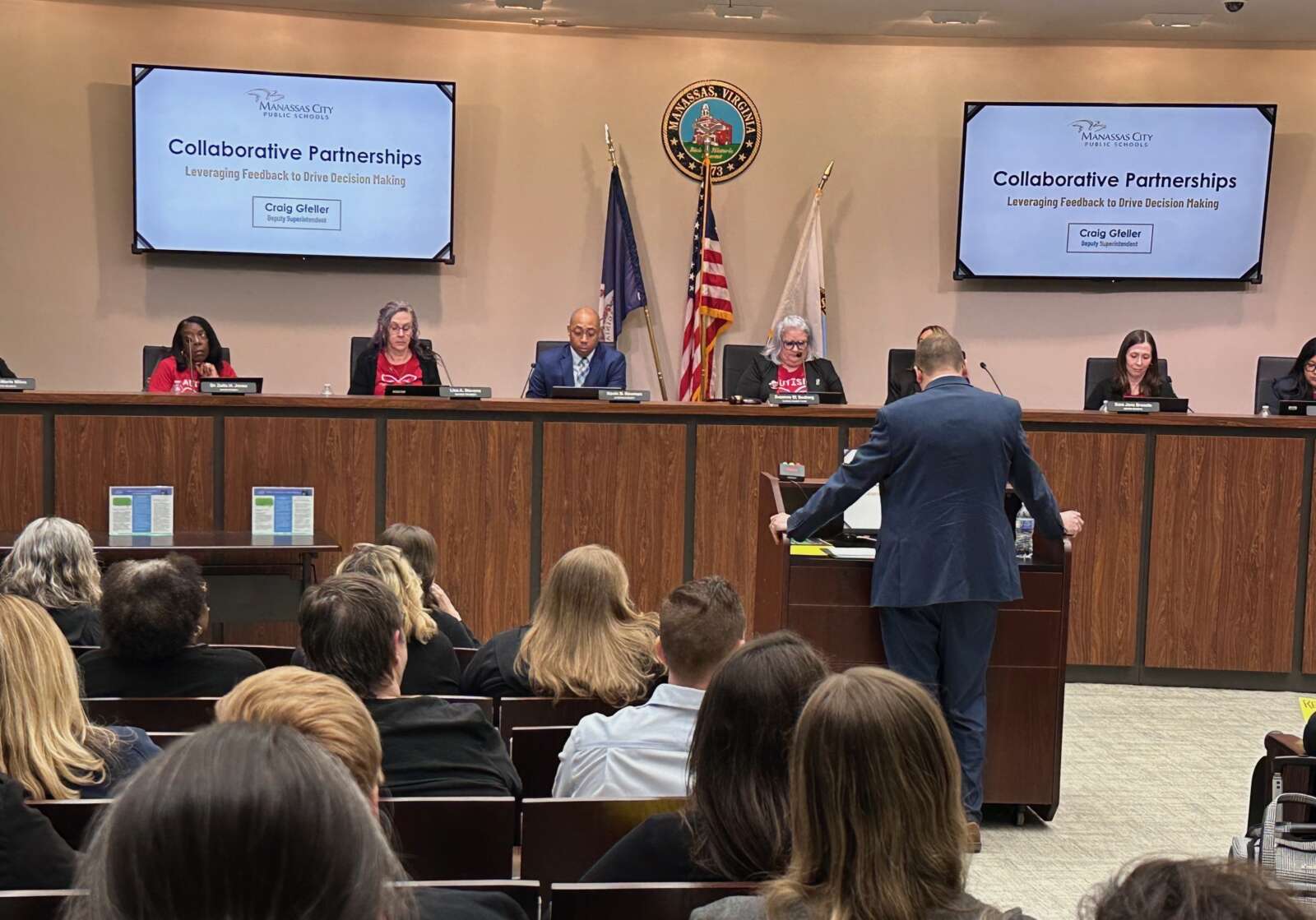
MANASSAS, Va. — The Manassas City School Board on Tuesday heard an update on the division’s plan to adopt a new primary mathematics curriculum resource, set to be implemented in the 2025-26 school year.
Dr. Ed Stevenson, director of instruction, and Deputy Superintendent Craig Gefeller presented the plan and explained how the state’s accelerated rollout of new math standards forced the division to revise its typical adoption process.
“Unlike previous years, there was no crosswalk or transition year built into the new standards,” said Stevenson. “That meant we had to align our local curriculum immediately for this school year and plan for adopting a new core resource the following year.”
The Virginia Department of Education has approved a broader set of math materials for use in K–12 classrooms, with seven to 12 resources available at each level from kindergarten through Algebra 2. The state has not released approved resources for higher-level courses, so Manassas will conduct its own review for those.
Timeline for Adoption
The school division will begin forming a resource adoption committee in May, composed of classroom teachers, ESOL and special education instructors, math specialists, and school and district administrators. Participants will be compensated for work done outside of contract hours.
Committee members will review sample resources over the summer and narrow their selection by November. The public will be invited to review the shortlisted materials in December and January through the division’s website, social media, email, and in-person appointments at the district office. A final recommendation will be made in February 2026.
The School Board is expected to vote on the adoption in May 2026, with the purchase finalized in July to prepare for classroom use beginning in August.
The cost of the new curriculum is estimated at $2 million and will be covered through the division’s standard operating budget.
Current Curriculum
Stevenson confirmed that elementary schools currently use a program called ORIGO Stepping Stones 2.0, which has been in place for the past six years. ORIGO was not submitted for state review and is not among the approved materials. New resources under review will be evaluated in comparison to ORIGO’s structure and pacing.
Stevenson assured board members that professional development is already underway to support teachers with the new standards—particularly in the area of math fluency. Once a new resource is selected, additional training will be offered to ensure educators are prepared to implement it.
Board members, including Dayna-Marie Miles and Sara Brescia, asked questions about the transparency of the review process, committee participation, public engagement, and budget timing.
“This is a more standard adoption timeline,” Stevenson said, contrasting it with the Virginia Literacy Act rollout, which required extensive and rapid changes to reading instruction.
Miles emphasized the importance of including ESOL and special education teachers in the adoption committee, to which Stevenson confirmed their participation.
The school division hopes the open call for committee members yields a wide range of expertise and strong engagement from educators.
“This timeline allows us to get feedback from all the right voices—teachers, the public, and subject matter experts,” Stevenson said. “We’re committed to making the transition smooth and informed.”
The next steps include outreach to educators for committee participation and preparing sample materials for summer review.
