
WOODBRIDGE — A two-inch piece of PVC pipe burst, spewing water down three of four floors at the Woodbridge Campus of Northern Virginia College.
The Jan. 24 flood displaced 855 classes on campus, affecting some 10,000 students from the day it happened on Wednesday, Jan. 24 until students returned to the campus on Tuesday, Feb. 12.
For three and half weeks, students and faculty displaced from the flooded section of the college building took classes both on and off-site in places across the street like Freedom High School, and down the street at All Saints Lutheran Church in Dale City.
Campus Provost Dr. Sam Hill is still assessing the damage, but he said early repair estimates indicate it will cost millions of dollars. Desks, classroom electronics, lighting fixtures, drywall, an entire computer lad — all damaged when the sprinkler pipe burst.
“This is a first for me,” said Hill, whose spent nearly 40 years as an educator. “There are people who say don’t tell me to panic, help me build an arc.”
As soon as the water from the burst piped stopped flowing, Hill’s team sprang into action looking for places to house students who had just returned to class from winter break eager to start the second-half of the academic year.
Students were moved to temporary classrooms at the campus’ new Workforce Education Center, a short walk from the main portion of the campus where the flooding took place. Others were crammed into the arts and sciences building next door.
For weeks, instructors taught in large, open rooms like the gym at the Dale City Boys and Girls Club and Grace Lutheran Church with eight-feet dividers temporary dividers making temporary classrooms.
[ngg_images gallery_ids=”820″ display_type=”ds-nextgen_royalslider”]
Faculty also taught in temporary classrooms at Strayer University near the intersection of Minnieville and Caton Hill roads in Woodbridge.
As time went on, costs piled up, as the college was paying $10,000 to $12,000 a week to rent off-site classroom space.
Hill praised the community for moving so fast to accommodate the displaced faculty and staff.
Susan Thompson is an associate history professor, whose office and classroom is on the third floor down the hall from where the pipe burst. She was preparing for class and didn’t hear the pipe burst. A co-worker came into her office to alert her.
“We’re having a water event,” her co-worker told her.
Thompson said she didn’t know what a “water event” was, and said her co-worker is apt to use terms like that after working years in the federal government and used a special “government speak” vocabulary.
She ignored the warning, but soon, the flood demanded her attention She described seeing a cascade of water flowing from a point where the wall meets the ceiling.
“Had she said ‘food,’ I would have known what she was talking about,” added Thompson.
The indoor river now two inches deep and rising snaked through the hallways and into an elevator shaft, crippling the car.
“Water was just flowing,” said Dona Clark, a Spanish instructor whose taught at the campus since 1991.
With the building evacuated and water off, police escorted Clark and others inside the building to salvage what they could so they could teach classes off-site or remotely
Clark taught classes at Strayer for the time she and her students have forced out the building while repairs began. She had to adjust to teaching without some of the creature comforts of her classroom, like a projector, and course manuals. But she adapted.
And so did the students, many of whom are older and rely less on students loans and instead pay for classes with money from their own pocket. Everyone I spoke with told me no one asked for classes to postpone or canceled during the event.
Jennifer Sorto, 20, took classes in the arts and science building next door, which quickly became cramped with the influx of displaced students.
Sorto and her classmates stayed glued to the Blackboard application used by students to keep up with classwork. She used email to keep in constant contact with professors.
This is the student government president and computer science major’s last semester at NOVA. She’ll transfer this fall to Virginia Tech with an Associates Degree.
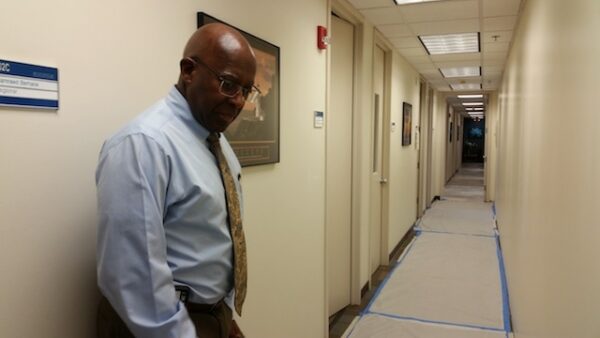
Hill walks the second floor of his campus, just below where the pipe burst. The tables and desks have all been removed from the classrooms where water flowed. Plastic covers desks and chairs in faculty offices on the second floor, and the drywall in the counselors’ office is ruined.
Only the fourth floor of the building was spared.
There was a flood like this before inside the Woodbridge Campus in the early 2000s, but it didn’t cause nearly the same amount of damage or displace students.
This most recent flood, dubbed by Hill as “Floodgate Woodbridge,” comes just fewer than 18 months before the affected portion of the building is due for a retrofit.
The building that flooded is the oldest on campus, built in the mid-1970s to get community college students out of the trailer classrooms being used at Woodbridge Middle School.
The recent flood probably won’t speed up the renovation timeline, said Hill. But when work is complete, the building won’t look like it does today. Walls will be removed to open up the floorplan, and more windows will be added for natural light, said Hill.