

Prince William police in late 2011 began seizing more and more heroin on the streets.
It was an early warning sign that the drug was becoming a problem in the community. Since then across the state, the use of heroin, fentanyl, and carfentanyl have exploded. The use of fentanyl alone increased 147% between then and now, according to Virginia State Health Commissioner Dr. Marissa Levine.
Despite the fact that so many Virginia residents are now hooked on opioids, the stigma that the drugs are used only by the poor or less fortunate is a contributing factor to the spread of the problem. Opioid addiction impacts everyone and does not discriminate by race, color, gender, or social class.
“This is a bigger problem that affects everyone, not just by race like we saw with crack or PCP,” said Prince William County District Court Chief Judge William Jarvis.
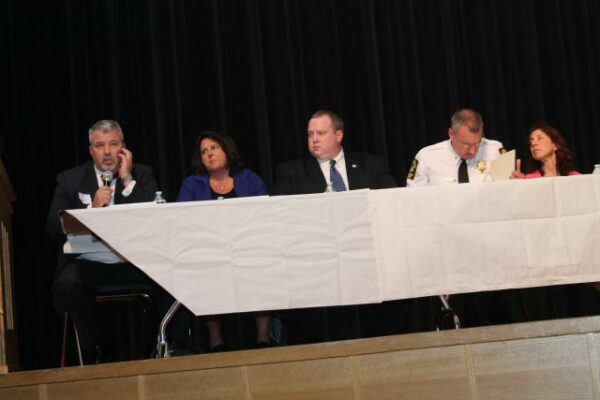
The Virginia Health Department on Thursday gathered 18 public officials in local, state, and federal governments, as well as the public at Forest Park High School near Dumfries to discuss the growing opioid problem in the community. In 2015, the latest data available on a Virginia Department of Health website, a total of 13 people died of an opioid overdose in Prince William.
The numbers continue to rise.
“Prince William County tends to be affluent but there are are some areas in Manassas and Manassas Park that are tough for people to get the healthcare that they need,” said Lavine.
Many opioid users start out by taking prescription drugs and then graduate to heroin, which today can be 90% fentanyl, a synthetic drug designed to be twice as potent as morphine.
Carfentanil, a substance that can be deadly if inhaled or touched, is also be being abused and injected. One gram of the substance can kill.
The names of the drugs found on the streets show a message of death. Some of the drugs seized by Prince William police were marked “C.O.D. Cause of Death.”
“I don’t know if that would be the best name for your product if you were marketing something,” said First Sgt. Kenneth Hulsey, Prince William police Narcotics Taskforce. “An addict wants to use the strongest drug possible, so if they know someone that was killed by using it, they want to acquire it.”
Children and teenagers are also affected by opioid addiction. Many babies, called “innocent bystanders” are born into addiction. Teenagers often begin by finding and using prescription drugs and graduate to heroin.
In the old days, a marijuana bong found in a child’s room was a tell-tell sign they were smoking pot. Today, those signs are not that obvious. Hulsey said to look for unusual objects in a child’s room like a roll of tin foil, or a cut off an aluminum can — items used in the place the powdery drugs inside and cook them for use by injection.
The drugs go by the names “dope,” “down,” “H,” “dog food,” and “gravel.” They’re often sold by the “point,” with one point equal to a tenth of a gram of the drug. Parents were told to check text messages on their children’s phone and look for any of the above references.
“You need to catch it early to we don’t end up at your house cleaning up a body,” said Hulsey.
Those suffering from opioid addiction were urged to call the Prince William Health District at 703-792-7800 for intake into a detox program. Area police said they’re more interested in getting finding addicts help to incarcerate them.
“We know we can’t arrest our way out of a problem,” added Hulsey.
