

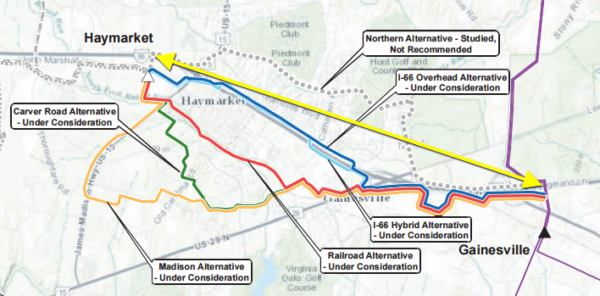
The Virginia State Corporation could go either way, telling Dominion Virginia Power that a proposed power transmission line along Interstate 66 to serve a new data center in Haymarket could run above ground, or that it could allow the utility to build hybrid option where part of the power line is buried.
The hybrid option is popular with residents who don’t want to see a 230-kilovolt transmission line when they look out their windows and are concerned about what a towering power line could do for property values. Last year at a series of public meetings, Dominion officials said an above-ground line provides more reliable service and costs less to maintain.
The Virginia State Corporation Commission (SCC) and Dominion differ, however, on who will pay for whatever power line is built in western Prince William County. In previous cases, the cost to construct a new transmission line had been picked up by ratepayers, also known as Dominion customers.
An August 5th report issued by the SCC states that the new data center requesting the new transmission line, commonly rumored Amazon, Inc., should pay the cost of placing a portion of the transmission line underground, should the hybrid option be selected.
That cost could be as much as $115 million, states the report.
Officials at Dominion Virginia Power are still pushing for the overhead option. Company spokesman Chuck Penn issued this statement:
“…we firmly believe we have proven that the line is needed, that the I-66 Overhead Route reasonably minimizes adverse impacts at a reasonable cost, has minimal construction impacts, can be constructed in time and that the cost recovery of this transmission line should be treated in the usual way that all electric transmission lines are treated – since this line will benefit the electric transmission grid as a whole and will have broad general public benefits on day one of its completion.
The company also disagrees with the assessment that the data center should pay the amount of the increased costs.
Penn continued:
We respectfully differ with the SCC staff’s interpretation of the facts and law in this case as it relates to cost recovery. The Hearing Examiner presiding over this case still has to issue his report of findings based on the evidence and arguments presented at the hearing and make recommendations to the Commission. Ultimately, it is for the SCC Commissioners, based on the evidence and facts properly presented, to determine the final outcome.
A final hearing with the SCC commissioners has yet to be scheduled. Two public hearings about this case were held in Richmond on June 21 and 22.
