

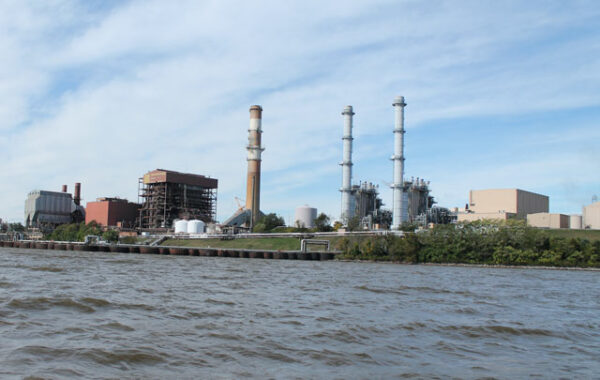
Prince William County will not appeal a plan to treat and release once toxic water into the Potomac River.
The county government and energy giant late Tuesday released the details of a settlement between the two organizations. Prince William officials in December chided Dominion for what it they claimed was a lack of transparency for plans to release water coal ash ponds into the Quantico Creek and Potomac River, that are currently stored at the Possum Point Power Station.
Stated a Dominion press release:
Dominion agrees with the Prince William Board of County Supervisor’s findings that the health and safety of its citizens, the environment, and aquatic life are fully protected.
Under the agreement, Dominion agrees to go beyond federal and state requirements and add enhanced protections in operating state-of-the-art treatment equipment already planned for the project and to provide additional water treatment if monitoring shows elevated levels of certain constituents.
“Dominion will always be committed to keeping Quantico Creek and the Potomac safe for fishing, boating, swimming and all the activities we Virginians love to do. We look forward to moving ahead with this important environmental project,” said Pam Faggert, chief environmental officer for Dominion. “The county has helped us create a plan that reflects Dominion’s and the County’s shared commitment to maintain the quality of these two waterways.”
Coal ash is a toxic byproduct of burning coal to make electricity. Before 2003, when the plant switched to natural gas, the ash was buried in ponds at the site. Federal orders from the Obama Administration
mandate the closure of such ponds.
Virginia’s Water Control Board approved a permit to allow Dominion to move ahead with the treat and release plan. Prince William County filed notice to appeal the permit, which led to “a productive dialogue with Dominion.”
A Prince William County press release notes the additional measures Dominion will take in monitoring of the water that is treated and released.
Dominion agrees to provide advanced treatment of all water from the coal ash ponds prior to discharge, regardless of whether this treatment level is needed to meet the required VPDES Permit levels.
Dominion agrees to take additional hourly samples, and if any of the samples exceed more stringent triggers for certain elements (arsenic, selenium, lead, copper, antimony, and thallium), Dominion agrees to provide an additional enhanced treatment step, thus assuring the final effluent concentrations will be considerably lower than required by the VPDES Permit.
Dominion will only use a State accredited third-party independent laboratory for its VPDES Permit-required sampling and testing, and it will work cooperatively with the County to address any concerns with the selected independent laboratory.
Dominion will implement Standard Operating Procedures and Quality Assurance/Quality Control protocols for the laboratory testing, consistent with industry best practices, after considering the County’s comments.
Dominion will regularly post on a publically accessible website all permit-required test results for public review.
Dominion and the County will work collaboratively to coordinate on solid waste permitting during the next phase of the closure of the inactive coal ash ponds to ensure that the Board’s and Dominion’s commitments to groundwater quality and environmental protection continue to be met.
Dominion will reimburse the County for its costs of outside technical consultation services regarding this state and federal regulatory matter about the water discharge and the solid waste permit application review. As such, the County and its citizens will not be responsible for these costs.
Late last year, Prince William County Board of Supervisors Chairman Corey Stewart, At-large called Dominion a “bad corporate citizen.” Despite the agreement reached today, that hasn’t changed.
“I still think they are a big, bad, arrogant corporation. I don’t think it was a threat of a lawsuit that changed their minds. They were facing a big black eye for what they were doing. They were behaving in a very arrogant way, and what we were asking for was very reasonable.”
Virginia’s Department of Environmental Quality — the agency that drafted the permit to allow the utility to treat and release the water — is now reviewing plans submitted by Dominion that outline the processes and procedures on just how they plan to accomplish their goal.
