

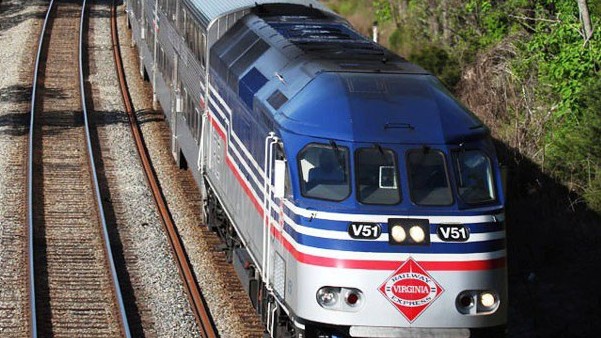
Virginia Railway Express (VRE) could face fines up to $25,000 a day starting in 2016.
This is one of the consequences that the Federal Railroad Administration (FRA) could levy against Virginia’s only commuter railroad for not meeting full federal compliance standards with implementation of “positive train control” by the end of 2015, according to VRE spokesman Bryan Jungwirth.
Positive train control is a combination of technologies that can automatically stop a train to prevent collisions and derailments, like the Amtrak train that derailed outside of Philadelphia in May.
Another possibility is that CSX, the railroad that owns the tracks that VRE’s Fredericksburg line trains operate on, could stop the trains from using the tracks until they are in compliance, stated Jungwirth.
Congress passed the Rail Safety Improvement Act of 2008, which mandated that all ‘Class 1’ railroads install positive train control by the end of 2015, according to documents from the Association of American Railroads (AAR).
Will railroads meet the deadline?
According to Jungwirth, many railroads will not meet this deadline.
“Everybody’s been aware of the deadline since 2008…[Congress] set up a compromise [when passing the bill] to have the deadline at the end of this year, but it wasn’t realistic. It’s a massive undertaking to try to do it between 2008 and 2015 – it really couldn’t be done,” said Jungwirth.
When the act passed in 2008, the technology for positive train control didn’t even exist yet, according to Jungwirth.
VRE purchased 19 new locomotives in 2010, which cost $77 million that was funded with state, local and federal government money. The locomotives were built by Motive Power in Idaho.
Jungwirth said positive train control technologies were somewhat available by 2010 when VRE purchased the new locomotives, but they chose not to purchase them at the time.
Additionally, VRE had a $5.1 million budget surplus. $2.5 million was used to acquire the new locomotives, $500,000 went to the company’s insurance trust fund and the remainder went to building a third track in Spotsylvania County.
Jungwirth stated that VRE currently needs to purchase radios and antennas for the positive train control mandate, but that Norfolk Southern, that runs the railroad lines that VRE uses, was also not in compliance with the technology on their tracks.
Amtrak on track to meet deadline
Amtrak spokeswoman Kimberly Woods said that Amtrak would meet the deadline.
“Amtrak is on schedule to activate PTC in the NEC by the federally mandated deadline of Dec. 31, 2015. Amtrak owns relatively few miles of the infrastructure we use – about 97% of our route mileage is owned by other railroads that host our trains. Installation of PTC is the legal responsibility of the railroad that owns the track,” stated Woods.
According to CSX spokeswoman Kaitlyn Barrett, the company is planning to spend more than $1.9 billion for compliance with the positive train control standards, but agreed with Jungwirth that the end of 2015 is an unrealistic deadline.
“More than 550 employees have been hired to focus on PTC, with 1,000 in total working on the system across our network. In 2015, we are planning to spend an additional $300 million in developing and deploying PTC…the industry has been steadfast in its comments that the 2015 deadline is not realistic. Given the complexity of implementation, we feel that extension is fair and reasonable,” stated Barrett.
What happens next?
The only way an extension for the railroads could be granted is an act from Congress.
Missouri Senator Roy Blunt introduced the Railroad Safety Act and Positive Train Control Extension Act to Congress in March, but no vote has been called on it yet. If passed, the act would extend the deadline for positive train control implementation to December 2020.
Congress will go into recess in August and September, so the timeline for a deadline to be extended is limited.
Rail companies, including CSX and VRE, are going to legislators to request they support the deadline extension, said Jungwirth and Barrett.
