
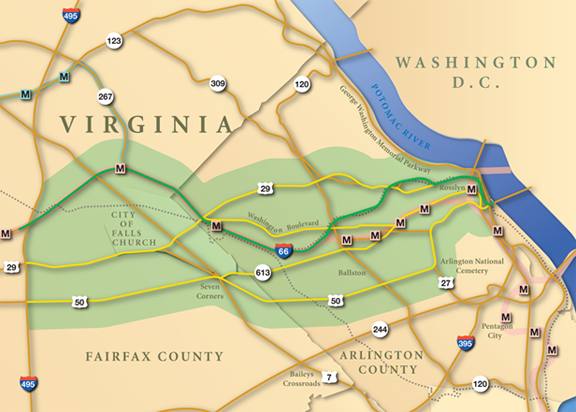
Virginia will move ahead with plans to put high occupancy toll lanes on Interstate 66.
But unlike new lanes that opened in December on I-95 between Stafford and Esdall Road in Alexandria, the lanes on I-66 will only be tolled during peak periods.
The idea is to move more people, not more cars. Virginia Transportation Secretary Aubrey Lane announced the new initiative this week in Fairfax.
“Drivers traveling on I-66 inside the Beltway face serious delays in both directions ranging from 2 to 5 miles each day,” said Layne in a press release. “Bus service and other transit options face connectivity challenges and are greatly impacted by this congestion and unreliability. Improving these conditions is going to take a transformation of the entire I-66 corridor, and it’s going to take more than one solution. Governor McAuliffe is committed to implementing the right solutions to improve this vital transportation corridor.”
Lane proposed tolls on the stretch of I-66 inside the Capital Beltway, from I-495 to Route 29 in Arlington’s Rosslyn neighborhood. Tolling would be imposed on both sides of the highway and work like this:
Vehicles with three or more people would travel the lanes for free during peak periods while other drivers would pay a toll to use the lanes. The lanes would remain free to all traffic during off-peak periods.
- Vehicles with three or more people would travel the lanes for free during peak periods while other drivers would pay a toll to use the lanes.
- The lanes would remain free to all traffic during off-peak periods.
Drivers on I-66 headed toward Washington in the mornings regularly hit a bottleneck at the Captial Beltway, when I-66 east drops from four lanes to two lanes. Other I-66 improvements outside the Capital Beltway, from I-95 to Haymarket are also under consideration.
The Virginia Department of Transportation would manage the tolling. Conversely, tolls on I-95 and 495 are managed by Transurban, a private company that also built the E-ZPass Express Lanes on those highways.
The tolls collected would go to fund new transit improvements in the I-66 corridor such as new bus routes on I-66, Route 29, and Route 50. The tolls could also go to fund improvements at Virginia Metrorail stations, as well as to ensure all Metro trains have eight cars, longer than the more common six car trains.
However, all of these multimodal improvements are still options on a table. Officials must still decide which project they want to fund. Whatever they do fund, the first fruits of the toll moneies could come by way of transit improvements as early as 2017.