At Riverside Center for the Performing Arts, the plates are still on the tables when the razors come out.
Uriah Kiser put that problem to the cast of Sweeney Todd: The Demon Barber of Fleet Street the morning after he sat through Stephen Sondheim and Hugh Wheeler’s musical thriller in a Stafford County dinner house. What happens, he asked, when the bloodiest show in the American musical catalog shares a room with dessert?
“You strike the balance with the character of Mrs. Lovett,” said Christopher Sanders, who is playing Sweeney for the fourth time and in his fifth Riverside show. “She is there as the comic relief.” Then he named her as the person pulling the strings.
That is the contract this production makes with Fredericksburg and Stafford through Oct. 25. You can laugh. You will also watch a man walk into the aisle, look at the tables, and decide that everybody in the house deserves to die.
The full conversation is on the Potomac Local News Podcast.
If you have never seen Sweeney Todd
The plot is a revenge story dressed as a Victorian penny dreadful, then scored like an opera.
A London barber named Benjamin Barker is shipped off on a false charge by Judge Turpin, a powerful man who wants Barker’s wife. Years later Barker comes home under a new name — Sweeney Todd — and finds the life he left in ruins. Mrs. Lovett, who runs a failing pie shop on Fleet Street, takes him in, parks a barber chair over her bakehouse, and helps him turn vengeance into a business. The pies improve. The line out the door gets longer. The joke gets worse.
Around that engine, Sondheim builds the rest of the city. A young sailor, Anthony Hope, falls for Johanna, the judge’s beautiful ward. A street boy, Tobias Ragg, attaches himself to Lovett and her pies. A Beggar Woman keeps circling the shop, saying more than the men on stage want to hear. The Beadle and the judge protect their own. Almost nobody in this London is only one thing.
The music does not behave like a conventional book musical. Numbers slam into the next number. The audience often does not know when to clap. Butler, a Sondheim lifer whose license plate reads SNDHEIM, said the title role sits close enough to opera that the difference is “where it’s staged.” Marco Giacona, who plays Anthony Hope, called the score nearly sung-through. “It feels like the music is always there.”
Kiser walked in cold. He had not seen the show on stage. He had not watched the Johnny Depp film. “You guys are it for me,” he told the company. What he carried out to the parking lot was the old warning: if you set out for revenge, dig two graves.
“I’ve never seen Sweeney himself as a villain,” Sanders said. “I see him as a man who’s been wronged who has been driven to the kind of insanity that has happened to him.” Give Barker a different set of facts, Sanders argued, and he marries Lucy, raises a child, and lives a normal life. Push any person far enough, and the feelings in this score stop looking exotic.
That is the door the production opens for a first-timer. The gore is real. The question underneath it is ordinary: what happens to a person, and to everyone standing next to him, when the injury does not stop.
The room, the chair, the hole in the floor
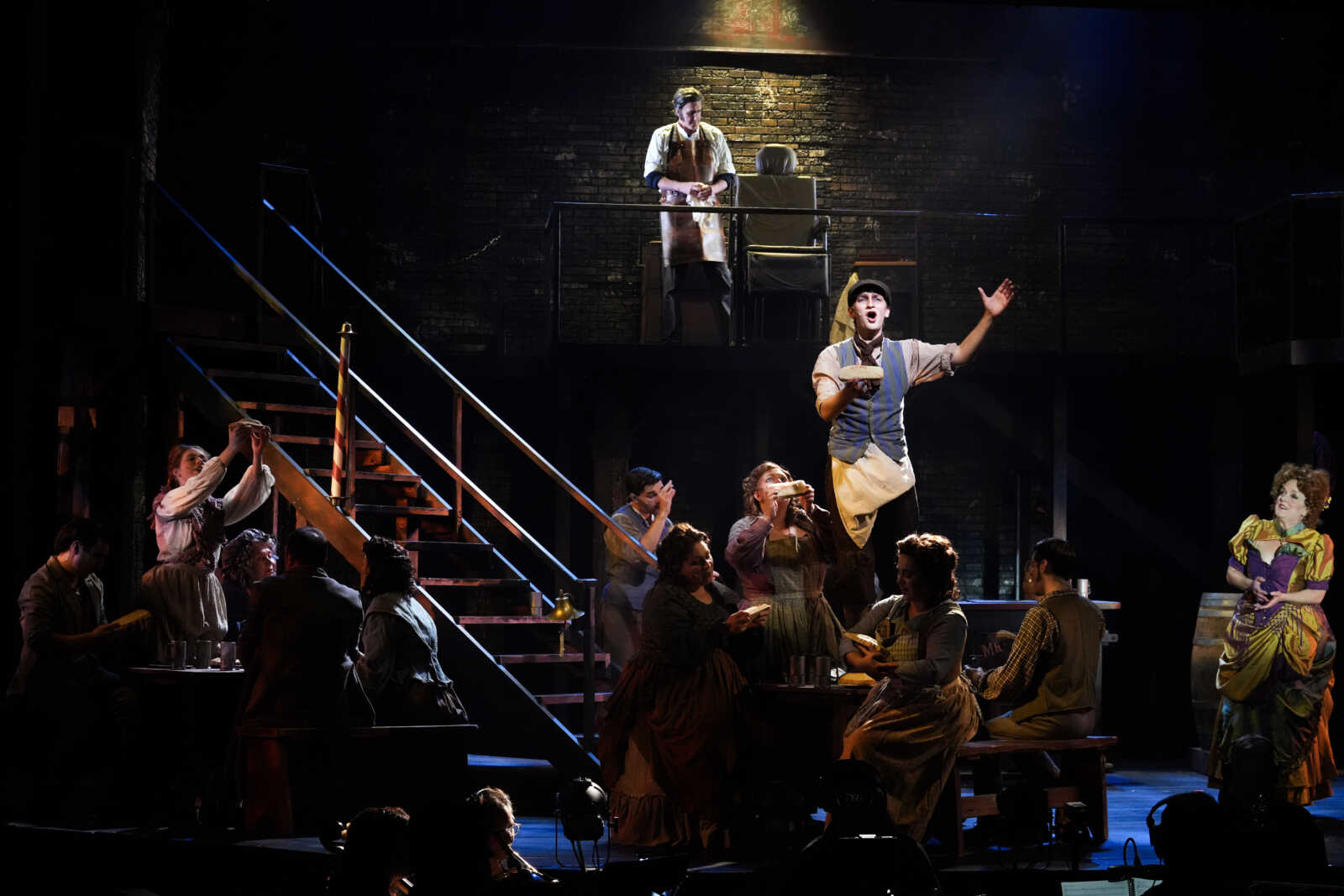
Riverside’s house is not a dark Broadway bunker. The orchestra sits in front of the stage. Dinner service happens in the same volume as the murders. The set uses a second level most community stages never bother with, so Fleet Street stacks over the pie shop and the barber chair hangs over a drop.
Kiser, who likes roller coasters, kept coming back to that chair. Nearly every major character takes a turn in it. The drop is timed to the music. Crew waits at the bottom with padding. Elizabeth Butler, who plays the Beggar Woman and is one of the four actors who actually ride the thing, said the stage manager went first.
“Keep your head back, your hands down,” Butler said. Her costume is bulky at the bottom. “I fly down that slide.”
What the audience does not clock, Sanders said, is the hole. In other productions he has signaled when the trap should open. In this one the trapdoor stays open for the entire second act.
“There’s just a big open hole up there on top of the stage,” he said. “So I have to make sure that I don’t step in that hole and that I work around that hole for the whole second act.”
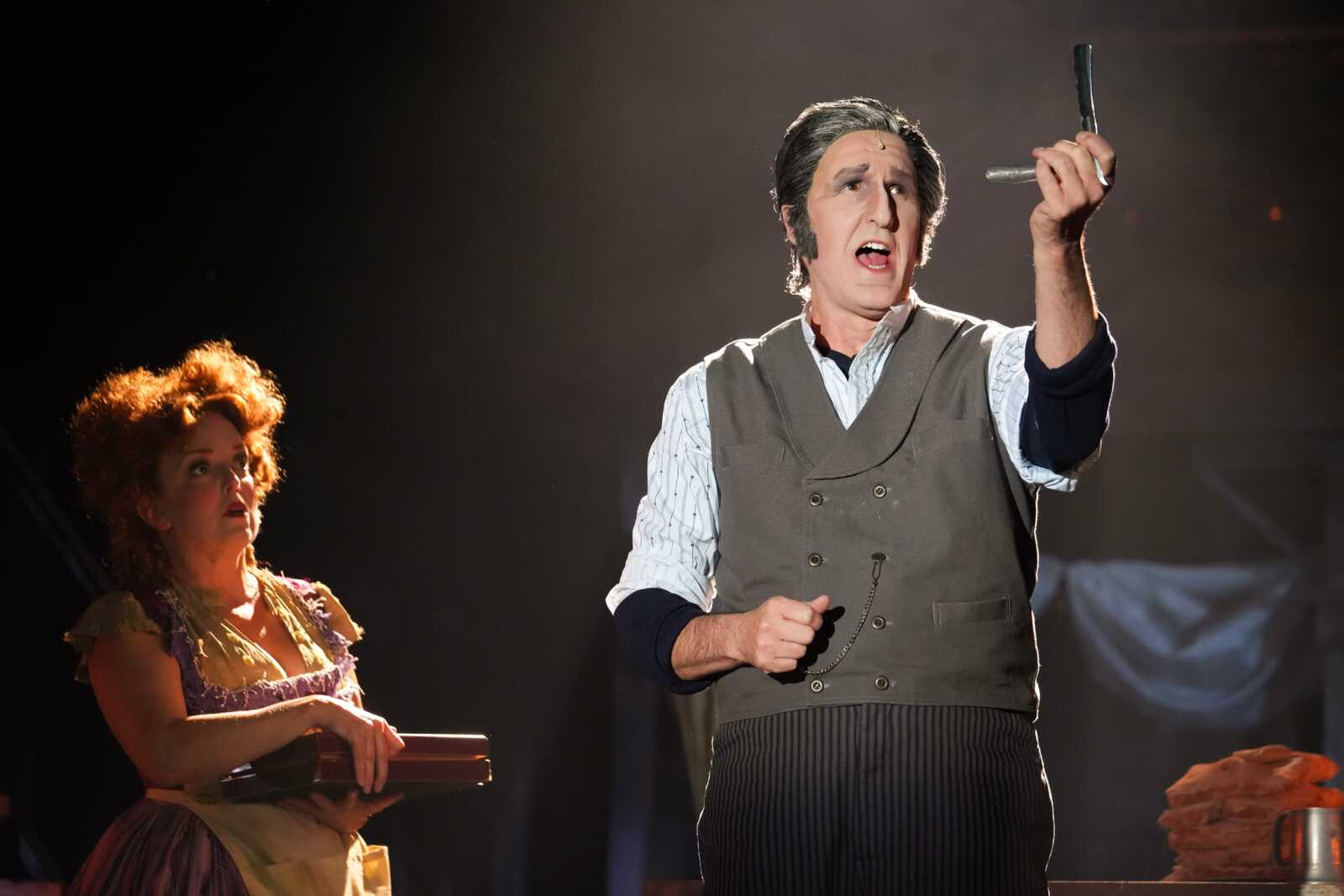
Another piece that doesn’t exist in a usual Sweeney is how close he gets to the paying customers. In “Epiphany,” the number where Todd snaps and sings that they all deserve to die, Sanders used to stop at the lip of the stage and point. At Riverside, he comes down into the house.
“Never have I been able to get that physically close to the audience,” he said. Before curtain, he scans the tables to pick a face for the blade.
The horror walks the same carpet the servers used an hour earlier.
Act 2 tightens. Cox and the ensemble work a lunatic-asylum sequence behind a sheet, throwing big silhouettes while Anthony tries to reach Johanna. Cox called Johanna a dream role and said the girl does not get much of Act 2 until that sprint. From the floor, Marco Giacona said the music under the scene was hard to think through in rehearsal, which is the point. “It should be unsettling.”
Elizabeth C. Butler, in her 30th-or-so Riverside show, plays the Beggar Woman and has the night’s other secret. She watched Sanders play this part years ago at Shenandoah. Giacona and Sheldon are new in the building. Butler is not.
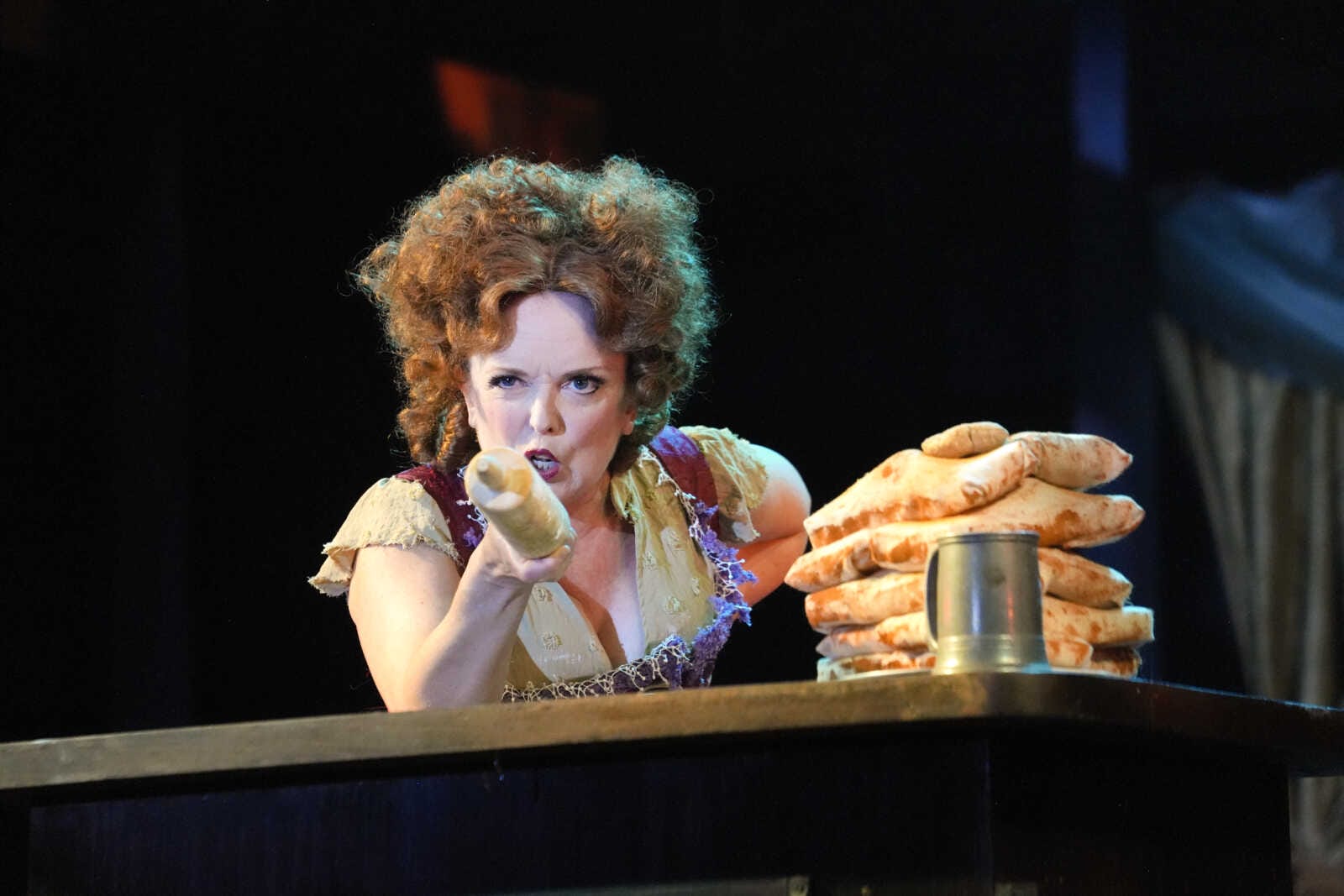
Nancy Anderson plays Mrs. Lovett — the role Angela Lansbury originated — and Sanders said she is the reason the room is allowed to laugh. She also, he said, is the true villain: the one who sees the bodies, sees the oven, and makes the business plan.
Kiser watched her belt while sprawled across the couch with Todd and could not figure out how Sanders kept a straight face.
“She gives me looks and she’s pinching me and doing all the stuff that the audience doesn’t even see,” Sanders said. “And I’m trying to be all serious.”
He called the ensemble the people with the hardest job in the piece: more music than the leads, nastier harmonies, wider range. “It’s the sum of the whole, not the sum of the one, that really makes this show sing.”
Tickets, pies, the demon drink
The run is seven weeks, Sept. 9 through Oct. 25, at 95 Riverside Parkway, Fredericksburg. Evening shows start at 7:30 p.m. Thursday through Saturday. Matinees are Wednesday at 1:30 p.m. and Sunday at 3 p.m. The running time is about two hours and 30 minutes, with a 20-minute intermission.
Show tickets start at $67 for adults, $62 for seniors and military, $55 for children 3 to 17, and $35 for same-day rush. Dinner is $25, plus tax. Riverside sells the two pieces as a two-step checkout at RiversideDT.com. Box office: 540-370-4300.