

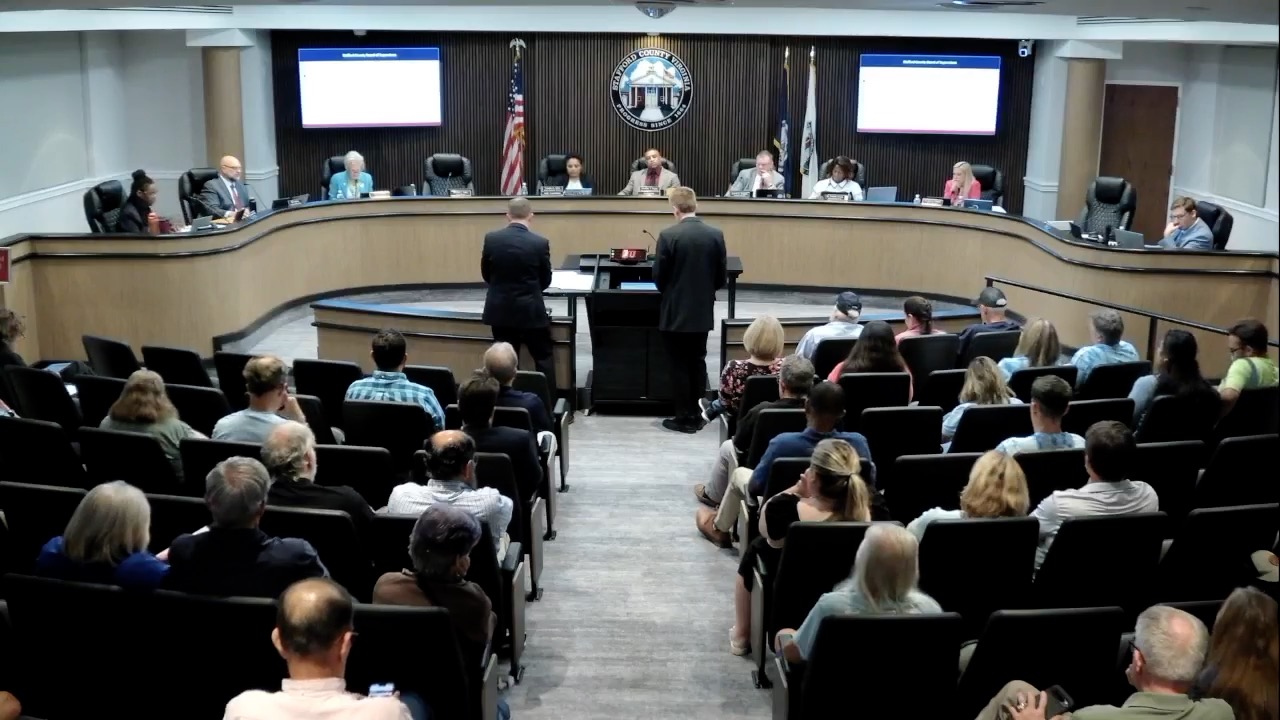
During the Stafford County Board of Supervisors meeting on July 7, 2026, Supervisor Crystal Vanuch (Rock Hill District) expressed strong concerns about the potential reimplementation of a Business Professional and Occupational License (BPOL) tax, warning that it could harm local small businesses and urging residents to participate in an upcoming public hearing.
Vanuch, who reviewed discussions from a recent work session she could not attend, stated she was “appalled” that the tax appeared to be moving forward. She noted that Spotsylvania County is actively working to eliminate its similar BPOL tax. “The general consensus is that it’s gonna crush our business growth in Stafford County,” she said.
The supervisor highlighted a key feature of the proposed tax: it would apply to gross receipts rather than net profits. This structure, she argued, fails to account for operating expenses and could disproportionately burden small businesses and restaurants.
“If you are gonna tax a small business, a restaurant, a local mom and pop shop on their gross receipts of even one to two million dollars and not take into account their operating expenses, that is grossly, absolutely negligent,” Vanuch said.
She contrasted the pace of the BPOL tax discussion with adjustments to data center tax rates, noting the latter were not advancing as quickly. Vanuch suggested that if the board proceeds with a BPOL tax, it should apply only to businesses with significantly higher gross revenue—at least $10 million.
“I will do everything in my power to stop this from moving forward,” she added. “I want to warn the community, you better come out and speak at this public hearing because if you don’t, your small business taxes are absolutely going to go up.” The hearing is expected in September.
Context on Stafford’s BPOL History
Stafford County previously collected a BPOL tax on business gross receipts but eliminated it in the late 2000s. The repeal occurred amid rapid growth and was positioned as a pro-business move to support job creation and economic development.
County documents from the FY2010 budget cycle reference the discontinuation, even though the tax was previously estimated to generate millions in revenue. Stafford has since marketed the absence of a BPOL tax as a competitive advantage compared to neighboring jurisdictions. Periodic discussions about reinstating a version of the tax have arisen in recent years amid budget pressures.
Vanuch’s remarks came amid broader fiscal discussions at the meeting, including approval of a FY2027 real estate tax rate increase (to $0.9675 per $100 of assessed value, effective July 1, 2026). That hike, combined with rising property assessments, has added hundreds to thousands of dollars to many homeowners’ annual bills.
The BPOL proposal aligns with ongoing conversations about alternative revenue sources as the county balances growth, school needs, infrastructure, and residents’ affordability.
For Stafford’s mom-and-pop shops and family-owned restaurants, the potential tax represents a direct hit on local businesses that often operate on thin margins. These establishments serve as community anchors, providing jobs and contributing to the county’s character.
The comments reflect divisions on the board regarding tax policy priorities. While data center development generates significant attention and revenue, Vanuch and others emphasized protecting smaller enterprises that form the backbone of Stafford’s commercial landscape.
