
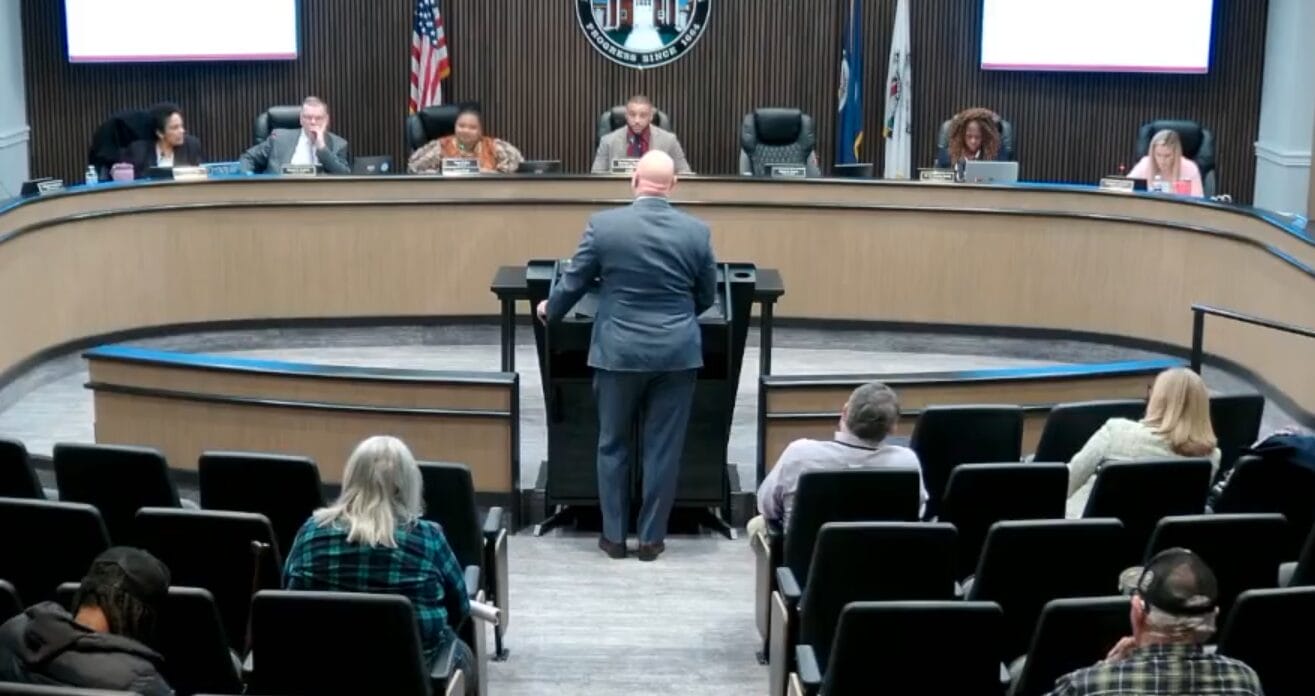
The average Stafford County homeowner could pay $370 to $462 more per year under the proposed FY2027 budget presented to the Board of Supervisors on Feb. 17, 2026.
The increase follows a recent property reassessment and a proposed tax rate hike to offset growing state-mandated costs.
Key Takeaways
- Date: Feb. 17, 2026
- Location: Stafford County Government Center
- The proposed real estate tax rate would rise to $0.985 per $100 of assessed value, up 6.14 cents from the current rate.
- The typical homeowner would see an annual increase of $370 to $462 due to the higher rate and a 10% rise in residential property values.
- County Administrator Bill Ashton presented the budget, citing $40 million in state-mandated tax relief programs as a primary driver.
- Supervisors expressed concern about the impact on residents, particularly those on fixed incomes.
Full Coverage
County Administrator Bill Ashton introduced the FY2027 budget proposal to the Stafford County Board of Supervisors during its Feb. 17 meeting, framing it as an effort to balance community needs with long-term fiscal pressures. Ashton recommended increasing the real estate tax rate from $0.9236 to $0.985 per $100 of assessed value.
Combined with the county’s 2026 reassessment — which raised residential property values by about 10% countywide and set the median assessed home value at $477,100 — the change would push the median annual tax bill to roughly $4,699.
By comparison, the average residential tax bill stood at $2,506 in 2012. When the FY2026 budget was adopted in April 2025, the average bill had climbed to about $4,069 for a home assessed at $434,400. If approved, the FY2027 proposal would represent an approximately 87% increase in average property taxes since 2012.
Ashton told supervisors that $40 million in state-mandated tax relief programs — primarily exemptions for disabled veterans — is consuming much of the county’s revenue growth. Those exonerations amount to about 15 cents in the tax rate and have risen from roughly $29 million the previous year.
“The exonerations have eaten up all the increases in the reassessment,” Ashton said. “To get to the exact same base revenue in real estate taxes, we would have to keep the tax rate the same… The commonwealth continues to impose new requirements without providing the funding necessary to support them.”
To limit the increase, county staff identified approximately $7 million in efficiencies. Those include a 2% across-the-board reduction in departmental budgets focused on non-core services, renegotiated technology contracts, and a $3 million reduction in transportation transfers due to project timing. The proposal adds no new positions, aside from two revenue-neutral roles, despite 81 positions requested by departments. Education remains the largest driver of spending.
Sixty-eight percent of new revenue would go toward schools, including $24 million to support three new school buildings opening in Stafford County and ongoing debt service. Education-related debt now accounts for more than 80% of the county’s total outstanding debt. Supervisors across the political spectrum voiced concern about the burden on residents.
Supervisor Tinesha Allen of the Griffis-Widewater District said the county faces difficult trade-offs.
“I warned that this would happen… it’s kind of disheartening to see we are six years later, and unfortunately, reality is hit… nine million dollars is a lot to trim off… we are literally asking you to move mountains, right, with literally spoons,” she said.
Vice Chairwoman Maya P. Guy of the Aquia District said she is especially concerned about residents on fixed incomes. “I’m worried about the citizen in Stafford who is on a fixed income because that’s a portion of my district who can’t bear this increase,” she said.
Supervisor Kecia S. Evans of the Falmouth District said holding the tax rate steady would require deep cuts. “We would essentially have to cut our current budget by nine million dollars in order to keep the tax rate the same… to absorb the exonerations,” she said.
Dr. Pamela Yeung, who represents the Garrisonville District, said the county’s flexibility is limited under current state law. “We have to wait until the state changes that statute before we do anything here,” she said.
Supervisor Crystal Vanuch of the Rock Hill District noted that “taxes have increased on the taxpayer by 49 percent since 2021.”
Chairman Deuntay Diggs of the George Washington District thanked county staff for preparing the proposal under what he described as significant fiscal pressure. The proposed combined tax rate, including a slightly higher fire levy, would remain under $1 per $100 of assessed value.
Commercial property values rose 9%, largely due to data center growth, but county officials said substantial business personal property tax relief from those projects is still years away. The full proposed FY2027 budget is available on Stafford County’s OpenGov platform. Budget work sessions are scheduled in the coming weeks, followed by a public hearing on April 7, 2026.
The Board of Supervisors is expected to adopt the final budget, Capital Improvement Program, and tax rates on April 21, 2026. The FY2027 budget takes effect July 1, 2026. Tax bills reflecting the new rate and 2026 assessments will be mailed in May 2026.
This article was created with AI assistance and reviewed by Potomac Local News editors for accuracy and clarity.