

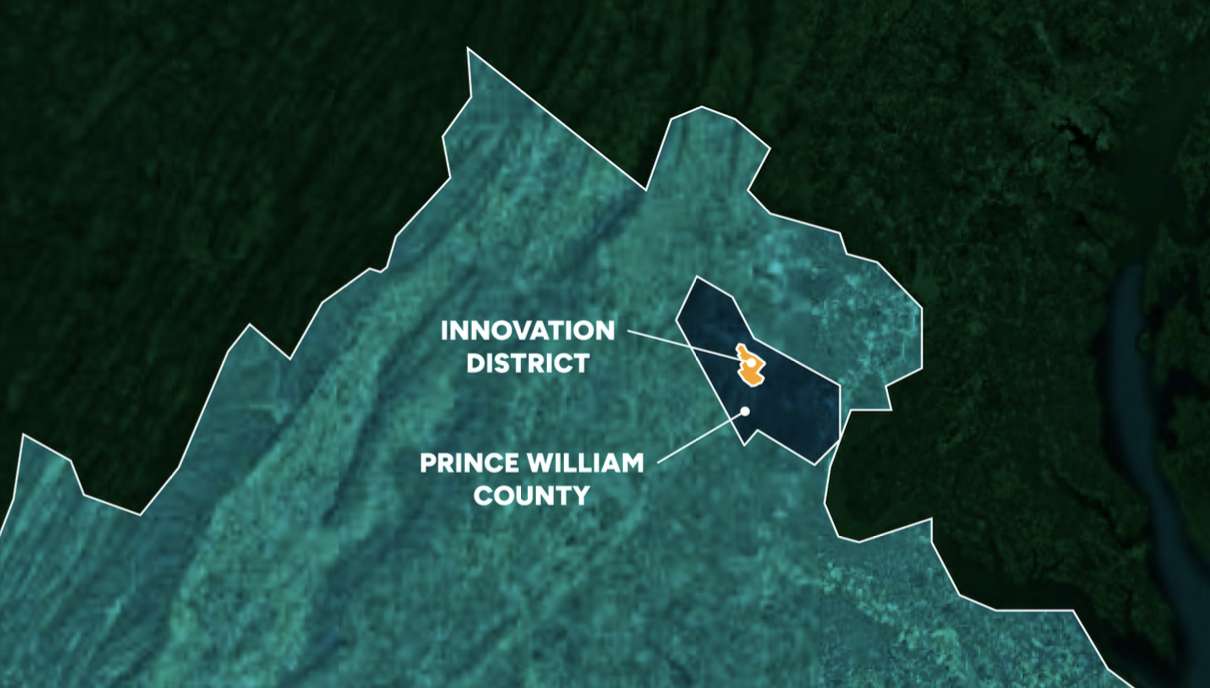
According to a concept plan document from 2024, the goal of the Innovation District — placed around the GMU SciTech Campus — is to connect jurisdictions and industry to create “lasting benefits for the community.”
“Serving as a catalyst, convener, connector, communicator and capacity-builder, the Innovation District will be a destination for ambitious minds to fuel lasting economic growth and well-being in the City of Manassas, Prince William County and beyond,” the document states.
Manassas Vice Mayor Mark Wolfe said this Innovation District is also a recognition that Manassas, Prince William County and GMU are uniquely placed.
“It’s a recognition that we have in the community a lot of tremendous pieces of an economic puzzle,” Wolfe said. “[We’ve] got a critical mass of technology and brain power, and frankly, money, that can come together and create a technology hub that will benefit [everyone].”
And, a new piece of the puzzle, the Innovation District Committee, which brings together elected officials and industry experts from Manassas, Prince William and GMU.
Wolfe said the committee is structured like a public-private partnership, led by Amy Adams, the executive director of GMU’s Institute for BioHealth Innovation.
“The committee [will] help govern the district in terms of the marketing, the funding of the process, the outreach to firms,” Wolfe clarified. “The committee is not in charge of land use. Land use decisions are still made by Prince William County and the City of Manassas, so that hasn’t and will not change.”
Wolfe said the private sector will be a driver in the process of building the Innovation District. According to the concept document, the committee and the District will focus on the life science, biotechnology and forensics; aerospace and defense; cybersecurity and data infrastructure; and semiconductors and electronics sectors.
Wolfe also said while the District will benefit Manassas, it will wholly benefit the entire region.
“The idea is creating opportunities. We compete for jobs. We compete for economic growth with other regions, other cities, but frankly, other countries, and this is just an effort to make us more and more competitive,” he said.
He said, as one of the Manassas appointees to the committee along with Councilors Tom Osina and Theresa Coates Ellis, he’s glad the Innovation District’s concept is coming to life.
“To me, the key components, from a Manassas perspective, of course, is our airport, and all that’s going on at the airport, whether it’s the growth, the commercial flights that are coming, creating more job opportunities out there,” he said.
The vice mayor expressed his excitement for the District and his work on the committee, as it aims to improve the quality of life for residents in the city and county.
“[The District and committee] also gives back to building a quality of life in our community that will attract these businesses and their people,” he said. “… It’s one thing to have a job, but they also want to have a great place to live.”
The District is still waiting on the confirmation of the $2.6 million GO Virginia grant, which will provide kickstart funds. GMU had to raise $1.3 million in matching contributions to receive the funding; as of late March, GMU had raised $1.1 million. GO Virginia is a bipartisan, business-led economic development initiative focused on the Commonwealth and its different regions.
Laura Berry, the marketing and communications director for the Prince William County Department of Economic Development and Tourism, said a decision on grant funding should be coming “any day now.”
The concept documents state the District will need an estimated $1 to $2 million per year to launch and sustain its annual operations for marketing, programs, staffing, administrative costs and asset mapping.
The concept documents have an estimated $75,000 per year over a three-year period for marketing, $500,000 per year for program development and an increasing estimate of salaries: $416,000 for year one, $578,5000 for year two and $871,000 for year three.
Early meetings have already taken place and will continue to throughout the coming months. The first step in the process, according to the concept documents, wa to establish the committee. The next steps are to develop a unified brand and name, launch sector-specific programming and explore short- and long-term funding.
