

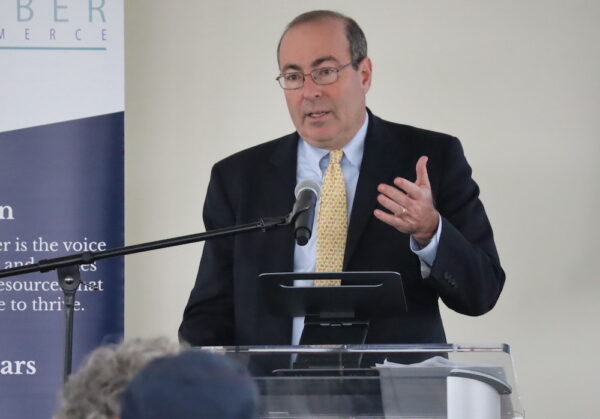
Tom Barkin, president of the Richmond Federal Reserve Bank, spoke about rising inflation, jobs, and consumer confidence today in Woodbridge.
The Fed president said that while the possibility of a recession looms, a recent rise in the number of new jobs created seems to negate those fears.
A total of 315,000 new jobs were created in August, according to the government’s jobs report, just shy of an anticipated 318,000 new jobs. August’s numbers are also lower than the more than 525,000 jobs created in July.
During an invitation-only event at George Mason University’s Potomac Science Center, Barkin asked questions to a group of CEOs who are Prince William Chamber of Commerce members. Many asked about rising inflation, rising interest rates, and the nation’s rising unemployment rate, which has hamstrung multiple companies across the U.S.
This month, the Fed raised interest rates three-quarters of a point to 3.75%, the highest since the great recession of 2008. The country has faced the highest inflation in the past 40 years.
‘If the inflation stabilizes and comes down on its own, there will be very little the Fed has to do,” said Barkin. “If inflation stays, the Fed will have to act.”
A panel of Federal Reserve Governors and Banking Presidents expect to continue interest rate increases into the upper 4% range next year to bring inflation down to a more stable 2%.
If the nation’s economic outlook worsens, that could benefit business owners struggling to find employees. “Maybe more poeple will come off the sidelines,” said Barkin.
Barkin said the waning coronavirus pandemic, fewer immigrant workers, and war in Ukraina are to blame for the nation’s current economic picture. He also pointed to $6 trillion in stimulus money the Federal government injected into to banking system to pay for stimulus checks and government loans to businesses to help them keep the lights on during the forced coronavirus lockdowns.
“Six trillion is a lot of money,” said Barkin.
At least a trillion and a half dollars of stimulus funds have yet to be spent, adding to existing economic pressures.
Barkin also fielded questions about the possibility of the U.S. dropping the dollar for a national digital currency, similar to China. Under that model, money would flow directly into government-maintained accounts instead of private banks.
Barkin remains bullish on the existing U.S. money system. “I already have a digital currency. It’s called the dollar. I pay my bills electronically. I do my banking online. And I keep a few bucks in my wallet,” he said.
Overall, Barkin tried to paint a rosy picture, saying economic indicators improved over the past two months when the U.S. saw two consecutive quarters of negative GDP growth — the tried and true definition of a recession until the White House declared it false.
Barkin said consumer sentiment is up, and declining gas prices have helped stabilize the economy, despite rising costs of goods on store shelves.
