

 Facebook, Google, Amazon.
Chances are these are names you know well. But what you may not know is that companies like these own large data centers across the U.S., including Northern Virginia.
Data centers, used for storage, backups and communications, use a lot of power for both powering their equipment and for keeping their facilities cool.
But a report titled ‘Risky Business’ completed by the Paulson Institute, asserts that climate change and rising temperatures – over time – will negatively impact these data centers and the electrical infrastructure.
There are about 25 data centers in Prince William, according to Prince William Economic Development Executive Director Jeff Kaczmarek.
Stafford has several data centers, but they won’t disclose the total because of confidentiality reasons.
For Kaczmarek, the data centers, which invest $3.7 billion into Prince William, will be able to combat rising temperatures.
“Data center companies are looking both at conventional as well as alternative energy systems…it’s a problem that can be solved. I don’t think it would cause [companies] to pull back in wanting to build data centers…the power and cooling problems will have to be solved, and they will be – it’s just a matter of how they’ll do it,” said Kaczmarek.
Manassas doesn’t have a data center, but their Economic Development Director Patrick Small asserted that during the coming years, data centers would be able to drastically change their technology in order to combat any possibility of increased temperatures.
“There are huge power consumers that are all over this state…I would think that the temperature would have to rise so significantly that it would be as uncomfortable for us to walk outside, as it would be for the data center to exist. The equipment in these [data centers] goes obsolete every two to three years, the useful life of the building is 30 years…over the next 100 years, technology’s going to change an awful lot,” said Small.
According Dominion Power spokesman Dan Genest, Dominion accounts for increased power usage and infrastructure strain in their planning, and would be able to replace equipment without a major issue for customers.
“As we move several decades out, ‘current’ equipment would either be replaced or augmented with more new power stations, transmission lines and distribution systems,” said Genest.
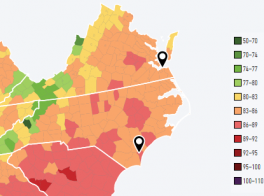
According to the report, during the last 30-years, on average in the Southeastern U.S., there have been nine days over 95 degrees per year.
By about 2050 there will be on average 17 to 53 days over 95 degrees each year, and 47 to 115 days over 95 degrees by the end of the century.
