
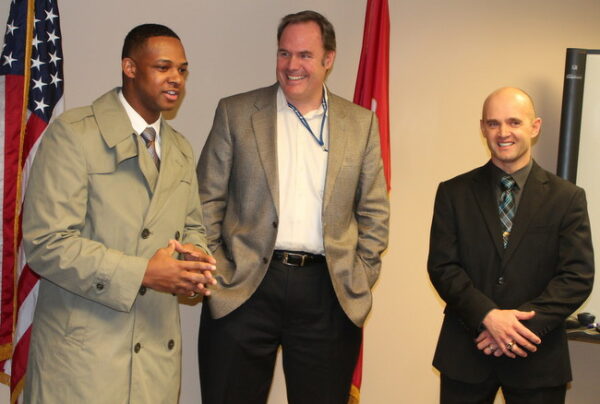
Military patients work in groups over 18 months learning IT skills
He watched the World Trade Center towers fall when he was 22 years old from his home country of Slovakia.
Miroslav Kazimir then vowed he would move to the U.S. and join the military in response to the terror attack.
“I was home watching TV when this happened, and a lot of my buddies were firefighters, too, and I felt a lot of anger and pain when this happened, so that’s why I wanted to join.
Kazimir, now 36, waited six years before he could obtain a green card to come to the U.S. Afterward, he joined the Marines, became a machine gunner, and served tours in Iraq and Afghanistan.
It was the latter tour in 2011 where he lost both his legs.
“We just ran over the IED. I never saw it, and we got blown up,” he said.
He was ejected from the turret attached to the vehicle he and his fellow Marines were riding. Two Marines in his unit died.
Kazimir was missing tibia bones, suffered shattered leg bones, and had bruising of the brain.
He’s called Walter Reed Army Medical Center in Maryland home for the past four years undergoing more than 60 surgeries to repair his wounds. He now walks on prosthetic legs, and he and his wife are the proud parents of a 15-month-old baby.
Kazimir misses shooting machine guns and his life in the Corps. But life for him is different now, and as he transitions from Marine to civilian, new opportunities are opening for him in the IT field.
He and about 25 others attend the Wounded Warrior Cyber Academy at Walter Reed. Here, patients on the mend learn new, marketable computer skills like networking and internet security.
Students attend classes taught at the medical center during the evening hours. Other wounded warriors in places like Alaska and Montana attend academy classes virtually through the web conferencing program called Adobe Connect.
The classes work to build morale and give purpose to many wounded warriors taking their next steps in life.
Marine Christopher Robinson, of Greenville, Alabama, has learned the ins of outs of computers and is working to become an internet security expert. He was stationed in Japan before coming to Walter Reed where doctors were able to regulate his leukemia.
“I started by helping friends fix their computers, and just being able to have the insight to do that is great,” said Robinson. “The security aspect of it, though, the more I learn, the more I cringe. You don’t realize what information you leave out there for anyone to get.”
The academy works in what they call “cyber teams.” Two groups of about 10 to 12 people who are working and learning together for 18 months.
All students in the program receive a certificate. Those who complete the entire 18 months of training get several certificates, and many are employed with large firms like Booze Allen Hamilton.
Raytheon in Stafford County took interest in the program this week and donated $7,500 to the Wounded Warrior Cyber Combat Academy. At a cost of $10,000 per student, the funding is vital to the program’s success.
“Finding the candidates is not the issue. The issue is finding the resources,” said cyber academy director Jim Wiggins.
As the need for more IT security grows greater, officials at Raytheon said this is a program they are proud to support. Many officials in the company’s regional headquarters in Rosslyn are now keeping a close watch on the program, and are interested in the talent it produces for future job openings.
Kazimir is employable now and is about to complete the program. Robinson will be ready for employment by summer, said Wiggins.
Both men say they’ll be ready to leave the hospital for a new start in a career they love.