
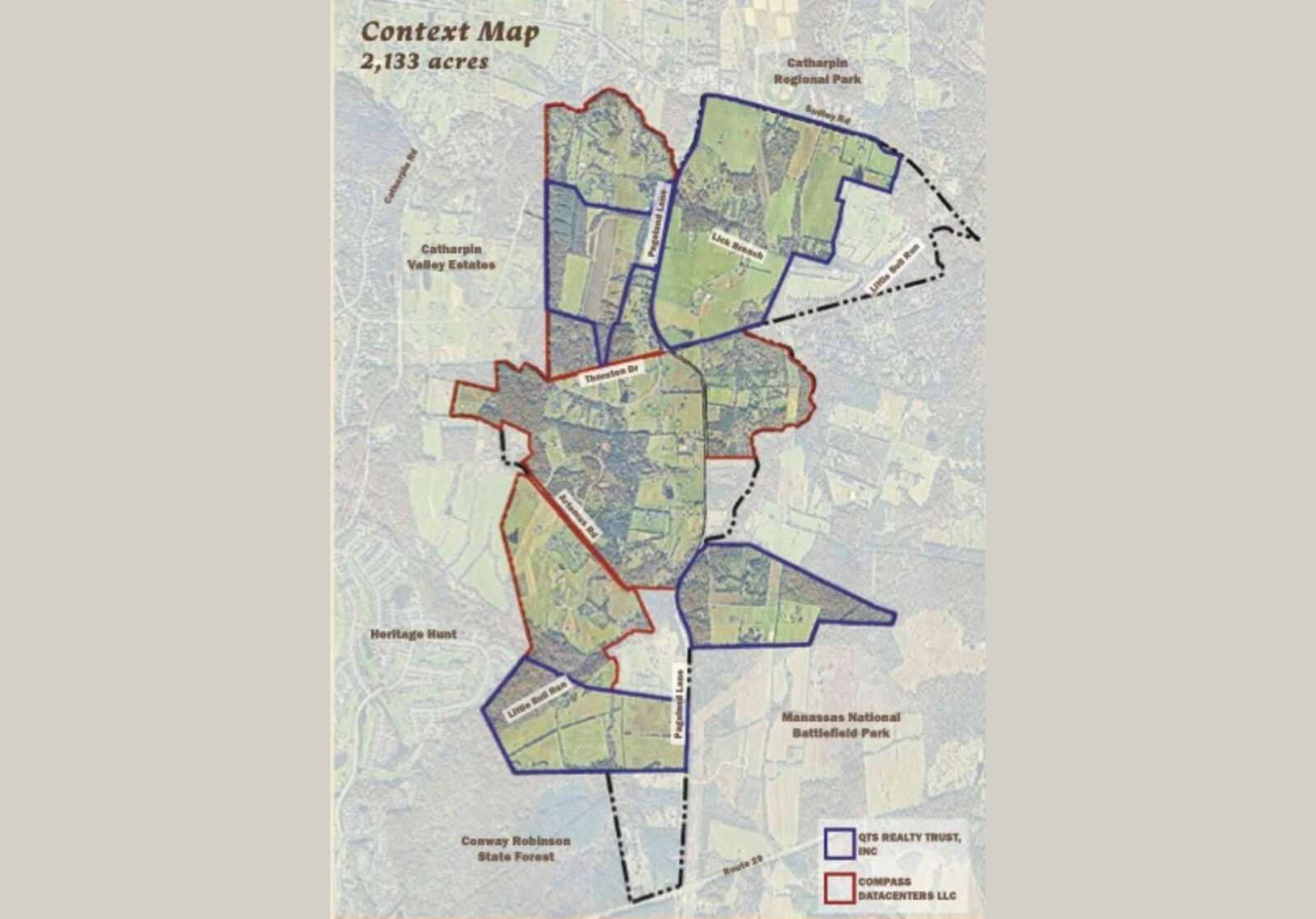
The Virginia Court of Appeals has declared three large-scale data-center rezoning ordinances in rural Prince William County void from the outset, delivering a significant setback to the Digital Gateway project and a victory for nearby homeowners who challenged the approvals.
In a unanimous opinion released today by Judge Stuart A. Raphael, the court affirmed that the Board of County Supervisors’ advertising for the December 12–13, 2023, public hearing violated both state law and the county’s own zoning ordinance. The ruling invalidates the Compass, Digital Gateway North (DG North), and Digital Gateway South (DG South) rezonings approved by a 4-3 vote after a 27-hour marathon hearing.
The three projects, which would have rezoned roughly 1,760 acres of former agricultural land in the Digital Gateway area near Oak Valley, Gainesville, Bristow, and Haymarket, were slated to allow up to 37 data centers operating 24/7. Compass alone spans 884 acres and 11.5 million square feet of gross floor area with height caps of 85 feet in most bays; DG North covers 534 acres and 7 million square feet (83-foot caps); DG South covers 342 acres and 3.7 million square feet (60-foot caps).
As Potomac Local has reported extensively since the 2022 Digital Gateway Comprehensive Plan Amendment, residents have repeatedly raised concerns about noise, traffic, viewshed impacts, well-water quality, and property values in the Rural Crescent. The court’s opinion cites trial testimony from Oak Valley plaintiffs detailing exactly those harms: construction noise lasting “years and years,” 24/7 HVAC and generator operations, wildlife disruption, and the inability of local roads to handle “rolling trucks.”
One plaintiff, living 130 feet from the Compass site, described the current “peace and tranquility” of the property where his wife homeschools their six children; another, with 25 beehives, worried about vibrations and light pollution; a polo-horse owner feared that noise sensitivity would disturb his animals. The opinion notes that the proffered noise limits (60 decibels during the day and 55 decibels at night at residential boundaries) do not apply during construction or emergency generator use.
The court upheld standing for at least eight Oak Valley plaintiffs, finding their proximity (as close as 130 feet and within 500 feet per the developers’ own adjacent-owners list) and particularized harms sufficient under Virginia precedent. It rejected the trial court’s approach of treating the three rezonings as a single “Digital Gateway area,” but still found the evidence supported standing for each individual project.
On the core issue of notice, the appeals court agreed with Circuit Judge Kimberly A. Irving’s findings after a five-day bench trial in June 2025: the Board’s planned first advertisement for Nov. 28, 2023, never ran because the clerk failed to confirm the order with The Washington Post (despite emails requiring confirmation by 3 p.m. the next day). Substitute ads ran Dec. 2, 5, and 9, but proposed ordinances and proffers were not available for public review until Dec. 7 — after the first two ads had already appeared — violating the “where-to-review” requirement. Timing violations were also found under both the statute and the county ordinance.
The court explicitly held that the statutory safe-harbor provision for newspaper errors does not apply when the locality itself is at fault, and that “actual notice” or participation in the hearing under Code excuses only failures to give written notice to adjacent landowners — not defects in the required public newspaper advertising under subsection (A).
In a related case (Burke v. Board of County Supervisors), the appeals court reversed Judge Tracy C. Hudson’s ruling on a demurrer and entered a final judgment for the landowners, mooting further proceedings.
The opinion continues a partial stay that bars any land-disturbing activities or actual construction on the sites pending possible further appeal to the Supreme Court of Virginia.
Board staff had recommended denial of all three rezonings in part because specific data-center footprints had not been submitted for review, and last-minute revised proffers could not be thoroughly vetted. The late Supervisor Robert Weir moved to postpone the hearing for proper notice (failed 5-3) and later to deny the applications (failed 4-4). Supervisor Victor Angry’s approval motion passed 4-3 with one abstention.
The decision underscores that Prince William County — like any locality — must strictly follow statutory and self-imposed advertising rules before enacting zoning changes that dramatically alter rural neighborhoods.