

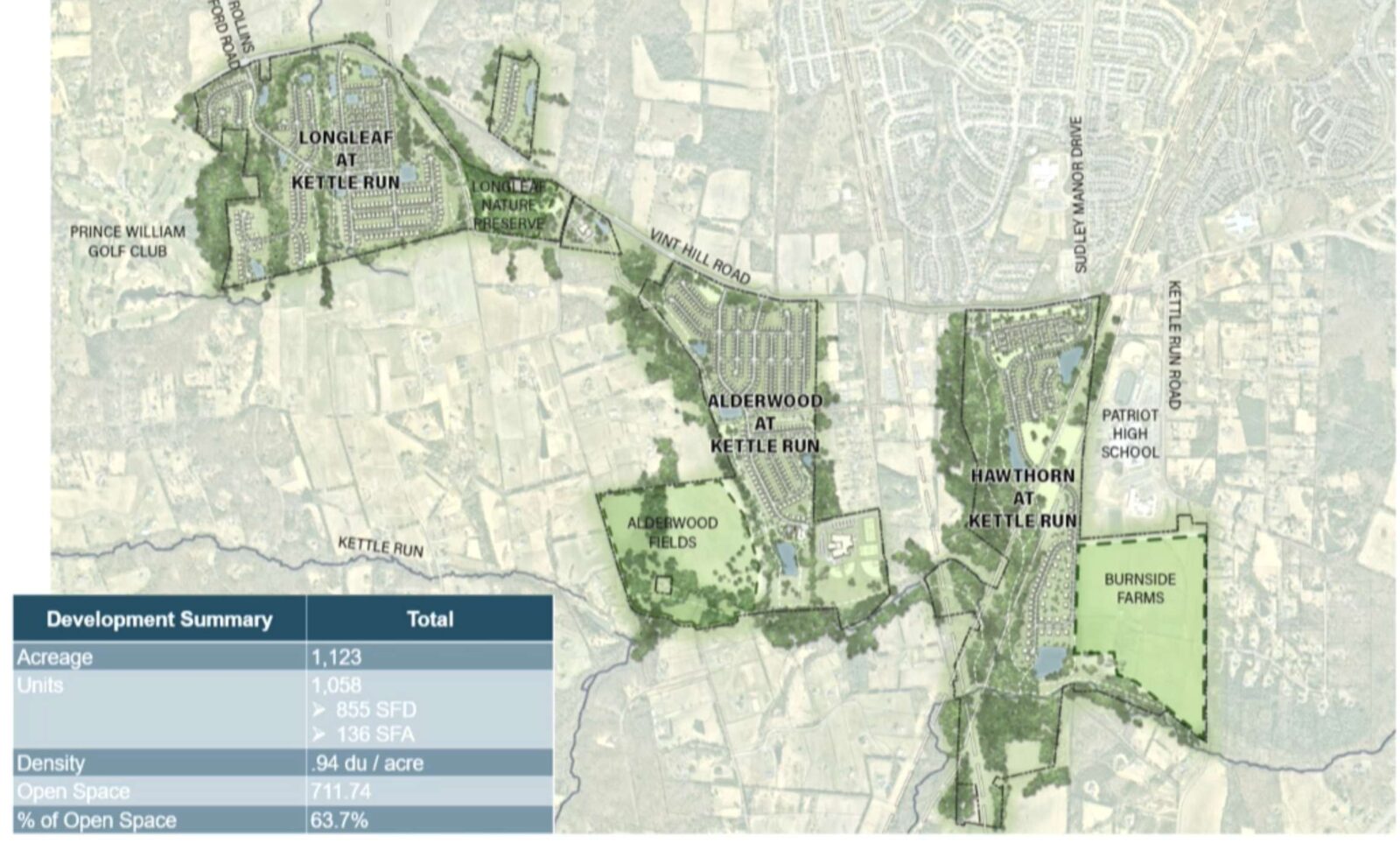
The project, which is slated to have 1,058 units along more than 1,100 acres, has caused significant resident pushback. The developments are in the rural areas of western Prince William County, near the Prince William Gold Club, the Alderwood Fields, Patriot High School and Burnside Farms.
According to the staff reports, there would be a total of 855 single-family detached homes and 136 townhouses across the three properties. The developer planned to have 712 acres dedicated to open space with 10 miles of trails nestled within the development. There would also be transportation improvements along Vint Hill Road to accommodate the large development.
The project was approved in a 6-1 vote at the Planning Commission in October, where the project also faced resident pushback. Many told the Commission that the area needed to maintain its rural character.
“It’s going to take us one step further to being East Prince William County, and that’s really a place a lot of us don’t want to be, and that’s why we live where we live,” Paul Dressler told the Commission this fall. “We are pretty happy with the area just the way it is, and we don’t see a need for change, and we don’t see any advantage to Prince William County to change it. I mean, there’s nothing to gain by overdeveloping the area and basically changing people’s lives the way we’ve lived.”
Dozens more residents showed up at the Board’s Dec. 10 meeting to echo Dressler and highlight other issues that may arise from this development, including congestion and public school overcrowding.
One of the developments, Alderwood, includes a space for the county to build a new elementary school should Prince William County Public Schools (PWCS) need it.
But, enrollment data from PWCS shows that its student population is declining at the kindergarten level. One staffer at the Dec. 10 meeting said this is likely due to the fact that mortgage rates in the county are low, resulting in fewer home sales and younger families.
“[PWCS said] that Nokesville [K-8] School does exceed 100% of the capacity. … Proximate schools are anticipated to address the overcrowding at the elementary and middle school levels,” Assistant Planning Director Alex Vanegas told the Board. “… If all are approved, cumulatively, they’ll have an impact that could exceed available capacity in all the schools. Therefore, space constraints at surrounding schools are being monitored by the school for available space to accommodate the anticipated students if multiple rezonings are approved in the next four years.”
The Board pointed out that PWCS may not need another school site, and asked if the allotted public space could be repurposed.
“The applicant is willing to add a proffer that says, in the event Prince William County Public Schools decides they no longer want the site, it can be used for another public use as the county deems necessary or appropriate,” Jonelle M. Cameron of Walsh Colucci Lubeley & Walsh, an attorney representing the applicant, said.
Gainesville District Supervisor George Stewart said in light of the resident response, he could not support this development.
“In America, we’re supposed to represent the people who elected us. I got that in the third grade,” he said. “I’ve been inundated with text messages, phone calls, smoke signals [and] carrier pigeons to not back this, and I’m not going to because that’s what the community wants.”
Brentsville District Supervisor Tom Gordy, whose district this development is in, said he’s worked tirelessly for two years with the developer to craft an acceptable project for the community.
“Right now, upward mobility has come to a screeching halt, and people are stuck in townhomes. They’ve outgrown those townhomes, but they can’t afford to go anywhere, even if there was a house available,” Gordy noted. “We need to add supply to the market, but it’s not just about one type of product. It’s about different types of supply that allow us to create those different price levels so that people can continue to grow with their family and meet their family’s needs.”
“I know it’s frustrating for a lot of folks,” Gordy continued, “but we have been listening. We’ve taken your concerns. We’ve applied those. We’ve addressed those concerns through these properties the bestway we can. … But we’ve done what we can do to the best of our ability.”
Coles District Supervisor Yesli Vega said she recognized the need for housing opportunities in Prince William County.
“I absolutely understand the need for housing in our community. I’m also a firm believer in protecting property rights. Also, in good conscience, I cannot support these applications for a primary reason …: the request to convert nearly 462 acres of agricultural land into a dense residential project is simply, in my opinion, asking for too much of our community, our environment and our public infrastructure,” she said.
Vega said the Board continues to approve projects before critical infrastructure needs are addressed to better the community.
“If it were not for these developments, there would not be a need for the traffic improvements that have been proposed,” she said. “… This is not a project for the public good. It is a request for the county to condemn private property for the express benefit of a private developer at their expense. This is a perversion of public power, and sets a dangerous precedent that undermines the very property rights that we are here to uphold.”
Occoquan District Supervisor Kenny Boddye noted that the county can serve to benefit from a reserved public space site.
“We’ve seen other opportunities like this in the past where, because folks were so concerned about the immediate impact, they forgone school sites and public facility sites to only have the county then buy them later,” he said. “We had an opportunity to have them at the outset at the developer’s dime and not ours. We’re avoiding that this time.”
“Is there a need for housing? Yes. Do we have an issue with affordability? Yes,” Vega said before her vote. “But at the end of the day, we cannot pave every single inch of open green space in this county without thinking of the dire consequences that will inevitably follow.”
The Board voted 6-2 to approve the project, with Stewart and Vega voting in opposition.
