

By URIAH KISER
NORTH STAFFORD, Va. — In the event of a school shooting, it can be survival of the fittest.
That’s why officials in Stafford County worked to exercise the minds of teachers and school administrators, to prepare them for the possibility of an armed intruder who could potentially kill them and their students.
A special seminar was held Thursday night at North Stafford High School for teachers from across the county. A partnership between the schools and sheriff’s department, it was billed as the first of its kind in the state following the school shooting that killed 27 people at Sandy Hook Elementary School in Connecticut.
A retired Stafford sheriff’s deputy, 1st Sgt Frank Martello, told teachers who don’t normally confront violent situations that they need to be prepared to run, hide or fight in the event of an active shooter situation at their schools. In many cases, attackers are thwarted before police arrive, so its important teachers have a plan and know what to do.
“If we have police on the scene in two minutes and you have an active shooter, that could be one minute and 58 seconds too late,” said Martello. “We will get there and we will find you. But the idea is to find you while you are still alive… inaction is not an option.”
Teachers were urged to go back to their classrooms following the training and take inventory of anything that could be used as a weapon and locate anything that would provide cover to hide behind in the event on an armed intruder. A chair is one of the weapon teachers were suggested to use, but it’s not the only one.
“…look around… almost anything, with a little practice, can be used as a weapon,” said Martello.
Profile of a possible school shooter
This countywide training is the first of many new security initiatives planned for the schools, said Sheriff Charles E. Jett. It wasn’t held in response to a specific threat but due to concerns about improved security in the county’s schools. Such improvements might include placing large numbers over every school entrance to make it easier for public safety crews to respond to shooting victims and giving police access to hallway security cameras at schools.
“There are a lot of things you don’t know about, and then there are a lot of things you know about that we don’t,” said Jett, urging cooperation and better communication between teachers and law enforcement.
School shootings are nothing new, with the first in the U.S. dating back to 1927 when 38 children were shot and killed, said Martello. Since then, in mass shootings like Columbine High School in 1999, Virginia Tech in 2007 and Sandy Hook in December, the shooters all had things in common, said Martello:
-Male
-Psychopathic
-Delusional
-Usually bullied in past
-Did not threaten victims
-Showed prior behavior / told others about idea to attack
-Did not intend to survive shooting incident
Teachers who attended the training said they’ve been teaching behind locked doors since Sandy Hook. They also wanted to know when it’s OK to act if a child seems suspicious.
“I already have children that fit into that profile,” said Laurie Gildstead, a second-grade teacher. “We need more awareness in the schools because, as teachers, we have to teach more than just the basic subjects, we have to teach basic manners to children who have parents who want to be their ‘friend’ and not their parent.”
Martello said the burden falls on the teacher, or those who spend the most time around the child, to report suspicious behavior.
What to report in during a shooting
If the worse happens, it’ll also be up to the people inside to report accurate and helpful information to law enforcement who will be charged with immediately entering the building and disarming the shooter. Police will want to know things like:
Are there any hostages?
Is there a barricade?
Have you heard any explosions others than gunfire?
Where is the shooter inside of the building?
When was the last time you saw the shooter?
What kind of weapon did the shooter have?
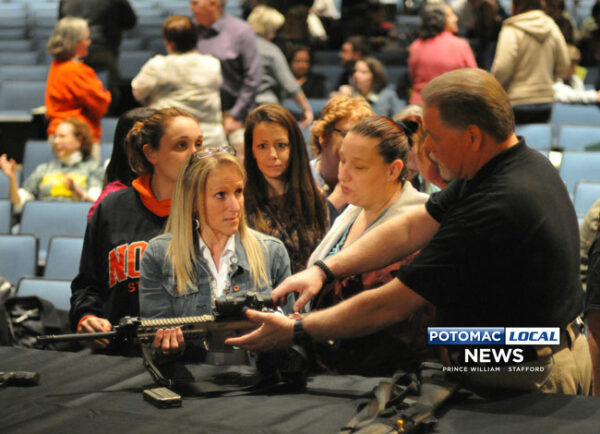
That last question about the type of weapon prompted Martello to show a variety of weapons – such as shotguns, rifles and handguns – so teachers would have a better understanding of what firearms look like and how to better described them to 911 call takers.
[imagebrowser id=70 template=”custom”]
