
How Dense Cluster Development Threatens Water Resources and Quality of Life in Prince William County
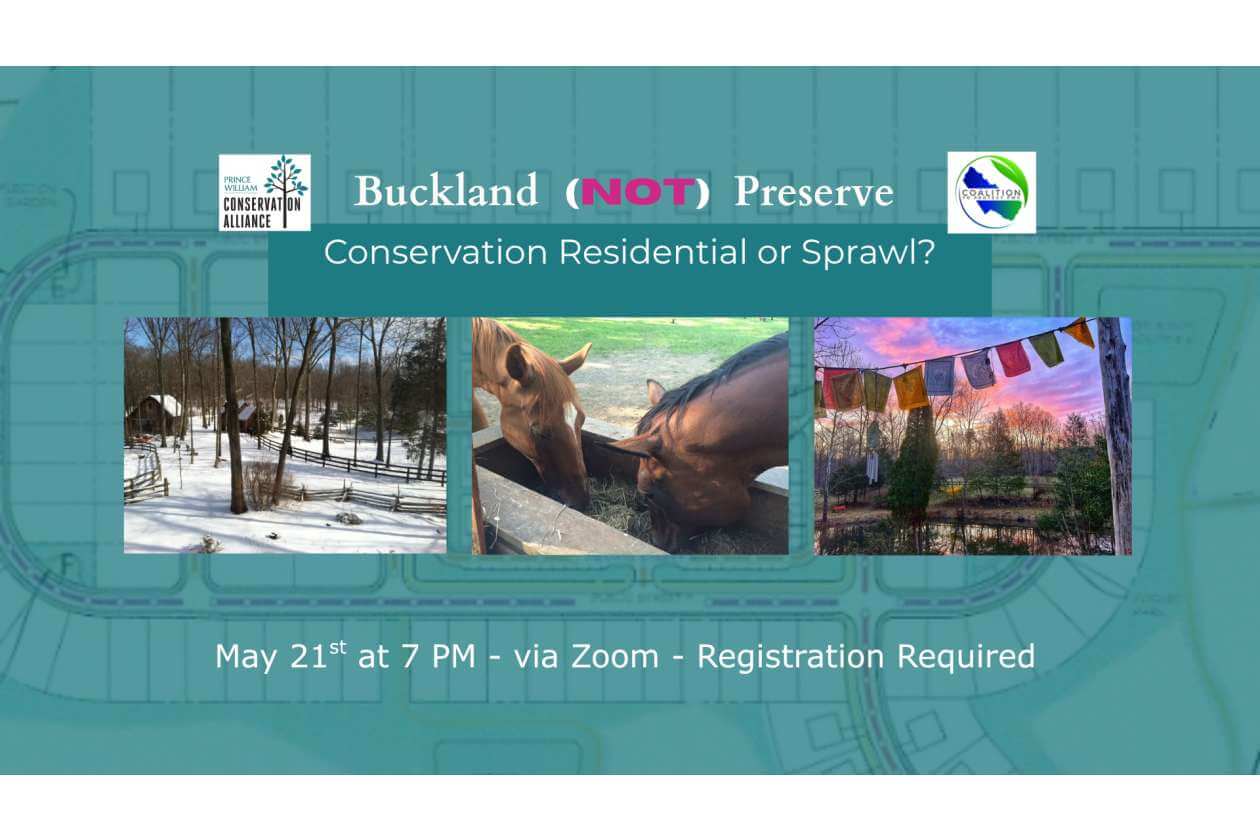
May 21st | 7pm – Free via Zoom – Registration Required
For decades, Prince William County’s rural landscape has helped protect the Occoquan Reservoir and groundwater, which provides drinking water for the region. Forests, farms, wetlands, and stream corridors throughout the watershed reduce flooding, recharge groundwater, and help filter pollution before it reaches the reservoir.
At the same time, Prince William County continues to face pressure for new housing and data centers. Thoughtful, well-planned dense cluster development can be an important part of smart growth strategies, but only when directed toward appropriate locations with existing infrastructure, services, and transportation networks.
Location matters.
When suburban-density cluster development is pushed into rural areas and sensitive watershed lands, projects may adopt the language of “smart growth” or leverage planning designations like conservation residential while undermining the very principles those approaches are intended to protect. Smart growth is not simply about density or cluster development design on a single parcel, it is about directing growth to the right places while preserving critical natural resources, drinking water supplies, farmland, and rural landscapes.
PWCA’s 3Rs framework – Reimagine, Reinvest, Redevelop- provides a roadmap for accommodating growth while protecting the county’s most environmentally sensitive areas. As former Prince William County Planning Director Tom Eitler noted during PWCA’s Building Better Burbs program, directing growth into appropriate areas “is harder to do, but it’s the right thing to do.”
Join the Prince William Conservation Alliance (PWCA) for a virtual community conversation examining how developments like the proposed Buckland (Not) Preserve project, if approved, would undermine long-term strategies for sustainable drinking water Prince William County.
Together, we’ll explore the connection between land use and healthy streams, using Little Bull Run as a local case study and discuss how the concerning changes at Little Bull Run could inform development moving forward for the stream health, groundwater, stormwater management, transportation infrastructure, and the long-term resilience of the Occoquan drinking water supply.
Program
-
Michael Kieffer, Bull Run Mountains Conservancy, will walk us through their monitoring of Little Bull Run and why they were concerned
-
Elizabeth Ward, GreenRisks, will help us to understand the significance and why continuing to build out rural lands undermines long-term strategies to protect these water resources
-
Karen Beswick, Preserve Buckland, will guide us through what’s being proposed and how others can get involved.