
Coles District Supervisor Yesli Vega is putting Prince William County taxpayers on notice: even if the Board of County Supervisors keeps the real estate tax rate flat, most homeowners will still see their bills rise this year because of higher property assessments.
In an email sent Monday morning to constituents — and forwarded to local media — Vega released detailed ZIP-code-level data showing average assessment increases for existing residential properties ranging from less than 1% to more than 5%. She highlighted the neighborhoods facing the steepest jumps and urged the board to consider lowering the tax rate rather than relying on the automatic revenue boost from rising home values.
“Even if the Board of County Supervisors keep the tax rate flat, the increased assessed value of your home means that your bill will still be bigger,” Vega wrote. “I’ve advocated for lowering our real estate tax rate every year. With more homes and data centers constantly being built, our revenue continues to increase. So, we don’t need to keep taking more money from people.”
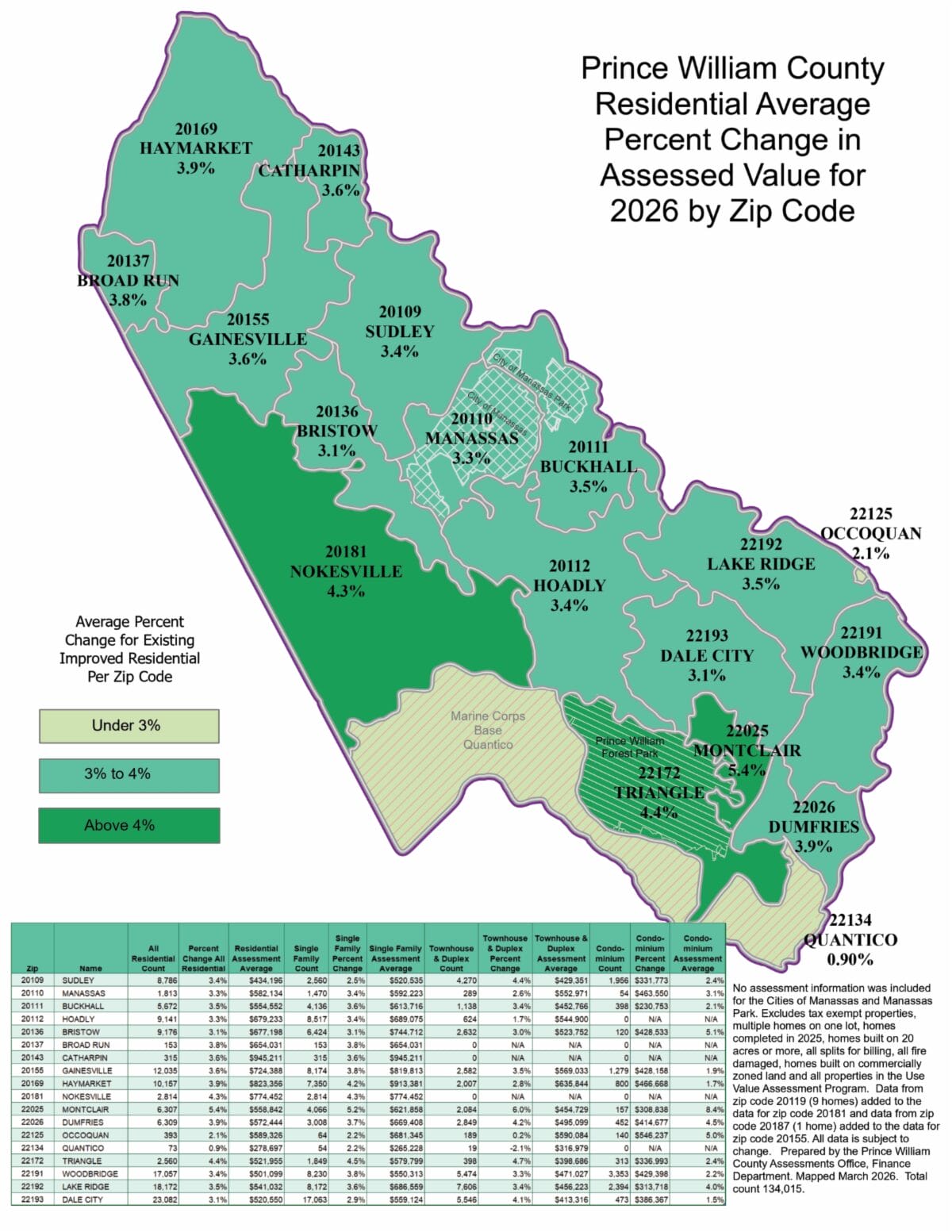
The data, prepared by the county’s Assessments Office and mapped in March 2026, shows the following average percent changes in assessed value for all residential properties by ZIP code (excluding the independent cities of Manassas and Manassas Park):
- Montclair (22025): 5.4% — the highest in the county
- Triangle (22172): 4.4%
- Nokesville (20181): 4.3%
- Haymarket (20169): 3.9%
- Dumfries (22026): 3.9%
- Broad Run (20137): 3.8%
- Catharpin (20143) and Gainesville (20155): 3.6% each
- Countywide average: approximately 3.5%
Lower-impact areas include Quantico (0.9%), Occoquan (2.1%), and several ZIP codes clustered around 3.1% to 3.4% such as Bristow, Dale City, and Woodbridge.
Vega’s notice comes just 13 days after the first public hearing on the proposed Fiscal Year 2027 budget. On March 17, residents packed Board Chambers to demand tax relief, citing the county’s surging data-center revenue and eight-year surpluses exceeding $333 million. The proposed $2.22 billion general fund budget, introduced by County Executive Christopher Shorter on Feb. 17, keeps the real estate tax rate unchanged at $0.906 per $100 of assessed value.
County staff project that the average 3.5% assessment increase would raise the typical residential real estate tax bill by about $181 per year — roughly $15 per month — pushing the average bill to approximately $5,351 before other levies and fees. When combined with proposed increases in stormwater, solid waste, and other fees, the overall average household impact is projected at $203, or about 3.6%.
Data centers remain a central point of contention. The proposed budget forecasts $549.7 million in data-center and related equipment tax revenue for FY2027 — roughly 28% of all general fund tax revenue and a sharp increase from the $166 million collected in FY2024.
At the March 17 hearing, Coles District residents George and Barbara Dodge reminded supervisors of long-standing promises that data-center growth would deliver tax relief. “The board has talked for years about the advantages of bringing in the construction of data centers, with one of those benefits being the ability to freeze, reduce, or offset county real estate taxes… But that has never happened,” George Dodge told the board.
Vega’s email also included results from a constituent survey her office conducted. Respondents overwhelmingly rejected higher taxes:
- With $550 million in data-center revenue, should your taxes go up? Yes: 0.05% | No: 99.5%
- Should we keep the meals tax? Yes: 7.5% | No: 92.5%
- Should Prince William County Schools automatically receive more than half the county budget? Yes: 7.5% | No: 92.5%
- 2026 Tax Increases overall: Yes: 16.1% | No: 83.9%
Vega thanked the hundreds of residents who participated, saying their input “gives me a clearer picture of what Prince William County families expect (and deserve) from their county budget.”
The full assessment data, including breakdowns by single-family homes, townhouses, and condos, plus a color-coded map (green = under 3%, yellow = 3–4%, red = above 4%), is available on Vega’s website and was attached to the email. Notes indicate the figures exclude new construction, tax-exempt properties, and certain other categories, and all numbers remain subject to change.
The Board of County Supervisors is scheduled to hold additional budget hearings in the coming weeks, including an April 7 session focused on schools. Final adoption of the FY2027 budget is targeted for April 21.