

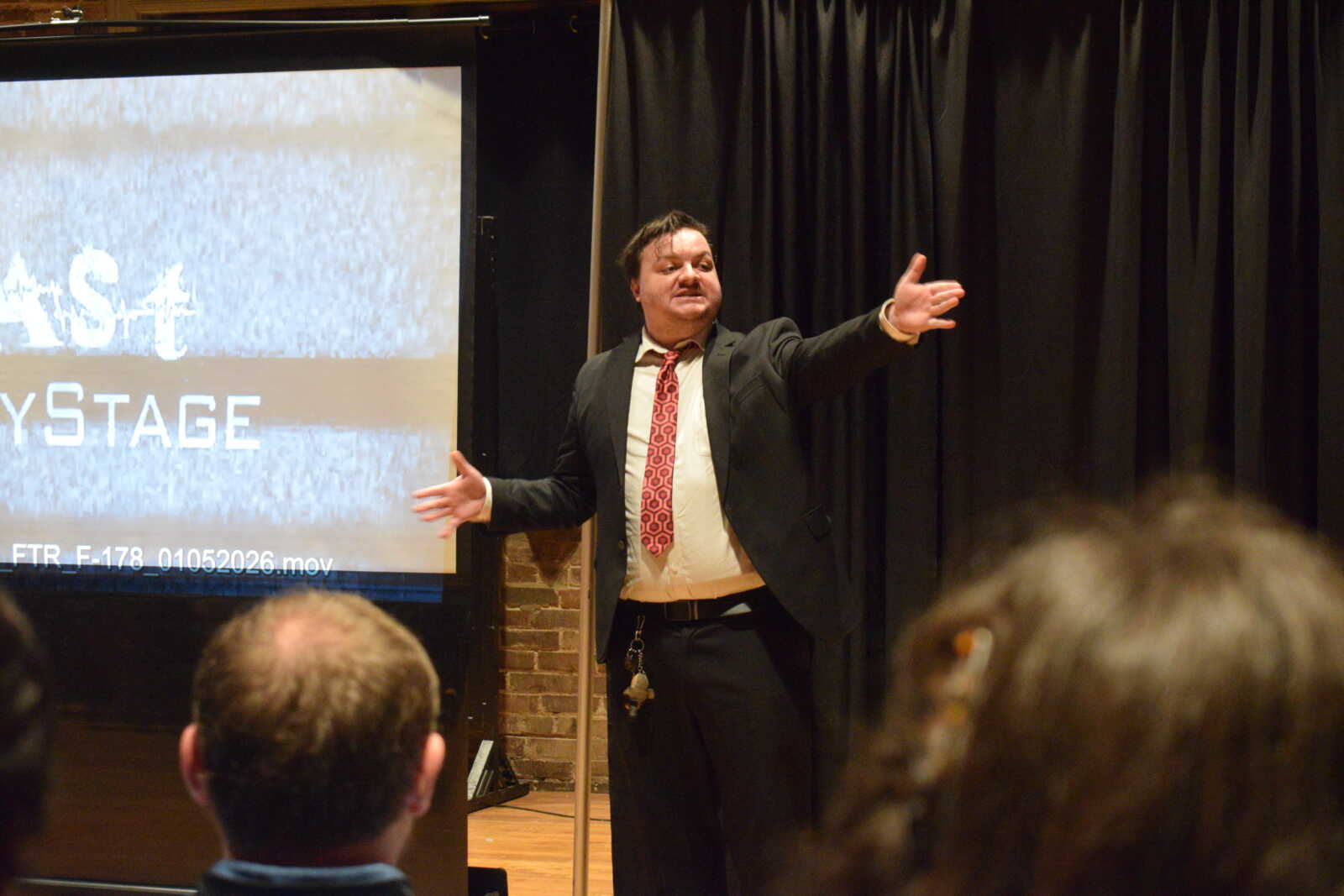
A decade-long independent filmmaking project premiered Jan. 10 at the Virginia ARTfactory in Manassas, where filmmaker Zack Walsh unveiled his first feature-length film, Prosperity Creek, to the public.
The free, ticketed screening marked the first time the completed film had been shown publicly. Seating was limited, with donations accepted, and the film was recommended for audiences ages 13 and older.
Prosperity Creek is a social satire with science fiction elements, set in an affluent Washington, D.C., area suburb. The story follows a young woman hired to house-sit over the summer, only to uncover increasingly strange and absurd secrets about the neighborhood’s residents.
Before the screening, Walsh addressed the audience and invited viewers to react freely during the film. The screening began shortly after 7 p.m. and concluded between 8:40 and 9 p.m., followed by a brief intermission and a question-and-answer session.
The post-screening discussion featured Walsh alongside three collaborators who contributed to the project. During the approximately 30-minute Q&A, the filmmakers discussed the long development process, creative challenges, and the collaborative nature of the production.
Walsh said the idea for Prosperity Creek originated after he watched a news segment about public belief in conspiracy theories.
“I was watching Rachel Maddow’s show at the time, and she covered a statistic from Public Policy Polling that suggested that a surprisingly large percentage of Americans were open to believing in one particularly outrageous conspiracy theory,” Walsh said. “I had never heard this specific belief before and found its implications absolutely hilarious, so I began devising a story around it, and thus the idea was born.”
While the film leans heavily into satire, Walsh said it also explores themes of exclusion and belonging.
“This movie is definitely a tribute to the ‘other’ in society,” he said, describing the two lead characters as outsiders in a community resistant to change. “If the audience manages to take anything away, I would hope it would be to embrace the outsider, and make space for viewpoints outside your bubble.”
Furthermore, Walsh explains that he first expanded on this theme, drawing on his childhood.
“This movie was definitely inspired, at least initially, by my own experiences going to public school in an affluent DC suburb, much like the setting of the film,” Walsh said. “There was this weird exclusivity to everything, this weird proximity to power where every other person’s stepdad was a lobbyist or government contractor, and the wealth gap was crazy.”
Aside from the socio-economic differences, Walsh also shows us how his experience being on the Autism spectrum allowed him to feel very divided. “I was alienated from my wealthy, powerful classmates, and alienated in my state-sanctioned standardized studies,” said Walsh. He further explains how this inspired the deeper themes included in Prosperity Creek: “I wanted to create something that highlighted and satirized those feelings of alienation, you wouldn’t necessarily think it based on how silly so much of the film is, but Prosperity Creek is hands down the most personal thing I’ve ever written.”
Walsh said the film’s development began in the mid-2010s and gained momentum in 2017, when he was selected by filmmaker Robert Rodriguez for the El Rey Network as a potential participant in a reality television project. Although Walsh was not ultimately chosen for the series, he said the experience helped him refine the screenplay and commit to producing the film independently with friends.
Principal photography began in 2018, but production was interrupted by multiple setbacks, including the loss of an actor originally cast as the film’s antagonist, personal health challenges, and delays caused by the COVID-19 pandemic. Walsh said a rough cut of the unfinished film was submitted to online festivals during the pandemic and received several awards, which encouraged the team to complete the project.
Final scenes were filmed in late 2021 and early 2022, with the antagonist reimagined as a computer-generated character performed through motion capture.
Walsh, who was born and raised on the East Coast, said the film’s setting was influenced by his experiences growing up and attending public school in Northern Virginia. He has lived in Reston for approximately 20 years and said most of the film was shot there.
“I have an immense love for Reston,” Walsh said. “We shot the majority of the movie there.”
He said the town’s versatility enabled it to serve as a more traditional suburban setting while remaining rooted in the region.
Walsh does not have formal film school training, but said he gained experience working as an editing intern at Troma Films in New York after graduating high school. He estimated the film was produced on a budget of about $10,000, funded through crowdfunding and personal favors, with most contributors volunteering their time.
Following the screening, attendees lingered to speak with Walsh and the filmmaking team, take photos, and discuss the film. Walsh said he was encouraged by the audience response and credited his collaborators for bringing the project to completion.
“This movie only exists, and is only good, because I am surrounded by remarkably talented friends,” he said.
Walsh said the team is now seeking distribution for Prosperity Creek.
